In echtem Maßstab anzeigen
 Versenden als Grußkarte
 Teilen
 Details anzeigen

 Herunterladen
 Ähnliche Objekte
 Röntgenaufnahme
 Diashow
 Besucherstatistiken
Misty Morning on the Seine


 Mehr anzeigen
Giclée / Kunstdruck
Giclée- oder Leinwanddruck in Museumsqualität mit schneller Produktion und flexiblen Veredelungsoptionen. ( Handgemalte Reproduktion kaufen Zum digitalen Bild wechseln)




P118B $10

P118H $10

P118W $10

P438Z $10

P508JH $12

P508YH $12

P805H $10

P805Z $10

P919BZ $10

P919G $10

P919XJ $10

P959ZH $10

P968JZ $12

W106C $8

W218G $10

W218JH $8

W218Y $10

W307PJ $10

W316G $10

W316PJ $8

W316Y $10

W398PJ $8

W4111J $10

W500HY $15

W500JH $15

W692G $12

W849H $8

W940BG $15

W953PJ $8
Wählen Sie aus unseren vordefinierten Formaten, die den ursprünglichen Proportionen des Kunstwerks entsprechen.

Sie können Ihre eigenen Maße eingeben, um ein bestimmtes Format oder einen speziellen Platz einzupassen. Wenn das von Ihnen gewählte Format nicht den Proportionen des Originalbildes entspricht, werden wir das Kunstwerk entweder beschneiden oder das Bild mit einem gespiegelten oder einfarbigen Rand erweitern. Ein digitaler Entwurf wird Ihnen zur Genehmigung zugesandt, bevor die Produktion beginnt.
Bitte beachten Sie, dass die Vorschau auf dem Bildschirm nicht den tatsächlichen Zuschnitt oder die Erweiterung widerspiegelt. Nur der Entwurf zeigt die endgültige Komposition präzise an.
Obwohl Sondermaße verfügbar sind, empfehlen wir die Auswahl eines Maßes aus der vordefinierten Liste, um die ursprünglichen Proportionen zu bewahren.
Weltweiter Versand () innerhalb von 2 Wochen statt der üblichen 4/5 Wochen. (17 September)

Kostenloser weltweiter Expressversand

Hochwertige Leinenleinwand

Vollständiger Versicherungsschutz beim Versand

Zollgebühren-Rückerstattungsgarantie

Garantie für exakte Farbtreue

100-tägiges Rückgaberecht (nur bei Mängeln)

100% Geld-zurück-Garantie

Angebot für Mengenrabatt
 Die Glasoption ist nur für Größen unter 110 cm verfügbar.

Misty Morning on the Seine
Giclée / Kunstdruck
Format der Reproduktion
-


Gesamtpreis
$ 62
A Dawn of Impressionism: "Misty Morning on the Seine" by Frederick Carl Frieseke
Frederick Carl Frieseke’s “Misty Morning on the Seine,” painted in 1899, isn't merely a depiction of a riverside scene; it’s a shimmering distillation of light and atmosphere, a quintessential example of American Impressionism infused with a distinctly European sensibility. The painting captures a fleeting moment – a soft, pearlescent dawn over the iconic Parisian waterway – rendered with an almost ethereal quality that invites the viewer to step directly into its tranquil embrace. It's a work brimming with nostalgia, a romanticized vision of leisure and beauty that speaks volumes about the artistic currents of the late 19th century.
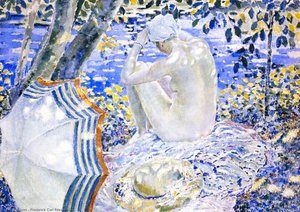
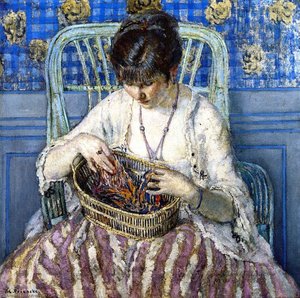
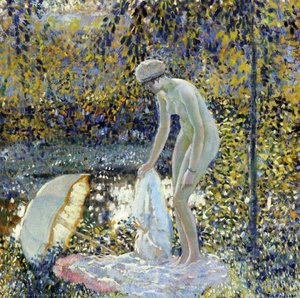
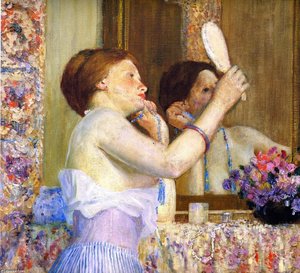
Frieseke, born in Owosso, Michigan, spent much of his life as an expatriate in France, absorbing the techniques and philosophies of the Impressionist movement. His early training at the Art Institute of Chicago exposed him to influences like Whistler, while his time in Paris solidified his commitment to capturing the ephemeral effects of light and color. Unlike many of his contemporaries who focused on grand landscapes or historical subjects, Frieseke specialized in intimate scenes – often featuring women in idyllic settings—a style he termed “decorative impressionism.” This approach prioritized mood and atmosphere over strict realism, resulting in paintings that are both visually stunning and emotionally resonant.
The Dance of Watercolor: Technique and Atmosphere
Executed primarily in watercolor, "Misty Morning on the Seine" exemplifies Frieseke’s masterful control of this delicate medium. The washes of color – soft blues, greys, and hints of lavender – blend seamlessly to create a sense of diffused light and atmospheric perspective. Notice how he uses broken brushstrokes to suggest movement within the mist, creating an illusion of depth and distance. The artist's layering technique is particularly evident in the bridge itself, rendered with subtle gradations of tone that capture its form while maintaining a hazy, dreamlike quality. The inclusion of several figures strolling along the embankment – their forms suggested rather than precisely defined – further enhances this sense of fleeting presence and adds to the painting’s overall feeling of quiet contemplation.
Frieseke's use of color is key to the painting’s evocative power. He avoids sharp contrasts, instead relying on subtle shifts in hue and value to create a harmonious and luminous effect. The reflections shimmering on the water’s surface are particularly noteworthy, demonstrating his ability to capture the way light interacts with different surfaces. The overall impression is one of gentle warmth, despite the cool tones dominating the scene – a testament to Frieseke's intuitive understanding of color theory.
Symbolism and Emotional Resonance
Beyond its technical brilliance, “Misty Morning on the Seine” carries a wealth of symbolic meaning. The misty atmosphere itself can be interpreted as representing uncertainty or the passage of time, while the figures strolling along the embankment evoke themes of leisure, connection, and the beauty of everyday life. The painting’s setting – the Seine River in Paris – is steeped in romantic tradition, symbolizing art, culture, and the allure of the city of lights. The inclusion of a dog adds an element of domesticity and companionship, grounding the scene in a sense of warmth and familiarity.
Ultimately, “Misty Morning on the Seine” is more than just a landscape painting; it’s a meditation on beauty, memory, and the fleeting nature of experience. It invites us to slow down, appreciate the simple pleasures of life, and lose ourselves in the evocative atmosphere of a Parisian dawn. Reproductions of this work capture much of its original charm, offering a window into Frieseke's artistic vision and a reminder of the enduring power of Impressionism.
Ähnliche Kunstwerke
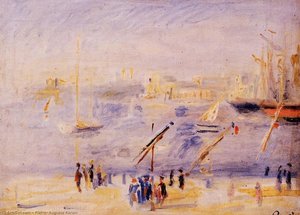
Biografie des Künstlers
Frederick Carl Frieseke: Ein Leben voller künstlerischem Ausdruck
- Geboren: 7. April 1874, Owosso, Vereinigte Staaten von Amerika
- Gestorben: 24. August 1939
Frederick Carl Frieseke war eine bedeutende Figur in der amerikanischen Impressionismus-Bewegung und hinterließ einen bleibenden Eindruck auf die Kunstwelt. Er verbrachte den größten Teil seines Lebens als Expatriate in Frankreich, wo er sein Handwerk perfektionierte und einen einzigartigen Stil entwickelte, der durch geflecktes Sonnenlicht und Darstellungen weiblicher Subjekte gekennzeichnet ist.
Frühes Leben und Ausbildung
Friesekes künstlerische Reise begann früh mit Ermutigung seiner Tante, Valetta Gould Graham. Er erhielt zunächst eine Ausbildung am Art Institute of Chicago unter Frederick Warren Freer und John Vanderpoel. Anschließend setzte er seine Ausbildung an der Académie Julian in Paris fort, beeinflusst von Jean-Joseph Benjamin-Constant und Jean-Paul Laurens. Seine Studien umfassten auch Zeit an der Académie Carmen unter James Abbott McNeill Whistler.
Künstlerischer Stil und Einflüsse
Friesekes Werk ist bekannt für seinen Schwerpunkt auf geflecktem Sonnenlicht und die Darstellung weiblicher Subjekte, sowohl drinnen als auch draußen. Sein Stil, oft als "dekorativer Impressionismus" bezeichnet, verbindet klassische impressionistische Techniken mit einem ausdrucksstärkeren Einsatz von Farbe und Muster.
- Einfluss von Renoir: Friesekes Gemälde zeigen sinnliche, runde Figuren, die an Pierre-Auguste Renoir erinnern.
- Postimpressionistische Elemente: Seine Arbeit beinhaltet intensive, fast willkürliche Farben, die Einflüsse von Paul Gauguin und Pierre Bonnard widerspiegeln.
- Früher Whistler Einfluss: Frühe Werke zeigen einen starken Einfluss von James McNeill Whistlers Wertschätzung für tonale Abstufungen und fließende Linien.
Bemerkenswerte Werke und Karrierehöhepunkte
Friesekes Gemälde befinden sich in renommierten Sammlungen, darunter im Musée d'Orsay in Paris.
- Der Garten von Giverny: Ein Paradebeispiel für seine Mischung aus impressionistischen und postimpressionistischen Stilen.
- Frau in einem Garten: Eine typische Darstellung seines dekorativen Impressionismus.
- Vor dem Spiegel (1904): Von der französischen Regierung gekauft, im Luxembourg Gallery ausgestellt.
- Zerrissene Spitze (1920): Erhielt zwei Goldmedaillen und den Publikumspreis am Chicago Art Institute.
Im Laufe seiner Karriere erhielt Frieseke zahlreiche Auszeichnungen, darunter eine Silbermedaille bei der Weltausstellung in St. Louis im Jahr 1904, die Temple Gold Medal von der Pennsylvania Academy of Fine Arts im Jahr 1913 und den Grand Prix bei der Panama-Pacific International Exposition im Jahr 1915.
Vermächtnis und historische Bedeutung
Frederick Carl Frieseke verstarb am 24. August 1939. Seine Arbeit inspiriert weiterhin Künstler und Kunstliebhaber gleichermaßen und demonstriert die bleibende Kraft der impressionistischen Kunst. Er wird für seine einzigartige Fähigkeit erinnert, Sonnenlicht einzufangen und visuell fesselnde Szenen mit weiblichen Figuren in idyllischen Umgebungen zu schaffen. Sein Beitrag zum amerikanischen Impressionismus festigte seinen Platz als bedeutender Künstler seiner Zeit.
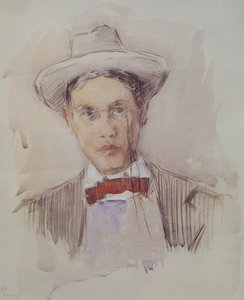
Frederick Carl Frieseke
1874 - 1939 , Vereinigte Staaten von Amerika
Eckdaten zum Künstler
- Beeinflusste Künstler:
- Pierre-Auguste Renoir
- James McNeill Whistler
- Bemerkenswerte Werke:
- Der Garten von Giverny
- Frau in einem Garten
- Vor dem Spiegel
- Geburtsdatum: 7. April 1874
- Geburtsort: Owosso, Vereinigte Staaten
- Künstlerische Richtung: Impressionismus, Dekorationsimpressionismus
- Nationalität: Amerikanisch
- Todatum: 24. August 1939
- Vollständiger Name: Frederick Carl Frieseke
Verwandte Artikel

Ephemeral Visions: Exploring the Artistic Legacy & Contemporary Practice of Watercolor Painting
Explore the captivating world of watercolor painting! Discover its rich history, essential techniques, influential artists & collecting tips. A comprehensive guide for art enthusiasts from ArtsDot.
Ephemeral Visions: Exploring the Artistic Legacy & Nuances of Watercolor Painting
Explore the captivating world of watercolor painting! Discover its rich history, essential techniques, influential artists & collecting tips from art experts. A comprehensive guide for enthusiasts.
Die 10 legendärsten Aquarellwerke der Kunstgeschichte – Meisterwerke für Ihr Zuhause
Entdecken Sie die 10 legendärsten Aquarellwerke der Kunstgeschichte! Von Turner bis Monet – erleben Sie die Geschichten, Techniken & Farben dieser Meisterwerke. Finden Sie hochwertige Kunstdrucke auf ArtsDot.com und gestalten Sie Ihr Zuhause mit zeitloser Eleganz.

Evocations of Place: A Historical Journey Through Landscape Art
Explore the rich history of landscape art with ArtsDot. Discover renowned artists, movements like Impressionism & Romanticism, and expert guidance for collecting timeless pieces. Find your perfect serene escape today!
Flüchtige Visionen: Die Geschichte und emotionale Resonanz der Aquarellmalerei
Entdecken Sie die faszinierende Welt der Aquarellmalerei! Von historischen Ursprüngen bis zu modernen Techniken – wir bieten Expertenwissen, Inspiration und Tipps für Anfänger & Fortgeschrittene.