 Vorschau anzeigen
 Versenden
 Teilen
 Details anzeigen

 Herunterladen
 Ähnliche Objekte
 Röntgenaufnahme
 Diashow
The Holy Kinship (detail) (12)


 Weiterlesen
Handgefertigte Ölreproduktion
Handgemaltes Ölgemälde auf Leinwand in Ihrer Wunschgröße und mit Rahmen, auf Bestellung von unseren Künstlern angefertigt. ( Druck bestellen Bild kaufen)




P118B $10

P118H $10

P118W $10

P438Z $10

P508JH $12

P508YH $12

P805H $10

P805Z $10

P919BZ $10

P919G $10

P919XJ $10

P959ZH $10

P968JZ $12

W106C $8

W218G $10

W218JH $8

W218Y $10

W307PJ $10

W316G $10

W316PJ $8

W316Y $10

W398PJ $8

W4111J $10

W500HY $15

W500JH $15

W692G $12

W849H $8

W940BG $15

W953PJ $8




Wählen Sie aus unseren vordefinierten Formaten, die den ursprünglichen Proportionen des Kunstwerks entsprechen.

Sie können Ihre eigenen Maße eingeben, um einen bestimmten Rahmen oder Platz auszufüllen. Wenn die gewählte Größe nicht den Proportionen des Originalbildes entspricht, werden wir das Kunstwerk entweder beschneiden oder das Gemälde durch zusätzliche, handgemalte Elemente erweitern. Ein digitales Mockup wird Ihnen zur Genehmigung zugesandt, bevor die Produktion beginnt.
Bitte beachten Sie, dass die Bildschirmvorschau nicht die tatsächliche Beschneidung oder Erweiterung widerspiegelt. Nur das Mockup zeigt die endgültige Komposition exakt an.
Obwohl Sondermaße verfügbar sind, empfehlen wir, eine Größe aus der vordefinierten Liste zu wählen, um die ursprünglichen Proportionen beizubehalten.
Nach der Bestellung wird das ArtsDot.com-Team dem Kunden Anweisungen per E-Mail zusenden und eine Mockup-Vorschau bereitstellen.
Weltweiter Versand () in nur 3 bis 4 Wochen statt der üblichen 5 Wochen. (28 August). Keine Kompromisse bei der Qualität.

Kostenloser weltweiter Expressversand

Hochwertige Leinenleinwand

Umfassender Versicherungsschutz beim Versand

Zollgebühren-Rückerstattungsgarantie

Garantie für exakte Farbtreue

60 Tage Rückgaberecht (nur bei Mängeln)

100% Geld-zurück-Garantie

Mengenrabatt verfügbar
 Die Glasoption ist nur für Größen unter 110 cm verfügbar.

The Holy Kinship (detail) (12)
Art der Reproduktion
Format der Reproduktion
-


Gesamtpreis
$ 263
A Whisper of Brilliance: Decoding Geertgen tot Sint Jans’ ‘The Holy Kinship’
Geertgen tot Sint Jans remains an enigma—a painter whose life unfolds largely through the recollections of Karel van Mander, a Dutch art historian writing over a century after his demise. This scarcity of biographical information paradoxically amplifies our fascination with his extraordinary artistic output, particularly works like ‘The Holy Kinship,’ completed around 1485. Van Mander’s attribution to the Knights Hospitaller of Saint John in Haarlem—a connection debated by scholars—suggests a profound influence on Sint Jans' worldview and creative vision, grounding him firmly within the intellectual currents of Early Netherlandish painting. The resulting artwork is a testament to meticulous observation and masterful execution, offering us a glimpse into a world steeped in religious piety and illuminated by humanist ideals.A Vision of Medieval Faith: Context and Composition
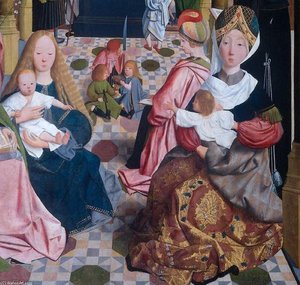
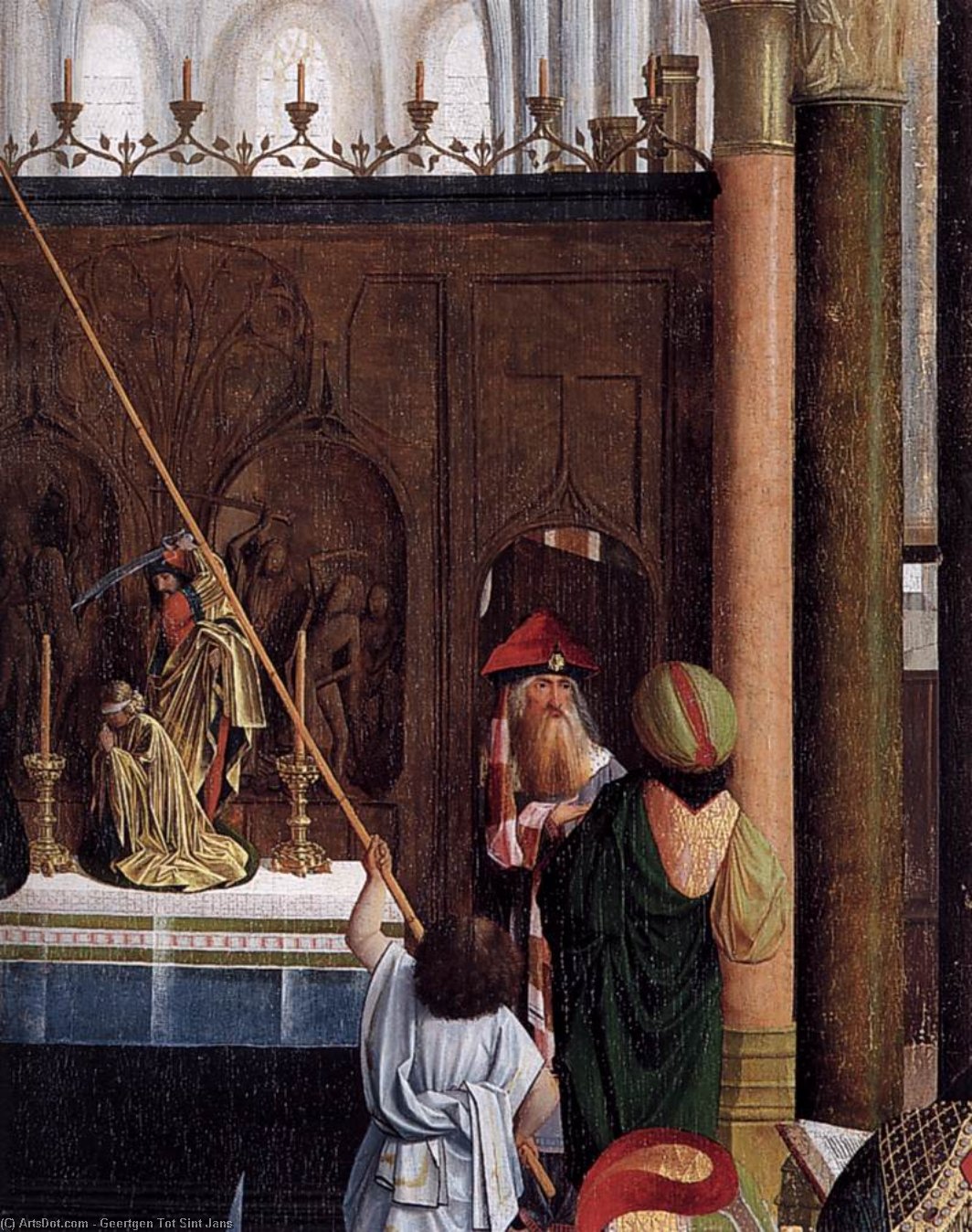
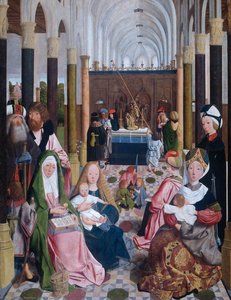
‘The Holy Kinship,’ housed prominently at the Rijksmuseum Amsterdam, depicts an idealized medieval church interior—a space deliberately conceived to evoke contemplation and reverence. The scene draws upon established artistic conventions of the period, mirroring depictions found in illuminated manuscripts and altarpieces across Northern Europe. Sint Jans’ meticulous attention to detail—evident in the richly textured drapery, the subtly modeled figures, and the atmospheric lighting—reflects a burgeoning interest in realism within the artistic realm, albeit filtered through a lens of spiritual symbolism. The artist skillfully employs perspective to create depth and spatial illusion, immersing the viewer in an imagined environment that embodies the sanctity of Christian belief.Technique and Material: Oil on Wood – A Legacy of Innovation
Sint Jans’ technique—primarily oil paint applied onto wooden panels—represents a significant advancement over tempera painting, offering greater luminosity and tonal range. This medium allowed for nuanced blending and layering, capturing subtleties of light and shadow that would have been unattainable with tempera alone. The artist's meticulous preparation of the wood surface ensured optimal adhesion of the pigment, contributing to the enduring vibrancy of the colors and preserving the artwork’s integrity over centuries. Examination reveals a remarkable level of craftsmanship—evidence of Sint Jans’ dedication to mastering his materials and achieving unparalleled artistic precision.Symbolism: Layers of Meaning Within Sacred Space
The composition itself is laden with symbolic significance. The central figures – Mary, Joseph, Jesus, Elizabeth, and John the Baptist – represent the lineage of Christ, embodying divine grace and familial piety. The placement of candles—one positioned at the upper left corner, another at the lower right, and a third centrally located—symbolizes illumination and spiritual enlightenment, guiding the viewer’s gaze toward the sacred narrative unfolding before them. Furthermore, the depiction of the Virgin Mary seated with Jesus on her lap underscores the importance of maternal compassion and divine incarnation – themes central to Christian theology.Emotional Resonance: Capturing Spiritual Serenity
Ultimately, ‘The Holy Kinship’ transcends mere visual representation; it aspires to evoke a profound emotional response in the viewer. Sint Jans achieves this through his masterful use of color—primarily blues and reds—to convey serenity and solemnity respectively. The artist's careful rendering of facial expressions communicates tenderness and devotion, inviting contemplation on themes of faith, family, and divine love. Viewing this artwork is akin to stepping into a timeless tableau—a moment frozen in prayerful reverence that speaks powerfully across the centuries.Ähnliche Kunstwerke
Über den Künstler
Geertgen tot Sint Jans (c. 1460-1495) – A Life Shrouded in Mystery
Geertgen tot Sint Jans, also known as Gerrit van Haarlem, Gerrit Gerritsz, Gheertgen, Geerrit (* c. 1465; Leiden, Netherlands † before 1495; Haarlem), was a Dutch painter of the Early Netherlandish Renaissance. Despite the scarcity of contemporary documentation concerning his life, he remains one of the most enigmatic figures in Northern European art history—a testament to the challenges inherent in reconstructing artistic biographies from fragmentary evidence. Karel van Mander’s *Schilderboeck*, published over a century after Geertgen’s death, provides the primary account of his life and oeuvre, portraying him as a lay brother of Saint John’s Hospitaller Order in Haarlem—a connection that profoundly shaped his artistic output and imbued his work with spiritual significance.Early Life and Training
The precise circumstances surrounding Geertgen’s birth remain elusive, though Karel van Mander suggests Leiden as his birthplace, citing a print by Jacob Matham which refers to him as Gerardus Leydanus. This attribution is supported by scholarly research indicating that Matham’s engraving was produced around 1620—a considerable time after Geertgen’s demise. Van Mander describes Geertgen's artistic training as occurring under the tutelage of Albert van Ouwater, a pivotal figure in establishing oil painting techniques within Haarlem and arguably the most influential artist of his era. This formative relationship undoubtedly instilled in Geertgen a deep appreciation for realism and meticulous detail—characteristics that would become hallmarks of his distinctive style.The Art of Saint John’s Hospitaller Order
Geertgen's affiliation with Saint John’s Hospitaller Order played an instrumental role in shaping his artistic trajectory. As a lay brother, he was tasked with decorating the altar of the Order’s Haarlem chapel—a commission that resulted in two monumental paintings: *The Lamentation of Christ* and *The Legend of Saint John the Baptist*. These works exemplify Geertgen's mastery of chiaroscuro—the dramatic interplay of light and shadow—creating a palpable sense of emotional depth and conveying profound spiritual contemplation. The composition of *The Lamentation*, particularly, foreshadowed developments that would characterize Dutch painting in the decades to follow, marking him as a precursor to the artistic innovations of his successors.Stylistic Innovations and Notable Works
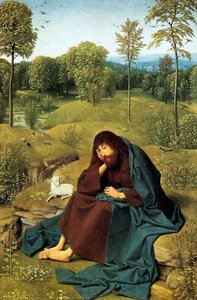
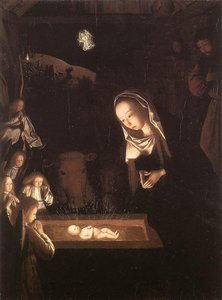
Geertgen tot Sint Jans distinguished himself through several stylistic breakthroughs—most notably his pioneering use of landscape as an integral component of narrative paintings. Unlike many artists of his time who employed landscapes merely as decorative backgrounds, Geertgen imbued them with symbolic meaning—reflecting the inner state of the figures depicted and contributing significantly to the overall artistic impact. His meticulous attention to detail—evident in every brushstroke—further solidified his reputation as a master craftsman. Among his surviving masterpieces are *John the Baptist in the Wilderness*, a serene depiction of spiritual isolation; *Man of Sorrows*, a powerfully emotive portrayal of Christ’s suffering; and *The Nativity at Night*, where Geertgen skillfully utilizes chiaroscuro to illuminate the scene—creating an atmosphere of solemn reverence.Legacy and Influence
Despite the paucity of biographical information, Geertgen tot Sint Jans occupies a significant position within the history of Early Netherlandish art. His innovative approach to landscape and his sensitive portrayal of human emotion profoundly influenced subsequent generations of Dutch painters—particularly those associated with the Haarlem school. The enduring fascination with *The Lamentation*—documented in Jacob Matham’s engraving and accompanying poetry—demonstrates Geertgen’s lasting impact on artistic sensibilities. Modern scholarship recognizes Geertgen as a crucial link between the International Gothic style and the burgeoning realism of the 16th century—a testament to his enduring legacy as one of the most remarkable artists of his time.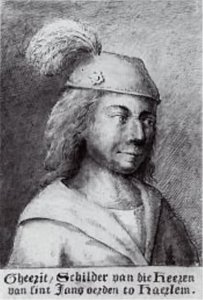
Geertgen tot Sint Jans
1460 - 1490 , Niederlande
Kurzinfos
- Artistic Movement Or Style: Early Netherlandish painting
- Artists Who Influenced This Artist: ['Albert van Ouwater']
- Date Of Birth: c. 1465
- Full Name: Geertgen tot Sint Jans
- Nationality: Dutch
- Notable Artworks:
- The Lamentation of Christ
- The Legend of St. John
- John the Baptist in Wilderness
- Man of Sorrows
- Place Of Birth: Leiden, Netherlands
Ähnliche Artikel
Frühniederländische Meisterwerke: 10 Gemälde, die eine Epoche prägten | ArtsDot
Entdecken Sie die 10 prägendsten Meisterwerke der Frühniederländischen Malerei! Von Jan van Eyck bis Rogier van der Weyden – erleben Sie Kunstgeschichte hautnah. Hochwertige Reproduktionen & Inspiration für Ihr Interieur auf ArtsDot.com.
Jan Gossart: Bridging Netherlandish Realism & Renaissance Humanism – A Comprehensive Exploration
Explore the captivating world of Jan Gossart, a pivotal figure bridging Netherlandish realism & Renaissance humanism. Discover his masterpieces, patronage, and lasting influence – an essential guide for discerning art collectors.
Jan Gossaert (Mabuse): Pioneering Renaissance Style & the Birth of Netherlandish Antiquity
Explore the groundbreaking art of Jan Gossaert (Mabuse), a pioneer of Renaissance painting in the Low Countries. Discover his Romanist style, stunning portraits, and influence on Northern European art history.
Illuminating Realism: A Comprehensive Exploration of the Early Netherlandish Renaissance Movement
Explore the captivating world of Early Netherlandish painting! Discover Jan van Eyck & other Flemish masters, their revolutionary techniques, hidden symbolism, and lasting legacy. A comprehensive guide for art enthusiasts.
Frühniederländische Renaissance: 10 Meisterwerke für Ihr Zuhause | ArtsDot
Entdecken Sie die 10 prägendsten Meisterwerke der Frühniederländischen Renaissance! Erfahren Sie mehr über Jan van Eyck, Rogier van der Weyden & Co. und ihre ikonischen Gemälde. Hochwertige Reproduktionen für Ihr Zuhause – jetzt auf ArtsDot.com!