 Vorschau anzeigen
 Versenden
 Teilen
 Details anzeigen

 Herunterladen
 Ähnliche Objekte
 Röntgenaufnahme
 Diashow
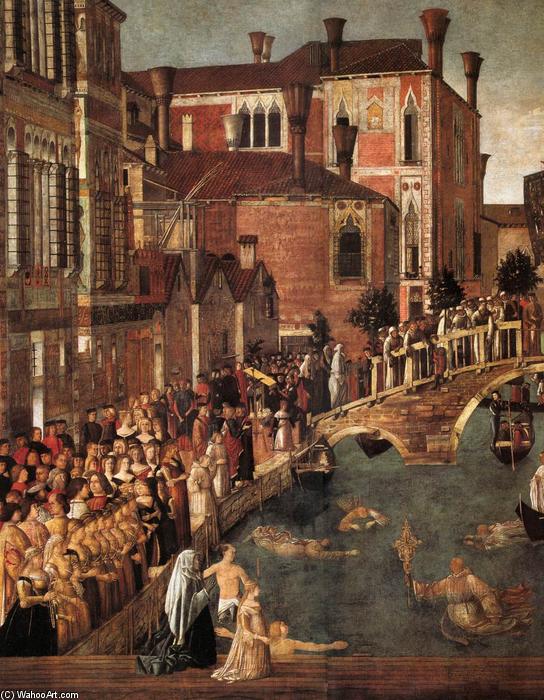
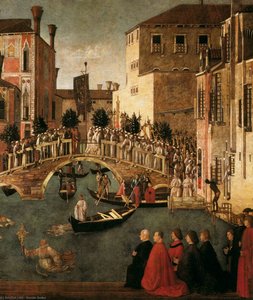
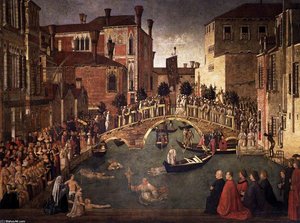
Miracle of the Cross at the Bridge of San Lorenzo (detail)


 Weiterlesen
Handgefertigte Ölreproduktion
Handgemaltes Ölgemälde auf Leinwand in Ihrer Wunschgröße und mit Rahmen, auf Bestellung von unseren Künstlern angefertigt. ( Druck bestellen Bild kaufen)




P118B $10

P118H $10

P118W $10

P438Z $10

P508JH $12

P508YH $12

P805H $10

P805Z $10

P919BZ $10

P919G $10

P919XJ $10

P959ZH $10

P968JZ $12

W106C $8

W218G $10

W218JH $8

W218Y $10

W307PJ $10

W316G $10

W316PJ $8

W316Y $10

W398PJ $8

W4111J $10

W500HY $15

W500JH $15

W692G $12

W849H $8

W940BG $15

W953PJ $8




Wählen Sie aus unseren vordefinierten Formaten, die den ursprünglichen Proportionen des Kunstwerks entsprechen.

Sie können Ihre eigenen Maße eingeben, um einen bestimmten Rahmen oder Platz auszufüllen. Wenn die gewählte Größe nicht den Proportionen des Originalbildes entspricht, werden wir das Kunstwerk entweder beschneiden oder das Gemälde durch zusätzliche, handgemalte Elemente erweitern. Ein digitales Mockup wird Ihnen zur Genehmigung zugesandt, bevor die Produktion beginnt.
Bitte beachten Sie, dass die Bildschirmvorschau nicht die tatsächliche Beschneidung oder Erweiterung widerspiegelt. Nur das Mockup zeigt die endgültige Komposition exakt an.
Obwohl Sondermaße verfügbar sind, empfehlen wir, eine Größe aus der vordefinierten Liste zu wählen, um die ursprünglichen Proportionen beizubehalten.
Nach der Bestellung wird das ArtsDot.com-Team dem Kunden Anweisungen per E-Mail zusenden und eine Mockup-Vorschau bereitstellen.
Weltweiter Versand () in nur 3 bis 4 Wochen statt der üblichen 5 Wochen. (7 September). Keine Kompromisse bei der Qualität.

Kostenloser weltweiter Expressversand

Hochwertige Leinenleinwand

Umfassender Versicherungsschutz beim Versand

Zollgebühren-Rückerstattungsgarantie

Garantie für exakte Farbtreue

100-Tage-Rückgaberecht (nur bei Mängeln)

100% Geld-zurück-Garantie

Mengenrabatt verfügbar
 Die Glasoption ist nur für Größen unter 110 cm verfügbar.

Miracle of the Cross at the Bridge of San Lorenzo (detail)
Art der Reproduktion
Format der Reproduktion
-


Gesamtpreis
$ 663
A Venetian Drama Painted in Light and Sorrow
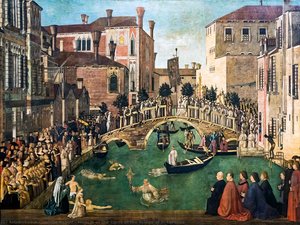
Gentile Bellini’s “Miracle of the Cross at the Bridge of S. Lorenzo,” completed around 1500, isn't merely a depiction of a historical event; it’s a profound meditation on faith, mortality, and the vibrant pulse of Renaissance Venice. This monumental tempera painting, now residing in the Gallerie dell’Accademia, transports us to a bustling canal scene, dominated by the dramatic rescue of a fragment of the Holy Cross – an event that resonated deeply within the city's religious life.
The painting unfolds against the backdrop of the Bridge of San Lorenzo, a crucial artery in Venice’s intricate network of waterways. Bellini masterfully captures the chaotic energy of the scene: figures jostle for position, boats navigate the canal, and the air is thick with both curiosity and grief. The composition is remarkably complex, layering numerous individuals into a single, dynamic space – a testament to Bellini's skill in creating a sense of depth and movement within a crowded setting. The artist’s attention to detail extends beyond the figures themselves; he meticulously renders the architecture of Venice, showcasing its distinctive inverted cone chimneys and the bustling activity along the fondamenta.
The Historical Context: Faith and Miracle
To understand “Miracle of the Cross,” one must delve into the fervent religious atmosphere of 15th-century Venice. The relic of the True Cross was a source of immense devotion, and its annual procession – known as the *Miracolo della Croce* – drew massive crowds. The event itself involved a staged ‘fall’ of the relic into the canal, followed by a miraculous recovery, symbolizing divine intervention and the power of faith. Bellini's painting isn’t simply a record of this spectacle; it’s an embodiment of its significance for the Venetian people.
The commission itself was deeply rooted in the city’s social fabric. The *Scuola Grande di San Giovanni Evangelista*, one of Venice’s most influential confraternities, commissioned the series of paintings to commemorate the relic's arrival in 1369. Bellini’s contribution, alongside other prominent artists, underscored the importance of this religious artifact and its role in shaping Venetian identity. The inclusion of figures like Caterina Cornaro, a queen of Cyprus, further highlights the painting’s connection to Venice’s complex network of political and cultural alliances.
A Masterclass in Technique: Light, Color, and Detail
Bellini's technique is characterized by a remarkable blend of Early Netherlandish influence – particularly evident in the meticulous detail and atmospheric perspective – with the vibrant colors and dynamic compositions typical of Venetian painting. He employs *impasto*—thickly applied paint—to create textural richness, especially in the building facades and clothing folds, lending a tactile quality to the scene. The use of glazing—thin layers of translucent color—builds up luminosity and depth, capturing the play of light on water and surfaces.
The painting’s palette is dominated by warm earth tones – ochres, siennas, and reds – creating a sense of realism and historical context. However, Bellini doesn't shy away from using brighter colors to draw attention to key figures and moments within the composition. The dramatic lighting—a combination of natural daylight and reflected light—further enhances the painting’s emotional impact, casting shadows that heighten the sense of drama and sorrow.
Symbolism and Emotional Resonance
Beyond its historical and artistic merits, “Miracle of the Cross” is rich in symbolism. The floating bodies represent the devastating effects of the plague that ravaged Venice during the 15th century – a poignant reminder of mortality and suffering. The gathering crowd reflects both grief and curiosity, capturing the complex emotions associated with such a momentous event. Bellini’s self-portrait within the composition adds a layer of personal reflection, inviting us to contemplate the artist's own place within this dramatic narrative.
Ultimately, “Miracle of the Cross at the Bridge of S. Lorenzo” is more than just a painting; it’s a window into the soul of Renaissance Venice – a city grappling with faith, mortality, and the enduring power of human belief. It remains a powerful testament to Bellini's artistic genius and his ability to capture both the grandeur and the sorrow of the Venetian experience.
Ähnliche Kunstwerke
Über den Künstler
Gentile Bellini: Ein venezianischer Meister der Renaissance
- Geboren: Venedig, Italien (1429)
- Gestorben: 1507
Frühes Leben und künstlerische Entwicklung
Gentile Bellini entstammte einer bedeutenden Familie von Malern in Venedig. Sein Vater, Jacopo Bellini, war ein etablierter Künstler, der für die Pionierarbeit bei der Verwendung von Ölfarben bekannt ist, während sein jüngerer Bruder, Giovanni Bellini, später zu einem der gefeiertsten venezianischen Meister werden sollte. Gentile erhielt seine anfängliche künstlerische Ausbildung in der Werkstatt seines Vaters und beherrschte so die Techniken des Ölmalens – ein relativ neues Medium zu dieser Zeit. Sein frühestes signiertes Werk, Der selige Lorenzo Giustinian (1445), gilt als eines der ältesten erhaltenen Ölgemälde Venezias und befindet sich heute im Accademia Museum. Frühzeitig zeigte Gentile ein bemerkenswertes Talent für Porträts, das ihm schnell Anerkennung einbrachte und seine Position als offizieller Porträtist der Dogen von Venedig sicherte.
Künstlerischer Stil und Einflüsse
Gentile Bellinis künstlerischer Stil wurde durch mehrere Schlüsselfaktoren beeinflusst. Die reichen Traditionen des Byzantinischen Reiches spielten eine bedeutende Rolle, ebenso wie die Exposition gegenüber der osmanischen Kultur nach seinem Besuch in Konstantinopel im Jahr 1479. Diese Reise, die auf Bitten von Sultan Mehmed II unternommen wurde, erwies sich als entscheidend für die Gestaltung seiner späteren Werke. Sein Porträt von Mehmed II, das sich heute in der National Gallery in London befindet, veranschaulicht diesen Einfluss. Bellinis Kompositionen zeichnen sich oft durch ihre Grandiosität aus und zeigen groß angelegte Szenen mit zahlreichen Figuren – ein häufiges Merkmal in seinen Aufträgen für die Scuole Grandi (wichtigste Bruderschaften) von Venedig.
- Byzantinischer Einfluss: Deutlich erkennbar in den stilisierten Figuren und den reichen Farbpaletten.
- Osmanischer Einfluss: Sichtbar in Darstellungen des osmanischen Hoflebens und der Architektur, wie es an seinem Porträt von Mehmed II zu sehen ist.
- Venezianische Tradition: Eine Fortsetzung venezianischer künstlerischer Praktiken, insbesondere im Bereich Porträts und großflächiger Erzählmalerei.
Bemerkenswerte Werke und Vermächtnis
Zu Gentile Bellinis bekanntesten Werken gehören Die Prozession des Wahren Kreuzes auf dem Markusplatz (1496) und Das Wunder des Wahren Kreuzes an der Brücke S. Lorenzo (ca. 1500). Letzteres Gemälde ist besonders bemerkenswert, da es ein Selbstporträt neben dem seines Bruders Giovanni Bellini enthält. Gentile’s künstlerische Beiträge reichten über einzelne Gemälde hinaus; er gilt als einer der Begründer der Orientalisten-Tradition in der westlichen Kunst – eine Bewegung, die durch Darstellungen östlicher Kulturen und Schauplätze gekennzeichnet ist.
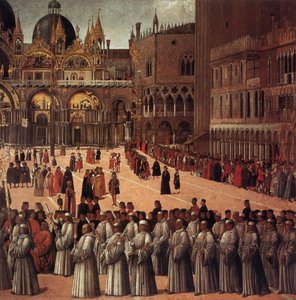
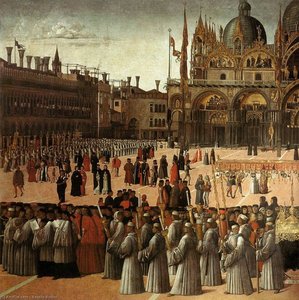
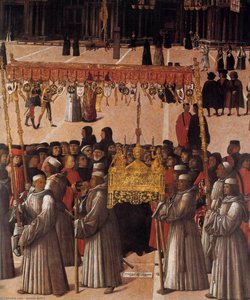
- Die Prozession des Wahren Kreuzes auf dem Markusplatz (1496): Ein monumentales Werk, das eine religiöse Prozession darstellt und seine Fähigkeit zeigt, große Menschenmengen und komplizierte Details darzustellen.
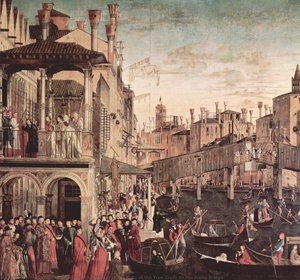
- Das Wunder des Wahren Kreuzes an der Brücke S. Lorenzo (ca. 1500): Zeigt ein Selbstporträt neben seinem Bruder Giovanni und bietet Einblicke in ihre Beziehung und künstlerliche Zusammenarbeit.
Historische Bedeutung
Gentile Bellinis Vermächtnis beruht auf seiner Pionierarbeit bei der Verwendung von Ölfarben in der venezianischen Malerei und seinem bedeutenden Beitrag zur Entwicklung der Orientalisten-Kunst. Seine Fähigkeit, venezianische künstlerische Traditionen mit Einflüssen aus dem Byzantinischen Reich und der osmanischen Kultur zu verbinden, führte zu einem einzigartigen und fesselnden Stil, der ganz Europa widerhallte. Obwohl er oft von seinem Bruder Giovanni überschattet wurde, wird Gentile Bellinis Werk heute als ein wesentliches Kapitel in der Geschichte der westlichen Malerei anerkannt – ein Beweis für seine Fähigkeiten, sein Talent und den kulturellen Austausch.
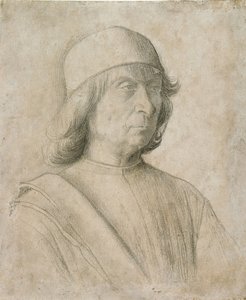
Gentile Bellini
1429 - 1507 , Italien
Kurzinfos
- Artistic Movement Or Style: Venezianische Malerei
- Artists Or Movements Influenced By This Artist:
- Giorgione
- Titian
- Artists Who Influenced This Artist:
- Gentile da Fabriano
- Byzantinisches Reich
- Date Of Birth: 1429
- Date Of Death: 1507
- Full Name: Gentile Bellini
- Nationality: Italienisch
- Notable Artworks:
- Sel. Lorenzo Giustinian
- Kreuzesprozession
- Wunderkreuz-Brücke
- Place Of Birth (City And Country): Venedig, Italien
Ähnliche Artikel

The Enduring Legacy of Oil on Canvas: Technique, History & Aesthetic Impact
Explore the rich history & techniques of oil painting – from Renaissance masters to Impressionism. Discover pigments, layering methods, and why this timeless medium endures. Expert insights for artists & art enthusiasts.

Öl auf Leinwand: Eine historische und technische Erkundung eines zeitlosen künstlerischen Mediums
Entdecken Sie die faszinierende Welt der Ölmalerei! Von historischen Techniken bis zur modernen Anwendung – wir bieten Expertenwissen, Restaurierungstipps und hochwertige Reproduktionen. Jetzt informieren!
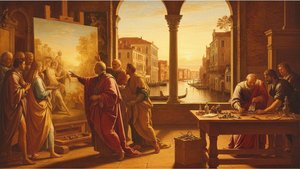
The Golden Light of Innovation: Exploring the Venetian Renaissance Art Movement (1430–1580)
Explore the Golden Age of Venetian art (1430–1580). Discover Giorgione, Titian & Tintoretto's techniques, the 'colorito' revolution, and lasting influence. Expert insights for collectors & enthusiasts.

The Enduring Power of Painting: A Historical & Contemporary Exploration of Form and Emotion
Explore the rich history & enduring techniques of oil painting with ArtsDot. Discover masterpieces, learn about art collecting, and find authentic handmade reproductions crafted by skilled artists.

Das bleibende Erbe der Ölmalerei: Technik, Geschichte und zeitgenössische Praxis
Entdecken Sie die faszinierende Geschichte der Ölmalerei – von den frühen Techniken bis zur modernen Kunst. Expertenwissen, detaillierte Analysen und Inspiration für Sammler & Kunstliebhaber.