 Vorschau anzeigen
 Versenden
 Teilen
 Details anzeigen

 Herunterladen
 Ähnliche Objekte
 Röntgenaufnahme
 Diashow
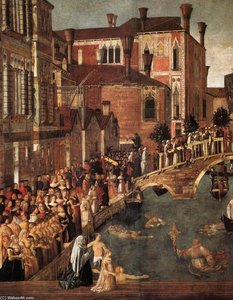
The Healing of Pietro dei Ludovici
 Öl auf Leinwand
- Wandkunst
- Renaissance
 1501
1501 369.0 x 259.0 cm
 Gallerie dell’Accademia
 Weiterlesen
Handgefertigte Ölreproduktion
Handgemaltes Ölgemälde auf Leinwand in Ihrer Wunschgröße und mit Rahmen, auf Bestellung von unseren Künstlern angefertigt. ( Druck bestellen Bild kaufen)




P118B $10

P118H $10

P118W $10

P438Z $10

P508JH $12

P508YH $12

P805H $10

P805Z $10

P919BZ $10

P919G $10

P919XJ $10

P959ZH $10

P968JZ $12

W106C $8

W218G $10

W218JH $8

W218Y $10

W307PJ $10

W316G $10

W316PJ $8

W316Y $10

W398PJ $8

W4111J $10

W500HY $15

W500JH $15

W692G $12

W849H $8

W940BG $15

W953PJ $8




Wählen Sie aus unseren vordefinierten Formaten, die den ursprünglichen Proportionen des Kunstwerks entsprechen.

Sie können Ihre eigenen Maße eingeben, um einen bestimmten Rahmen oder Platz auszufüllen. Wenn die gewählte Größe nicht den Proportionen des Originalbildes entspricht, werden wir das Kunstwerk entweder beschneiden oder das Gemälde durch zusätzliche, handgemalte Elemente erweitern. Ein digitales Mockup wird Ihnen zur Genehmigung zugesandt, bevor die Produktion beginnt.
Bitte beachten Sie, dass die Bildschirmvorschau nicht die tatsächliche Beschneidung oder Erweiterung widerspiegelt. Nur das Mockup zeigt die endgültige Komposition exakt an.
Obwohl Sondermaße verfügbar sind, empfehlen wir, eine Größe aus der vordefinierten Liste zu wählen, um die ursprünglichen Proportionen beizubehalten.
Nach der Bestellung wird das ArtsDot.com-Team dem Kunden Anweisungen per E-Mail zusenden und eine Mockup-Vorschau bereitstellen.
Weltweiter Versand () in nur 3 bis 4 Wochen statt der üblichen 5 Wochen. (31 August). Keine Kompromisse bei der Qualität.

Kostenloser weltweiter Expressversand

Hochwertige Leinenleinwand

Umfassender Versicherungsschutz beim Versand

Zollgebühren-Rückerstattungsgarantie

Garantie für exakte Farbtreue

60 Tage Rückgaberecht (nur bei Mängeln)

100% Geld-zurück-Garantie

Mengenrabatt verfügbar
 Die Glasoption ist nur für Größen unter 110 cm verfügbar.

The Healing of Pietro dei Ludovici
Art der Reproduktion
Format der Reproduktion
-


Gesamtpreis
$ 263
A Miracle in Red and Gold: Unveiling Gentile Bellini’s “The Healing of Pietro dei Ludovici”
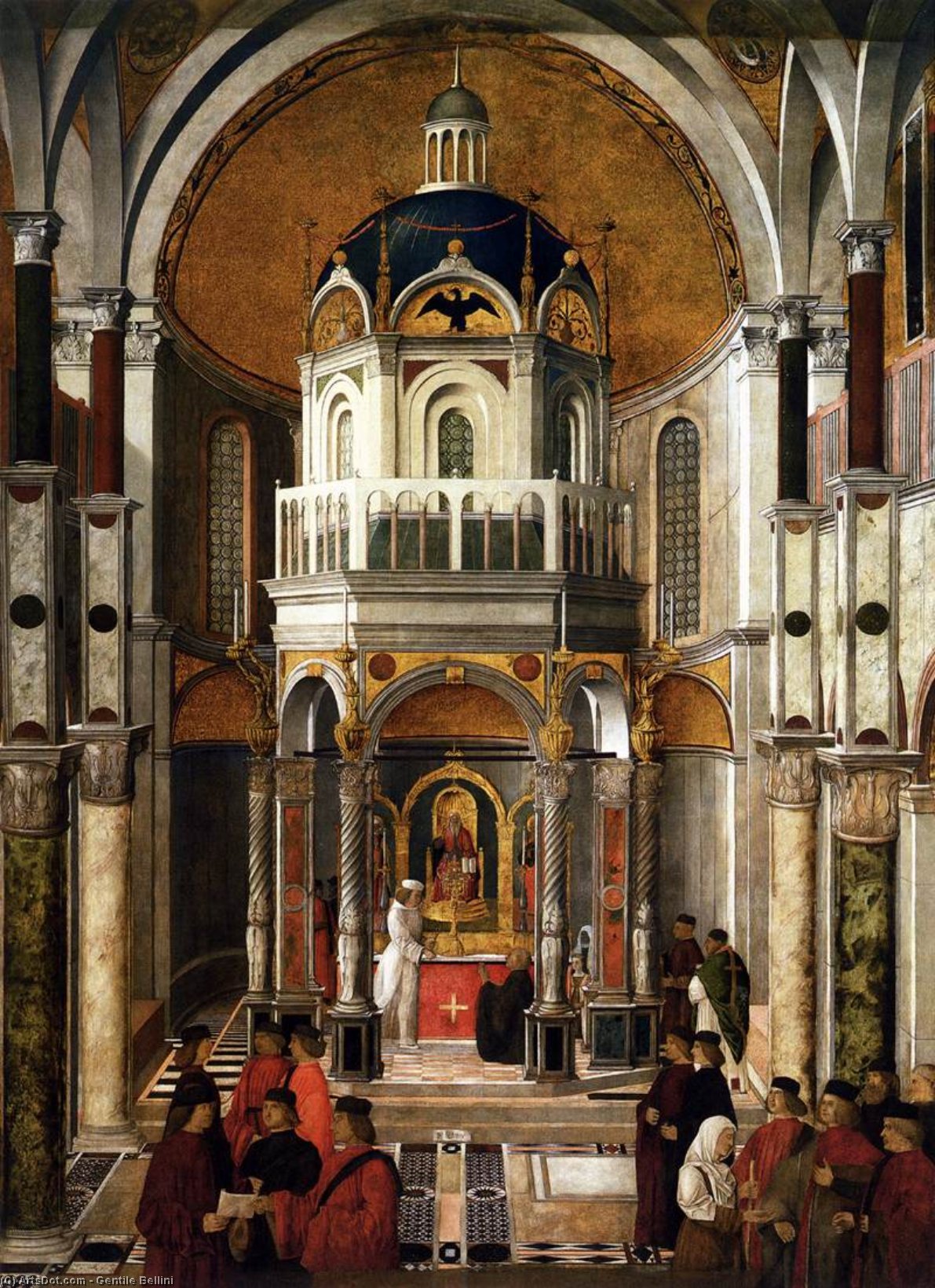
Gentile Bellini's "The Healing of Pietro dei Ludovici," painted around 1501, is more than just a religious scene; it’s a vibrant window into the heart of Venetian Renaissance society and a testament to the artist’s mastery of color, composition, and narrative. This captivating work, now housed in a high-quality reproduction, transports us to a moment of profound faith and miraculous healing within the serene confines of a Venetian chapel. The painting immediately draws the eye with its rich palette – deep reds dominate, echoing the robes of Pietro and his companion, contrasted beautifully against the luminous gold of the altar and architectural details. Bellini’s signature style is evident here: a masterful blend of realism and idealized beauty, creating figures that are both deeply human and imbued with an ethereal quality.
- Subject Matter: The scene depicts Pietro dei Ludovici, a man afflicted by illness, receiving miraculous healing through contact with a relic of the Holy Cross. This event, rooted in Christian legend, speaks to themes of divine intervention, faith’s power, and the alleviation of suffering – potent subjects for devotional art in Renaissance Venice.
- Composition: Bellini employs a carefully balanced composition, guiding the viewer's eye through the scene with converging lines and strategic placement of figures. The central focus is on Pietro and his companion, rendered with exquisite detail, while surrounding figures—including attendants and onlookers—add depth and context to the miracle.
- Technique: Executed in tempera on canvas, Bellini demonstrates a remarkable command of color and texture. His use of layering and glazing creates a luminous effect, capturing the play of light and shadow with breathtaking realism. The artist’s skillful rendering of architectural elements—the chapel's interior, complete with altar and ciborium—adds to the painting’s immersive quality.
The Venetian Context: Patronage, Faith, and Artistic Innovation
To fully appreciate “The Healing of Pietro dei Ludovici,” it’s crucial to understand its historical context within Venice. The city was a thriving center of trade, art, and religious fervor during the 15th and 16th centuries. Wealthy Venetian families, known as *scuole grandi*, commissioned elaborate devotional paintings to adorn their chapels and demonstrate their piety. These paintings were not merely decorative; they served as powerful symbols of faith and social status. Bellini’s work exemplifies this trend, reflecting the patronage of a prominent religious confraternity. Furthermore, Bellini was one of the first Venetian painters to fully embrace oil paint, allowing for richer colors and greater detail than previously possible with tempera.
Gentile Bellini's role as official painter of the Doges solidified his position at the heart of Venetian power and society. This prestigious commission shaped his artistic trajectory, placing him at the center of Venetian life and influencing his style and subject matter.Symbolism and Spiritual Resonance
Beyond its narrative content, “The Healing of Pietro dei Ludovici” is rich in symbolic meaning. The red robes worn by Pietro and his companion represent their devotion and sacrifice. The relic of the Holy Cross itself symbolizes divine grace and redemption. The architectural details—particularly the altar and ciborium—evoke a sense of sacred space and spiritual transcendence. Bellini’s use of light and shadow further enhances the painting's emotional impact, creating an atmosphere of reverence and awe. The inclusion of Pietro’s self-portrait within the scene adds a layer of intimacy and invites the viewer to connect with the miracle on a personal level.
A Timeless Masterpiece: Reproduction and Artistic Legacy
Today, “The Healing of Pietro dei Ludovici” continues to captivate audiences with its beauty and spiritual depth. High-quality reproductions offer an accessible way to experience this remarkable work of art, bringing its vibrant colors and compelling narrative into any space. Bellini’s influence can be seen in the works of subsequent Venetian painters, and his painting remains a cornerstone of Renaissance art history. Its enduring appeal lies not only in its technical brilliance but also in its ability to evoke profound emotions and inspire contemplation on themes of faith, healing, and the power of divine grace.
Ähnliche Kunstwerke
Über den Künstler
Gentile Bellini: Ein venezianischer Meister der Renaissance
- Geboren: Venedig, Italien (1429)
- Gestorben: 1507
Frühes Leben und künstlerische Entwicklung
Gentile Bellini entstammte einer bedeutenden Familie von Malern in Venedig. Sein Vater, Jacopo Bellini, war ein etablierter Künstler, der für die Pionierarbeit bei der Verwendung von Ölfarben bekannt ist, während sein jüngerer Bruder, Giovanni Bellini, später zu einem der gefeiertsten venezianischen Meister werden sollte. Gentile erhielt seine anfängliche künstlerische Ausbildung in der Werkstatt seines Vaters und beherrschte so die Techniken des Ölmalens – ein relativ neues Medium zu dieser Zeit. Sein frühestes signiertes Werk, Der selige Lorenzo Giustinian (1445), gilt als eines der ältesten erhaltenen Ölgemälde Venezias und befindet sich heute im Accademia Museum. Frühzeitig zeigte Gentile ein bemerkenswertes Talent für Porträts, das ihm schnell Anerkennung einbrachte und seine Position als offizieller Porträtist der Dogen von Venedig sicherte.
Künstlerischer Stil und Einflüsse
Gentile Bellinis künstlerischer Stil wurde durch mehrere Schlüsselfaktoren beeinflusst. Die reichen Traditionen des Byzantinischen Reiches spielten eine bedeutende Rolle, ebenso wie die Exposition gegenüber der osmanischen Kultur nach seinem Besuch in Konstantinopel im Jahr 1479. Diese Reise, die auf Bitten von Sultan Mehmed II unternommen wurde, erwies sich als entscheidend für die Gestaltung seiner späteren Werke. Sein Porträt von Mehmed II, das sich heute in der National Gallery in London befindet, veranschaulicht diesen Einfluss. Bellinis Kompositionen zeichnen sich oft durch ihre Grandiosität aus und zeigen groß angelegte Szenen mit zahlreichen Figuren – ein häufiges Merkmal in seinen Aufträgen für die Scuole Grandi (wichtigste Bruderschaften) von Venedig.
- Byzantinischer Einfluss: Deutlich erkennbar in den stilisierten Figuren und den reichen Farbpaletten.
- Osmanischer Einfluss: Sichtbar in Darstellungen des osmanischen Hoflebens und der Architektur, wie es an seinem Porträt von Mehmed II zu sehen ist.
- Venezianische Tradition: Eine Fortsetzung venezianischer künstlerischer Praktiken, insbesondere im Bereich Porträts und großflächiger Erzählmalerei.
Bemerkenswerte Werke und Vermächtnis
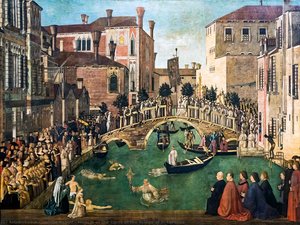
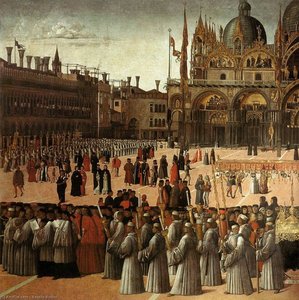
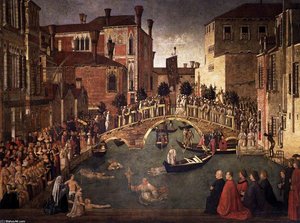
Zu Gentile Bellinis bekanntesten Werken gehören Die Prozession des Wahren Kreuzes auf dem Markusplatz (1496) und Das Wunder des Wahren Kreuzes an der Brücke S. Lorenzo (ca. 1500). Letzteres Gemälde ist besonders bemerkenswert, da es ein Selbstporträt neben dem seines Bruders Giovanni Bellini enthält. Gentile’s künstlerische Beiträge reichten über einzelne Gemälde hinaus; er gilt als einer der Begründer der Orientalisten-Tradition in der westlichen Kunst – eine Bewegung, die durch Darstellungen östlicher Kulturen und Schauplätze gekennzeichnet ist.
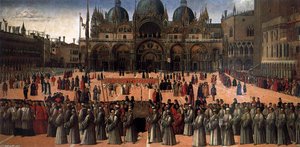
- Die Prozession des Wahren Kreuzes auf dem Markusplatz (1496): Ein monumentales Werk, das eine religiöse Prozession darstellt und seine Fähigkeit zeigt, große Menschenmengen und komplizierte Details darzustellen.
- Das Wunder des Wahren Kreuzes an der Brücke S. Lorenzo (ca. 1500): Zeigt ein Selbstporträt neben seinem Bruder Giovanni und bietet Einblicke in ihre Beziehung und künstlerliche Zusammenarbeit.
Historische Bedeutung
Gentile Bellinis Vermächtnis beruht auf seiner Pionierarbeit bei der Verwendung von Ölfarben in der venezianischen Malerei und seinem bedeutenden Beitrag zur Entwicklung der Orientalisten-Kunst. Seine Fähigkeit, venezianische künstlerische Traditionen mit Einflüssen aus dem Byzantinischen Reich und der osmanischen Kultur zu verbinden, führte zu einem einzigartigen und fesselnden Stil, der ganz Europa widerhallte. Obwohl er oft von seinem Bruder Giovanni überschattet wurde, wird Gentile Bellinis Werk heute als ein wesentliches Kapitel in der Geschichte der westlichen Malerei anerkannt – ein Beweis für seine Fähigkeiten, sein Talent und den kulturellen Austausch.
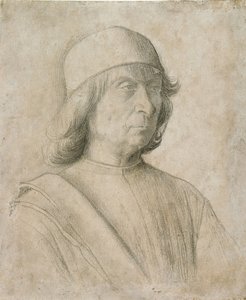
Gentile Bellini
1429 - 1507 , Italien
Kurzinfos
- Artistic Movement Or Style: Venezianische Malerei
- Artists Or Movements Influenced By This Artist:
- Giorgione
- Titian
- Artists Who Influenced This Artist:
- Gentile da Fabriano
- Byzantinisches Reich
- Date Of Birth: 1429
- Date Of Death: 1507
- Full Name: Gentile Bellini
- Nationality: Italienisch
- Notable Artworks:
- Sel. Lorenzo Giustinian
- Kreuzesprozession
- Wunderkreuz-Brücke
- Place Of Birth (City And Country): Venedig, Italien
Ähnliche Artikel
Pietro Longhi's Venetian Scenes: A Study of Rococo Society & Domestic Life
Explore the captivating world of Pietro Longhi's Venetian scenes! Discover insightful analysis of his Rococo masterpieces & social commentary on 18th-century life. Learn about this 'Venetian Hogarth' and his lasting artistic legacy.

Jacopo Tintoretto: Die 25 Meisterwerke des venezianischen Dramatikers | ArtsDot
Entdecken Sie die 25 Meisterwerke von Jacopo Tintoretto! Tauchen Sie ein in die dramatische Welt der venezianischen Renaissance. Hochwertige Kunst-Reproduktionen & Inspiration für Ihr Zuhause – jetzt auf ArtsDot.com.
Vittore Carpaccio: Venezianische Renaissance und die Poetik des Details
Entdecken Sie die faszinierende Welt Vittore Carpaccios! Analysieren Sie mit uns seine einzigartige venezianische Renaissance-Malerei, den St.-Georgs-Zyklus und seinen Einfluss auf die Kunstgeschichte. Expertenwissen & Detailreichtum.
The Golden Light of Innovation: Exploring the Venetian Renaissance Art Movement (1430–1580)
Explore the Golden Age of Venetian art (1430–1580). Discover Giorgione, Titian & Tintoretto's techniques, the 'colorito' revolution, and lasting influence. Expert insights for collectors & enthusiasts.
Paolo Veronese: Farbe, Komposition und venezianische Pracht eines Renaissance-Meisters
Entdecken Sie das beeindruckende Werk von Paolo Veronese! Erfahren Sie mehr über seine Farbenpracht, monumentalen Kompositionen und seinen Einfluss auf die venezianische Renaissance. Kunstgeschichte für Kenner.