 Vorschau anzeigen
 Versenden
 Teilen
 Details anzeigen

 Herunterladen
 Ähnliche Objekte
 Röntgenaufnahme
 Diashow
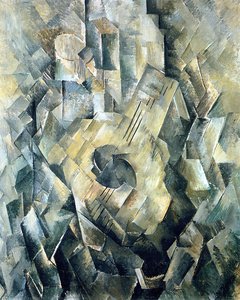
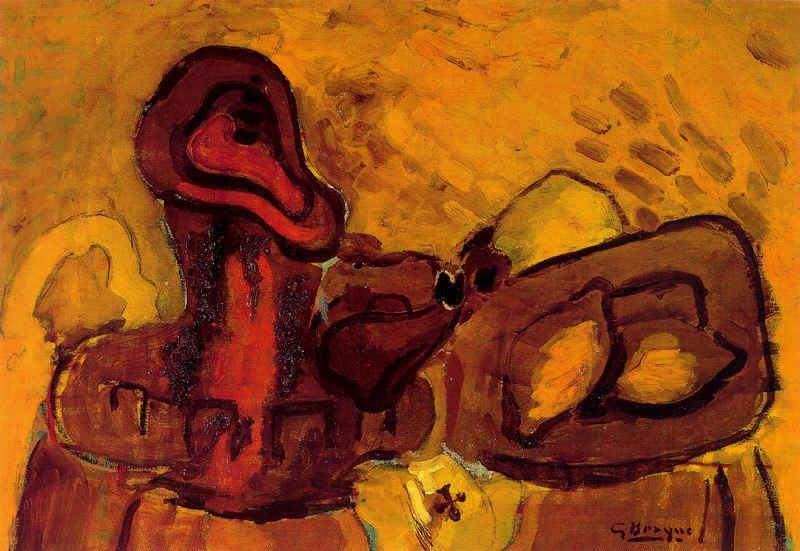
Jug and Ace of Clubs

 Weiterlesen
Giclée / Kunstdruck
Giclée- oder Leinwanddruck in Museumsqualität mit schneller Produktion und flexiblen Veredelungsoptionen. ( Handgemalte Reproduktion bestellen Bild kaufen)




P118B $10

P118H $10

P118W $10

P438Z $10

P508JH $12

P508YH $12

P805H $10

P805Z $10

P919BZ $10

P919G $10

P919XJ $10

P959ZH $10

P968JZ $12

W106C $8

W218G $10

W218JH $8

W218Y $10

W307PJ $10

W316G $10

W316PJ $8

W316Y $10

W398PJ $8

W4111J $10

W500HY $15

W500JH $15

W692G $12

W849H $8

W940BG $15

W953PJ $8




Wählen Sie aus unseren vordefinierten Formaten, die den ursprünglichen Proportionen des Kunstwerks entsprechen.

Sie können Ihre eigenen Maße eingeben, um ein bestimmtes Format oder einen speziellen Platz einzupassen. Wenn das von Ihnen gewählte Format nicht den Proportionen des Originalbildes entspricht, werden wir das Kunstwerk entweder beschneiden oder das Bild mit einem gespiegelten oder einfarbigen Rand erweitern. Ein digitaler Entwurf wird Ihnen zur Genehmigung zugesandt, bevor die Produktion beginnt.
Bitte beachten Sie, dass die Vorschau auf dem Bildschirm nicht den tatsächlichen Zuschnitt oder die Erweiterung widerspiegelt. Nur der Entwurf zeigt die endgültige Komposition präzise an.
Obwohl Sondermaße verfügbar sind, empfehlen wir die Auswahl eines Maßes aus der vordefinierten Liste, um die ursprünglichen Proportionen zu bewahren.
Weltweiter Versand () innerhalb von 2 Wochen statt der üblichen 4/5 Wochen. (25 August)

Kostenloser weltweiter Expressversand

Hochwertige Leinenleinwand

Umfassender Versicherungsschutz beim Versand

Zollgebühren-Rückerstattungsgarantie

Garantie für exakte Farbtreue

60 Tage Rückgaberecht (nur bei Mängeln)

100% Geld-zurück-Garantie

Mengenrabatt verfügbar
 Die Glasoption ist nur für Größen unter 110 cm verfügbar.

Jug and Ace of Clubs
Giclée / Kunstdruck
Format der Reproduktion
-


Gesamtpreis
$ 62
Sammlerstück-Beschreibung
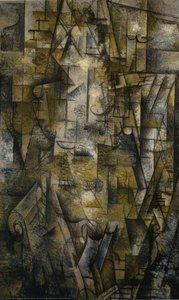
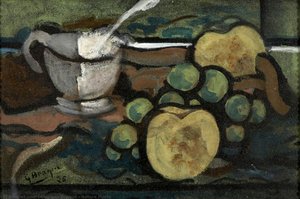
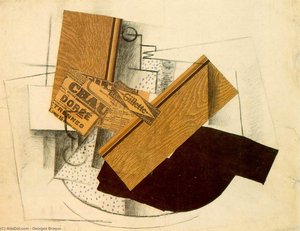
The Enigmatic Dance of Form: Georges Braque’s “Jug and Ace of Clubs”
Georges Braque's "Jug and Ace of Clubs," painted around 1913, isn’t merely a still life; it’s a meticulously constructed puzzle for the viewer, a testament to the burgeoning revolutionary spirit of Cubism. Born in Argenteuil, France, in 1882, Braque’s artistic journey began not with grand pronouncements but with a grounding in practical craft – his father and grandfather were house painters and decorators. This foundational knowledge, combined with formal training at the École des Beaux-Arts, instilled within him an acute awareness of material and structure, providing a crucial counterpoint to the radical departures he would later champion. The painting itself is a deceptively simple arrangement: a jug, an ace of clubs playing card, and fragments of a fruit dish – yet it’s this apparent ordinariness that fuels its profound impact. Braque wasn't interested in replicating reality; instead, he sought to dissect it, to reveal the underlying geometric forms that constituted its essence. This work emerged during a pivotal moment in art history—a time when artists were actively dismantling traditional perspectives and challenging the very notion of representation. The influence of Paul Cézanne’s emphasis on flattened planes and multiple viewpoints is palpable, laying the groundwork for Cubism's core principles.A Symphony of Geometric Fragments
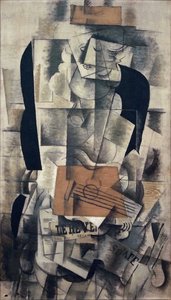
The painting’s power lies in its masterful manipulation of form and space. Braque employs a muted palette—primarily earthy browns, ochres, and blacks—that emphasizes the interplay between light and shadow, creating an illusion of depth within a largely flattened picture plane. The jug, the card, and the remnants of the fruit dish are not presented as solid objects but rather as fragmented geometric shapes – cubes, cones, cylinders – that interlock and overlap. This fragmentation isn’t arbitrary; it's a deliberate strategy to disrupt our conventional perception of three-dimensional space. Braque forces us to actively engage with the image, reconstructing the scene in our minds through the arrangement of these disjointed elements. Notice how the jug is broken down into its constituent planes, while the ace of clubs retains a recognizable form despite being similarly dissected. This duality—the simultaneous presence of recognizable objects and abstract geometric forms—is characteristic of Analytic Cubism, the style Braque was developing alongside Pablo Picasso at this time. The use of charcoal adds to the textural complexity, hinting at the artist’s meticulous process and his desire to capture not just the appearance but also the essence of each object.The Language of Collage and Symbolism
“Jug and Ace of Clubs” is a crucial work in understanding the development of Cubist collage. Braque was experimenting with incorporating non-traditional materials – newspaper clippings, wallpaper scraps, fabric – into his paintings, blurring the boundaries between painting and sculpture. This technique, pioneered by Picasso around the same time, introduced a new dimension to artistic expression, inviting viewers to consider the role of chance and accident in the creative process. The inclusion of the ace of clubs itself is laden with symbolic weight. In traditional imagery, the ace represents potential, beginnings, and even fate. Here, within the context of Braque’s fractured composition, it becomes a destabilizing element, questioning our assumptions about order and certainty. The jug, often associated with abundance and hospitality, further complicates the scene, suggesting a sense of contained chaos or perhaps a commentary on consumer culture. The overall effect is one of intellectual engagement—a challenge to the viewer to decipher the artist’s intentions and interpret the meaning embedded within this carefully constructed visual language.A Legacy of Innovation
“Jug and Ace of Clubs” stands as a pivotal work in the history of modern art, demonstrating Braque's crucial role in shaping Cubism alongside Picasso. It exemplifies his innovative approach to form, space, and representation—a move away from traditional illusionistic techniques toward a more conceptual and analytical mode of seeing. The painting’s influence can be seen in the subsequent development of abstract art and continues to resonate with contemporary artists who explore the possibilities of deconstruction and reconstruction. Reproductions of this artwork offer an accessible way to experience Braque's revolutionary vision, allowing viewers to appreciate the intricate details and profound ideas embedded within this deceptively simple composition. It’s a piece that rewards repeated viewing, revealing new layers of meaning with each encounter—a true testament to the enduring power of artistic innovation.Ähnliche Kunstwerke

Über den Künstler
**frühes Leben und Ausbildung**
Georges Braque, ein prominenter französischer Maler, Kollagist, Bleistrichzeichner, Grafiker und Bildhauer, wurde am 13. Mai 1882 in Argenteuil, Val-d'oise, geboren. Er wuchs in Le Havre auf und erhielt zunächst eine Ausbildung als Hausmaler und Dekorateur wie sein Vater und Großvater. Braques künstlerische Neigungen führten ihn jedoch dazu, von 1897 bis 1899 an der École des Beaux-Arts in Le Havre Malerei zu studieren.**Künstlerische Entwicklung und Fauvisme**
Im Jahr 1902, nachdem er seine Lehre bei einem Dekorateur in Paris abgeschlossen hatte, besuchte Braque bis 1904 die Académie Humbert. Dieser Zeitraum markierte seine Einführung ins Fauvismus, einen Stil, der durch lebendige Farben und emotionale Reaktionen gekennzeichnet ist. Beeinflusst von den Werken von Henri Matisse und André Derain, übernahm Braque einen fauvistischen Ansatz, wie in seinem Gemälde The Patience (Fauvismus, Öl auf Leinwand).**Beitrag zum Kubismus**
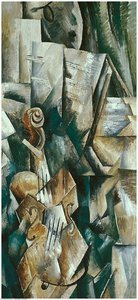
Braques Zusammenarbeit mit Pablo Picasso von 1908 bis 1912 führte zur Entwicklung des Kubismus. Ihre analytischen kubistischen Werke, wie z.B. Georges Braque: The Patience und Pablo Picasso: Clarinet(analytischer Kubismus, Öl auf Leinwand), gelten heute als Meilensteine der Kunstgeschichte.**Erbe und bemerkenswerte Werke**
* Houses at L'Estaques: Ein Zeugnis für Braques innovatives Einsatz von Geometrie und simultaner Perspektive. * The Patience(Fauvismus, Öl auf Leinwand): Demonstriert Braques fauvistischen Stil. * Clarinet(analytischer Kubismus, Öl auf Leinwand): Eine kollaborative kubistische Arbeit mit Picasso.**Museen und Sammlungen**
* Musée d'Orsay: Bietet eine umfangreiche Sammlung impressionistischer und postimpressionistischer Kunst, darunter Werke von Braque. * Musée de l'Orangerie: Zeigt eine breite Palette von Kunstwerken, darunter Werke von Braque und anderen bedeutenden Künstlern.- Erfahren Sie mehr über Georges Braques Leben und Werk auf ArtsDot.com
- Entdecken Sie die Sammlung des Musée d'Orsay, die Werke von Braque und anderen Künstlern umfasst, unter Musée d'Orsay - Wikipedia
- Erfahren Sie mehr über den Fauvismus und seinen Einfluss auf die Entwicklung des Kubismus mit Fauvismus Kunstbewegung auf ArtsDot.com
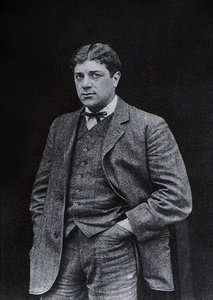
Georges Braque
1882 - 1963 , Frankreich
Kurzinfos
- Beeinflusste Künstler: ['Pablo Picasso']
- Bemerkenswerte Werke:
- Häuser in L'Estaque
- Die Geduld (Fauvismus)
- Stillleben mit Pfeife
- Mandola
- Einflussreiche Künstler:
- Henri Matisse
- André Derain
- Paul Cézanne
- Geburtsdatum: 13. Mai 1882
- Geburtsort: Argenteuil, Frankreich
- Künstlerischer Stil: Kubismus, Fauvismus
- Nationalität: Französisch
- Sterbedatum: 1963
- Vollständiger Name: Georges Braque
Ähnliche Artikel

Georges Braque: Die 25 Meisterwerke des Kubismus für Ihr Zuhause | ArtsDot
Entdecken Sie die 25 bedeutendsten Kunstwerke von Georges Braque – vom Kubismus bis zum Fauvismus. Erfahren Sie die Geschichten hinter den Meisterwerken und finden Sie hochwertige Reproduktionen für Ihr Zuhause auf ArtsDot.com.

Georges Seurat: Die 25 Meisterwerke des Pointillismus für Ihr Zuhause | ArtsDot
Entdecken Sie die 25 ikonischsten Meisterwerke von Georges Seurat! Tauchen Sie ein in die Welt des Pointillismus, der Farbtheorie und des Impressionismus. Hochwertige Kunst reproduzieren für Ihr Zuhause – jetzt auf ArtsDot.com!
Georges Braque: Pionier des Kubismus und die Evolution moderner Formensprache
Entdecken Sie Georges Braques revolutionären Einfluss auf den Kubismus und die moderne Kunstgeschichte. Expertenanalyse seiner Formensprache, Werke & Bedeutung. Jetzt lesen!
Deconstructing Reality: Cubism's Revolutionary Impact on 20th-Century Art
Explore the revolutionary world of Cubism with ArtsDot. Discover Picasso & Braque's groundbreaking techniques, its philosophical roots, and lasting impact on modern art. Expert insights for collectors.
Deconstructing Reality: Cubism's Evolution, Impact & Enduring Legacy
Explore the revolutionary world of Cubism with expert insights from ArtsDot. Discover Picasso & Braque's groundbreaking techniques, its philosophical roots, and lasting impact on modern art. Expert appraisal & custom reproductions available.