 Vorschau anzeigen
 Versenden
 Teilen
 Details anzeigen

 Herunterladen
 Ähnliche Objekte
 Röntgenaufnahme
 Diashow
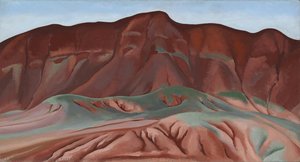
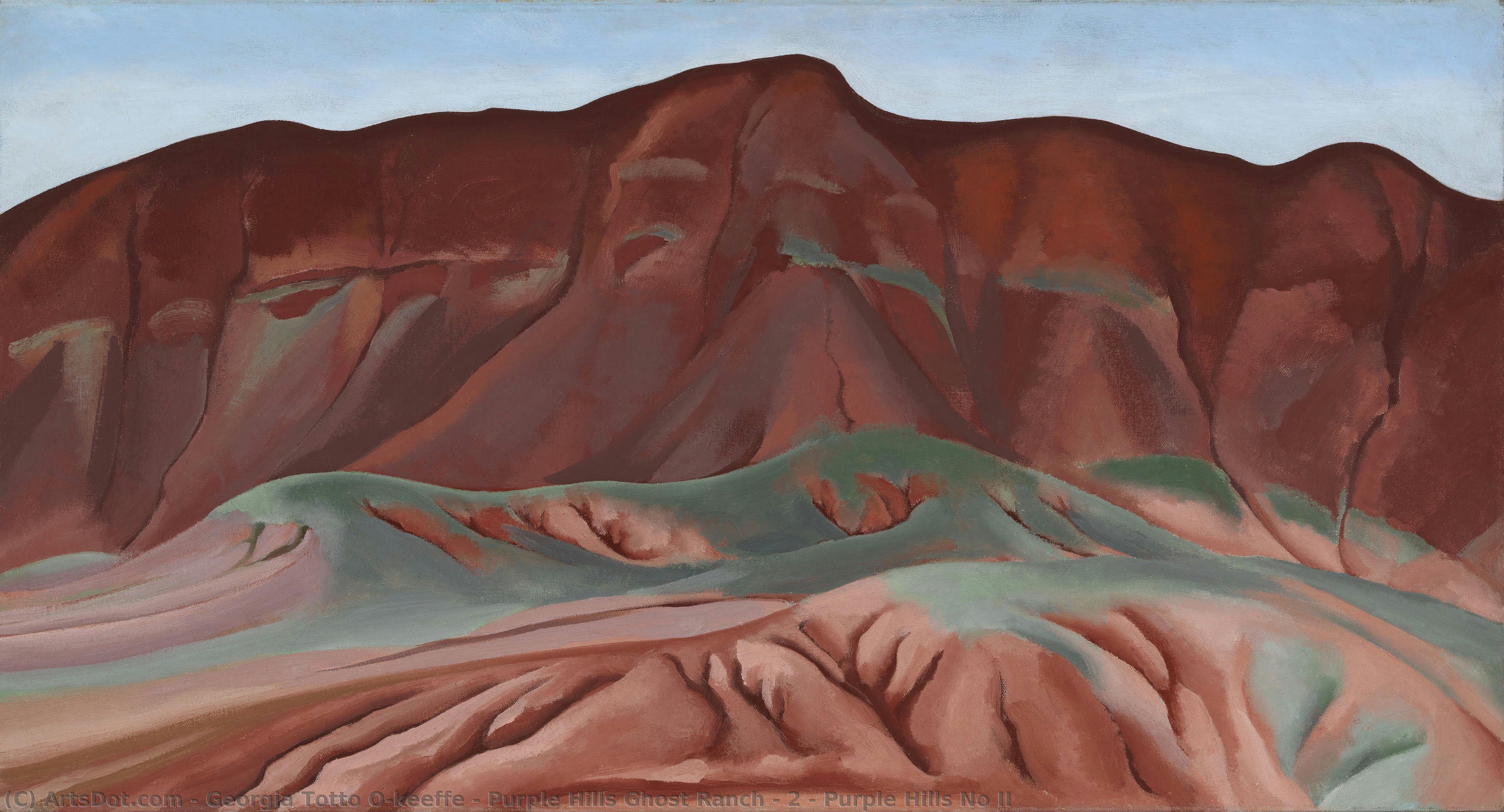
Purple Hills Ghost Ranch - 2 / Purple Hills No II


 Weiterlesen
Giclée / Kunstdruck
Giclée- oder Leinwanddruck in Museumsqualität mit schneller Produktion und flexiblen Veredelungsoptionen. ( Handgemalte Reproduktion bestellen Bild kaufen)




P118B $10

P118H $10

P118W $10

P438Z $10

P508JH $12

P508YH $12

P805H $10

P805Z $10

P919BZ $10

P919G $10

P919XJ $10

P959ZH $10

P968JZ $12

W106C $8

W218G $10

W218JH $8

W218Y $10

W307PJ $10

W316G $10

W316PJ $8

W316Y $10

W398PJ $8

W4111J $10

W500HY $15

W500JH $15

W692G $12

W849H $8

W940BG $15

W953PJ $8




Wählen Sie aus unseren vordefinierten Formaten, die den ursprünglichen Proportionen des Kunstwerks entsprechen.

Sie können Ihre eigenen Maße eingeben, um ein bestimmtes Format oder einen speziellen Platz einzupassen. Wenn das von Ihnen gewählte Format nicht den Proportionen des Originalbildes entspricht, werden wir das Kunstwerk entweder beschneiden oder das Bild mit einem gespiegelten oder einfarbigen Rand erweitern. Ein digitaler Entwurf wird Ihnen zur Genehmigung zugesandt, bevor die Produktion beginnt.
Bitte beachten Sie, dass die Vorschau auf dem Bildschirm nicht den tatsächlichen Zuschnitt oder die Erweiterung widerspiegelt. Nur der Entwurf zeigt die endgültige Komposition präzise an.
Obwohl Sondermaße verfügbar sind, empfehlen wir die Auswahl eines Maßes aus der vordefinierten Liste, um die ursprünglichen Proportionen zu bewahren.
Weltweiter Versand () innerhalb von 2 Wochen statt der üblichen 4/5 Wochen. (25 August)

Kostenloser weltweiter Expressversand

Hochwertige Leinenleinwand

Umfassender Versicherungsschutz beim Versand

Zollgebühren-Rückerstattungsgarantie

Garantie für exakte Farbtreue

60 Tage Rückgaberecht (nur bei Mängeln)

100% Geld-zurück-Garantie

Mengenrabatt verfügbar
 Die Glasoption ist nur für Größen unter 110 cm verfügbar.

Purple Hills Ghost Ranch - 2 / Purple Hills No II
Giclée / Kunstdruck
Format der Reproduktion
-


Gesamtpreis
$ 62
Sammlerstück-Beschreibung
A Desert’s Soul: Georgia O'Keeffe’s “Purple Hills Ghost Ranch – 2 / Purple Hills No II”
Georgia O’Keeffe’s “Purple Hills Ghost Ranch – 2 / Purple Hills No II,” painted in 1934, isn’t merely a landscape; it’s an immersion into the raw, elemental heart of the American Southwest. Created during a pivotal period of her artistic evolution, this oil on canvas captures not just a visual scene but a profound emotional response to the stark beauty and haunting solitude of New Mexico’s high desert. The painting transports us to Ghost Ranch, O'Keeffe’s beloved retreat, where she found both inspiration and a sense of detached contemplation – a feeling that permeates every brushstroke.
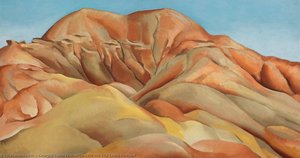
The composition is deceptively simple: undulating hills rendered in layers of deep crimson, dusky pink, and muted grey dominate the canvas. These aren’t gentle slopes; they possess an almost sculptural quality, rising and falling with a quiet intensity. The sky, a wash of pale blues and soft clouds, provides a subtle counterpoint to the earth tones below, suggesting vastness and timelessness. O'Keeffe masterfully employs a technique she’d honed over years – reductive painting. She simplifies forms, stripping away extraneous detail to focus on essential shapes and colors, creating an effect that is both monumental and intimate.
The Seeds of Abstraction
Prior to this period, O'Keeffe’s work leaned heavily towards representational realism, often depicting flowers with meticulous detail. However, her time at Ghost Ranch marked a significant shift toward abstraction. Influenced by Arthur Wesley Dow’s teachings on color and line – emphasizing personal expression over strict imitation – she began to prioritize the emotional impact of her paintings. “Purple Hills Ghost Ranch” exemplifies this transition; while recognizable as hills and sky, they are presented with an almost otherworldly quality, reduced to their fundamental elements.
The painting’s genesis is intertwined with O'Keeffe’s personal journey. Following a difficult marriage to Alfred Stieglitz, she sought refuge in the solitude of Ghost Ranch, a place that offered both physical and emotional distance. The landscape itself became a mirror reflecting her internal state – a space for introspection and renewal. The title, “Purple Hills,” hints at the vibrant hues of the region’s soil, while "Ghost Ranch" evokes a sense of mystery and the lingering presence of the past.
Symbolism in the Desert
Beyond its visual appeal, “Purple Hills Ghost Ranch” is rich with symbolic meaning. The vastness of the landscape speaks to themes of isolation and resilience – qualities that resonated deeply with O'Keeffe’s experience. The muted colors suggest a sense of melancholy, yet there’s also an underlying strength in the earth itself. Some art historians have interpreted the hills as representations of female genitalia, aligning with O'Keeffe’s often provocative depictions of flowers and natural forms. However, O'Keefe herself consistently denied this interpretation, emphasizing her focus on capturing the essence of the landscape rather than imposing a specific narrative.
The painting’s placement within the context of O’Keeffe’s broader body of work is also significant. It represents a crucial stage in her development as an artist, demonstrating her increasing confidence and willingness to experiment with abstraction while retaining a deep connection to the natural world. It's a testament to her ability to transform a simple landscape into a profound meditation on beauty, solitude, and the enduring spirit of the American West.
A Timeless Resonance
“Purple Hills Ghost Ranch – 2 / Purple Hills No II” continues to captivate viewers with its evocative power. Its muted palette, simplified forms, and underlying sense of mystery create a deeply resonant experience. Whether viewed as a celebration of the Southwest’s dramatic landscapes or a poignant reflection on O'Keeffe’s personal journey, this painting remains a cornerstone of American modernism – a testament to the artist’s unique vision and her ability to capture the soul of a place.
Ähnliche Kunstwerke
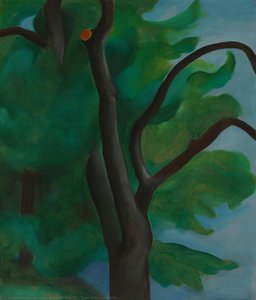
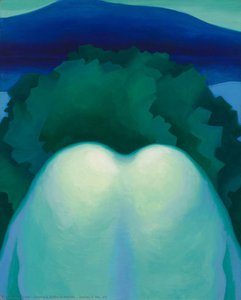
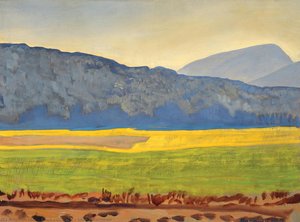
Über den Künstler
Frühe Jahre und Ausbildung (1887–1916)
Georgia Totto O’Keeffe, eine zentrale Figur des amerikanischen Modernismus, wurde am 15. November 1887 in Sun Prairie, Wisconsin, geboren. Ihre Eltern waren Francis Calyxtus O’Keeffe und Ida (Totto) O’Keeffe, Milchbauern irischer und ungarischer Abstammung. Schon im Alter von zehn Jahren entschied Georgia, Künstlerin zu werden. Sie erhielt Kunstunterricht von der lokalen Aquarellistin Sara Mann und besuchte später das Art Institute of Chicago von 1905 bis 1906, wo sie unter John Vanderpoel studierte. Ihr einzigartiger Stil begann sich während ihrer Studien in Virginia zu entwickeln.Künstlerische Karriere (1917–1986)
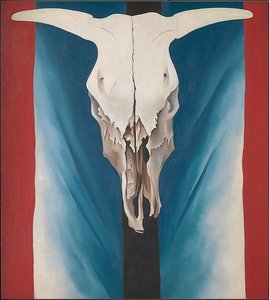
Alfred Stieglitz, ein Kunsthändler und Fotograf, veranstaltete 1917 eine Ausstellung von O’Keeffes Werken. Dies markierte den Beginn ihrer professionellen Karriere. Sie zog 1918 auf Stieltiz's Wunsch nach New York und begann ernsthaft als Künstlerin zu arbeiten. Ihre berufliche Beziehung entwickelte sich zu einer persönlichen, die zur Heirat am 11. Dezember 1924 führte. O’Keeffes abstrakte Kunst, darunter Nahaufnahmen von Blumen wie *Rote Canna*, wurde oft als Darstellung weiblicher Geschlechtsorgane interpretiert, obwohl sie dies stets bestritt. Ihre Arbeit wurde auch von ihrer Zeit im Südwesten beeinflusst, was Gemälde wie *Schädel eines Rindes: Rot, Weiß und Blau (1931)* und *Sommertage (1936)* inspirierte.Einflüsse und Stilentwicklung
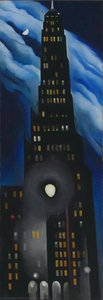
O’Keeffe war stark von Arthur Wesley Dow beeinflusst, dessen Lehren über abstraktes Design ihre künstlerische Praxis prägten. Sie experimentierte mit verschiedenen Stilen, darunter Präzisionismus, der sich in ihren Gemälden von New Yorker Wolkenkratzern zeigt. Ihre Landschaftsbilder aus New Mexico, insbesondere die Wüstenlandschaften rund um Abiquiú, wurden zu einem zentralen Thema ihres Werkes und zeigten ihre tiefe Verbindung zur Natur. Die Farbpalette O’Keeffes entwickelte sich im Laufe ihrer Karriere weiter, von den gedämpften Tönen ihrer frühen Werke bis hin zu den leuchtenden Farben, die in ihren späteren Gemälden dominieren.Vermächtnis und Bedeutung
Nach Stieltiz's Tod 1946 lebte O’Keeffe für die nächsten 40 Jahre in New Mexico. Ihr Gemälde *Jimson Weed/White Flower No. 1* aus dem Jahr 1932 wurde 2014 für 44,405.000 Dollar verkauft und stellte einen Rekordpreis für ein Werk einer weiblichen Künstlerin auf. Das Georgia O’Keeffe Museum wurde 2006 in Santa Fe gegründet, um ihrem Werk zu widmen. Ihre Werke sind auch in zahlreichen anderen Museen vertreten. Sie gilt als eine der wichtigsten Künstlerinnen des 20. Jahrhunderts und hat die Entwicklung der amerikanischen Kunst maßgeblich beeinflusst.Wichtige Werke
- Rote Canna
- Schädel eines Rindes: Rot, Weiß und Blau (1931)
- Sommertage (1936)
- Jimson Weed/White Flower No. 1
- Blaue und grüne Musik
Museen mit O’Keeffe-Werken
- Georgia O’Keeffe Museum
- Verschiedene weitere Museen, Informationen hier: https://www.okeeffemuseum.org/
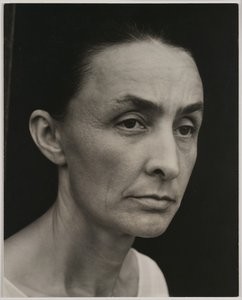
Georgia O’Keeffe
1887 - 1986 , Vereinigte Staaten von Amerika
Kurzinfos
- Beeinflusste Künstler: ['Keine Angaben']
- Bemerkenswerte Werke:
- Roter Canna
- Kuhschädel Rot, Weiß und Blau
- Sommertage
- Spitzwurz/Weißes Blumen Nr. 1
- Einflüsse: ['Alfred Stieglitz']
- Geburtsdatum: 15. November 1887
- Geburtsort: Sun Prairie, Vereinigte Staaten
- Künstlerische Richtung: Amerikanischer Modernismus
- Nationalität: Amerikanisch
- Sterbedatum: 6. März 1986
- Vollständiger Name: Georgia O’Keeffe
Ähnliche Artikel
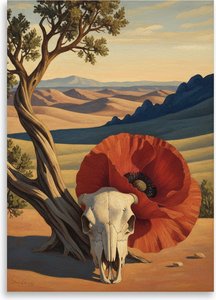
Georgia O’Keeffe: Symbolismus und Landschaft – Eine Neudefinition der Moderne in der amerikanischen Kunst
Entdecken Sie Georgia O’Keeffes revolutionäre Kunst! Analysieren Sie ihren Symbolismus, ihre Landschaftsmalerei und ihren Einfluss auf die amerikanische Moderne. Expertenwissen & tiefe Einblicke.
Thomas Hill: Luminosity, Landscape & the American Pastoral Ideal
Explore the luminous landscapes of Thomas Hill, a pivotal figure in the Hudson River School & Luminism movements. Discover his artistic journey, philosophical depth, and enduring legacy with ArtsDot.
Öl auf Holz: 10 Meisterwerke, die Kunstgeschichte veränderten | ArtsDot.com
Entdecken Sie die 10 legendärsten Gemälde auf Holz! Von Van Gogh bis Monet – erfahren Sie die Geschichten hinter den Meisterwerken des Impressionismus, Expressionismus & mehr. Hochwertige Reproduktionen für Ihr Zuhause finden Sie auf ArtsDot.com.
Frank O. Salisbury: Capturing an Era Through Victorian Portraiture & Atmospheric Realism
Explore the life & work of Frank O. Salisbury, Britain's celebrated 'Painter Laureate'. Discover his masterful Victorian portraits, atmospheric realism, and captivating historical murals. A deep dive into a remarkable artistic legacy.
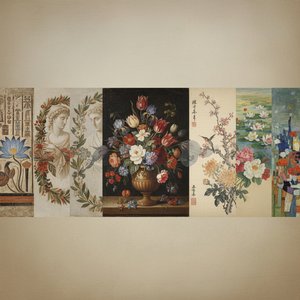
Blossoms of Time: A Historical & Aesthetic Exploration of Floral Painting Across Cultures
Explore the rich history of floral painting! Discover symbolism, techniques & masterpieces from Van Huysum to O'Keeffe. Expert insights for art lovers & collectors at ArtsDot.