 Vorschau anzeigen
 Versenden
 Teilen
 Details anzeigen

 Herunterladen
 Ähnliche Objekte
 Röntgenaufnahme
 Diashow
untitled (5751)

 Weiterlesen
Handgefertigte Ölreproduktion
Handgemaltes Ölgemälde auf Leinwand in Ihrer Wunschgröße und mit Rahmen, auf Bestellung von unseren Künstlern angefertigt. ( Druck bestellen Bild kaufen)




P118B $10

P118H $10

P118W $10

P438Z $10

P508JH $12

P508YH $12

P805H $10

P805Z $10

P919BZ $10

P919G $10

P919XJ $10

P959ZH $10

P968JZ $12

W106C $8

W218G $10

W218JH $8

W218Y $10

W307PJ $10

W316G $10

W316PJ $8

W316Y $10

W398PJ $8

W4111J $10

W500HY $15

W500JH $15

W692G $12

W849H $8

W940BG $15

W953PJ $8




Wählen Sie aus unseren vordefinierten Formaten, die den ursprünglichen Proportionen des Kunstwerks entsprechen.

Sie können Ihre eigenen Maße eingeben, um einen bestimmten Rahmen oder Platz auszufüllen. Wenn die gewählte Größe nicht den Proportionen des Originalbildes entspricht, werden wir das Kunstwerk entweder beschneiden oder das Gemälde durch zusätzliche, handgemalte Elemente erweitern. Ein digitales Mockup wird Ihnen zur Genehmigung zugesandt, bevor die Produktion beginnt.
Bitte beachten Sie, dass die Bildschirmvorschau nicht die tatsächliche Beschneidung oder Erweiterung widerspiegelt. Nur das Mockup zeigt die endgültige Komposition exakt an.
Obwohl Sondermaße verfügbar sind, empfehlen wir, eine Größe aus der vordefinierten Liste zu wählen, um die ursprünglichen Proportionen beizubehalten.
Nach der Bestellung wird das ArtsDot.com-Team dem Kunden Anweisungen per E-Mail zusenden und eine Mockup-Vorschau bereitstellen.
Weltweiter Versand () in nur 3 bis 4 Wochen statt der üblichen 5 Wochen. (22 August). Keine Kompromisse bei der Qualität.

Kostenloser weltweiter Expressversand

Hochwertige Leinenleinwand

Umfassender Versicherungsschutz beim Versand

Zollgebühren-Rückerstattungsgarantie

Garantie für exakte Farbtreue

60 Tage Rückgaberecht (nur bei Mängeln)

100% Geld-zurück-Garantie

Mengenrabatt verfügbar
 Die Glasoption ist nur für Größen unter 110 cm verfügbar.

untitled (5751)
Art der Reproduktion
Format der Reproduktion
-


Gesamtpreis
$ 263
Beschreibung des Kunstwerks
The Ambassadors: A Window into Tudor Ambition
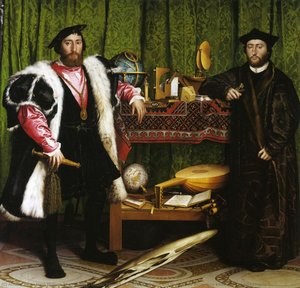
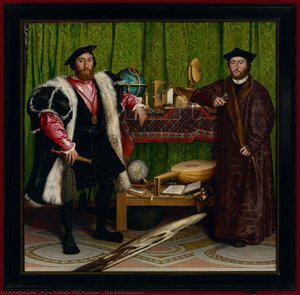
Hans Holbein the Younger’s “The Ambassadors,” painted in 1533 during the artist's second and most significant period in England, is far more than a mere portrait of two men. It’s a meticulously constructed tableau – a visual embodiment of humanist ideals, intellectual ambition, and the precarious political landscape of Henry VIII’s court. The painting, currently residing within the National Gallery in London, continues to captivate viewers with its astonishing detail and subtle layers of meaning, offering a rare glimpse into the mindset of a pivotal era.
- Subject & Composition: The central figures are Jean de Dinteville, the French ambassador to England, and Charles Brandon, 1st Duke of Suffolk, a prominent member of Henry VIII’s court. They stand shoulder-to-shoulder, engaged in what appears to be a scholarly discussion, yet their postures subtly reveal an underlying tension – a reflection of the complex diplomatic relations between England and France at the time. The composition is remarkably balanced, drawing the eye across the meticulously rendered details.
- Technique & Materials: Holbein’s mastery of oil paint is immediately apparent. He employed a glazing technique, layering thin washes of color to achieve an unparalleled luminosity and depth of tone. The textures – from the velvet of the cushions to the sheen of the silver – are rendered with astonishing realism. Note the use of black chalk for the detailed drawing under the paint layers, a common practice in Holbein’s work that adds to the painting's richness and longevity.
Symbolism Woven into the Scene
“The Ambassadors” is saturated with symbolism, reflecting the intellectual currents of the Renaissance and the specific concerns of Tudor England. The objects scattered across the table are not merely decorative; they carry profound significance. The globe represents the world’s knowledge and ambition, while the celestial sphere symbolizes divine order and human aspiration. The musical instruments – a lute, a recorder, and a viola da gamba – represent the pursuit of artistic excellence and intellectual refinement. The presence of the book, open to a passage from Euclid's *Elements*, underscores the importance of mathematics and reason in understanding the universe.
- The Skull: Perhaps the most unsettling element is the small skull resting on the table. It serves as a stark reminder of mortality – a subtle yet powerful commentary on the fleeting nature of earthly achievements and the vanity of human ambition.
- The Dutch Delftware: The distinctive blue and white Delftware vases are not just decorative items; they represent the burgeoning trade between England and the Netherlands, highlighting the economic opportunities available during this period.
A Portrait of a Court – And Its Uncertainties
Beyond its individual portraits, “The Ambassadors” offers a valuable insight into the atmosphere of Henry VIII’s court. The painting reflects the era's fascination with humanism, classical learning, and worldly pursuits. However, beneath this veneer of sophistication lies an undercurrent of uncertainty – symbolized by the skull and the tense expressions of the figures. Holbein was acutely aware of the political machinations surrounding him, and his work subtly acknowledges the dangers inherent in navigating the treacherous waters of courtly life.
Painted during a period of immense change—the break with Rome, the dissolution of monasteries, and the expansion of England’s influence on the world stage— “The Ambassadors” stands as a powerful testament to the ambition, intellect, and anxieties of a nation at a critical juncture in its history. It is a masterpiece that continues to challenge and inspire viewers centuries later.
Ähnliche Kunstwerke
Über den Künstler
frühes Leben und Ausbildung
Hans Holbein der Jüngere, eine bedeutende Figur in der Nordischen Renaissance, wurde 1497 in Augsburg, Deutschland, geboren. Obwohl er oft mit seinem Vater, Hans Holbein dem Älteren, einem renommierten Künstler und Grafiker verwechselt wird, ist Holbeins Werk der Jüngeren eigenständig und herausragend.Künstlerische Karriere
Holbeins künstlerische Karriere begann unter der Anleitung seines Vaters. Später reiste er nach England, wo er Hofmaler für König Heinrich VIII. wurde. Diese Position ermöglichte es ihm, die Essenz der königlichen Familie und des aufkommenden englischen Adels einzufangen. Sein Werk ist durch folgende Merkmale gekennzeichnet:- Außergewöhnliche Realismus: Holbeins Porträts sind für ihre lebensechte Qualität bekannt, wie in Portrait einer unbekannten Dame (Nordische Renaissance).
- Innovative Komposition: Seine Verwendung von Kompositionen ist in Sir William Butts (37 x 46 cm, Nordische Renaissance, Öl auf Holzpanel) erkennbar.
- Studie für das Familienporträt von Thomas More (38 x 52 cm, Nordische Renaissance) zeigt seine Fähigkeit, die Essenz einer Familie einzufangen.
Bekannte Werke und Vermächtnis
Holbeins Werk befindet sich in verschiedenen Museen, darunter die Staatlichen Museen zu Berlin (Deutschland), wo sein unbekannter Gelehrter mit Musikbüchern und Laute (Öl auf Holzpanel) ausgestellt ist. Sein Einfluss auf die Nordische Renaissance ist unbestreitbar, und sein Werk inspiriert bis heute Künstler. Holbein der Jüngere starb 1543, aber sein Vermächtnis lebt durch seine fesselnden Porträts und detaillierten Studien weiter. Weitere Werke von Hans Holbein dem Jüngeren ansehen auf ArtsDot.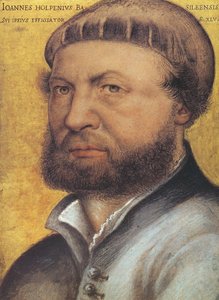
Hans Holbein der Jüngere
1497 - 1543 , Italien
Kurzinfos
- Bemerkenswerte Werke:
- Porträt einer Unbekannten
- Sir William Butts
- Studie zum Familienschloss More
- Die Familie des Bürgermeisters Meyer
- Das Grab Jesu
- Porträt Heinrichs VIII.
- Geburtsdatum: 1497
- Geburtsort: Augsburg, Italien
- Künstlerische Bewegung: Nordische Renaissance
- Künstlerische Einflüsse:
- Hans Holbein der Ältere
- Albrecht Dürer
- Nationalität: Deutsch
- Sterbedatum: 1543
- Vollständiger Name: Hans Holbein der Jüngere
Ähnliche Artikel

Crimson Threads of Narrative: Exploring Symbolism & Representation in Artworks Featuring the Red Dress
Explore the rich symbolism of the red dress in art history! From ancient power displays to iconic portraits like Cézanne’s 'Madame Cezanne', discover the cultural and artistic significance behind this captivating color. Expert analysis & insights.
Hans Holbein der Jüngere: Realismus, Psychologie und die Meisterschaft des Renaissance-Porträts
Entdecken Sie das Werk von Hans Holbein dem Jüngeren! Erfahren Sie mehr über seinen revolutionären Realismus, die psychologische Tiefe seiner Porträts und seine Meistertechnik. Jetzt lesen!

Fra Angelico: Die 25 Meisterwerke des italienischen Frührenaissance-Malers | ArtsDot
Entdecken Sie die 25 schönsten Meisterwerke von Fra Angelico! Erleben Sie religiöse Kunst der italienischen Renaissance, himmlische Fresken & Panelgemälde. Finden Sie hochwertige Kunstdrucke und Reproduktionen für Ihr Zuhause auf ArtsDot.com.
Jacob Henricus Maris: Meister des niederländischen Stimmungsrealismus und der intimen Landschaft
Entdecken Sie das Werk von Jacob Henricus Maris, einem Meister des niederländischen Stimmungsrealismus! Erfahren Sie mehr über seine Landschaftsmalerei, Einflüsse und berühmte Gemälde. Jetzt lesen & inspirieren lassen!
Sacred Narratives Embodied: A Comprehensive Exploration of Religious Iconography in Art History
Explore the rich history of religious iconography in art! Discover symbolism, movements & masterpieces from Byzantine to Renaissance periods. Expert insights for collectors and enthusiasts at ArtsDot.

![Doppelporträt von Jean de Dinteville und Georges de Selve (auch bekannt als Die Gesandten) [Detail]](/media/artworks/images-thumb/bb/ab/bbab7ce77b7dd15d23d21114a63b51a4.jpg)