


 Versenden als Grußkarte
 Teilen
 Details anzeigen

 Herunterladen
 Ähnliche Objekte
 Diashow
 Besucherstatistiken
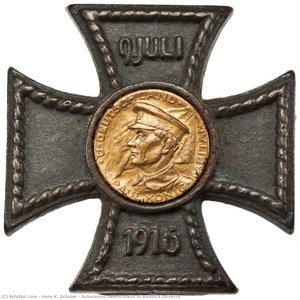
Submarine Deutschland in America Obverse
 Metal
Metal- Sculpture
 1916
1916- 19th Century
 7.0 x 7.0 cm
 American Numismatic Society
 Mehr anzeigen
Erwerben Sie ein hochauflösendes, optimiertes digitales Bild, das der Online-Vorschau weit überlegen ist.
Jede Datei wird von unseren hauseigenen Spezialisten mit modernsten Werkzeugen und fachmännischer manueller Retusche sorgfältig vorbereitet. Wir stellen sicher, dass jedes Bild eine außergewöhnliche Klarheit, präzise Farbgenauigkeit und feinste Details aufweist.
Die endgültige Datei wird innerhalb von 72 Stunden per E-Mail zugestellt und ist für den sofortigen Einsatz in professionellen, redaktionellen und Druckumgebungen optimiert. Es handelt sich um dieselbe Qualität, der führende Designstudios, Verlage und Galerien vertrauen.
Digitales Bild
Laden Sie eine hochauflösende Datei für die persönliche Präsentation, den Druck und kreative Projekte herunter. ( Zum Druck wechseln Handgemalte Reproduktion kaufen)
In jeder Bestellung digitaler Bilder enthalten
Professionelle digitale Bereitstellung, garantiert
Wenn Sie sich für ArtsDot.com entscheiden, erhalten Sie nicht nur ein Bild – Sie erhalten ein professionell aufbereitetes digitales Kunstwerk, das mit höchster Präzision erstellt und durch eine Zufriedenheitsgarantie abgesichert wird. Hier ist alles, was automatisch mit Ihrer Bestellung geliefert wird:

Schnelle E-Mail-Zustellung
Ihre hochauflösende digitale Bilddatei wird Ihnen innerhalb von 72 Stunden nach der Bestellung per E-Mail zugestellt – bereit zur sofortigen Verwendung.

KI-optimierte digitale Datei
Ihre Kunstwerke werden professionell mithilfe fortschrittlicher KI-Tools und manueller Bearbeitung optimiert, um maximale Detailtreue, Klarheit und Farbgenauigkeit zu gewährleisten.

Kostenloser lebenslanger Neudruckservice
Datei versehentlich gelöscht oder verloren? Keine Sorge – wir senden sie Ihnen jederzeit kostenlos erneut zu.

Keine Einfuhrgebühren – jemals
Genießen Sie Ihr Kunstwerk sofort ohne Zollgebühren, Einfuhrabgaben oder Versandkosten – digitale Downloads sind immer steuerfrei.

Garantierte Farbtreue
Wir garantieren, dass Ihr digitales Bild mithilfe professioneller Werkzeuge und Farbmanagement die Originalfarben so präzise wie möglich wiedergibt.

100-Tage-Zufriedenheitsgarantie
Sollten Sie mit Ihrem digitalen Bild nicht zufrieden sein, werden wir es überarbeiten oder 100% innerhalb von 100 Tagen erstatten – ohne Wenn und Aber.

100% Geld-zurück-Garantie
Nicht zufrieden? Erhalten Sie innerhalb von 100 Tagen nach Erhalt Ihrer digitalen Datei eine vollständige Rückerstattung – ohne Wenn und Aber.

Rabatte bei Großbestellungen
3 Bilder kaufen, 10% sparen – 5 Bilder kaufen, 15% sparen – Ab 10 Bildern 20% sparen. Ideal für kreative Projekte, Galerien und Agenturen.
Ähnliche Kunstwerke



Künstlerbiografie
Early Life and Artistic Foundations
Hans K. Schuler, born in Alsace-Lorraine in 1874—a region then under German rule but steeped in French cultural heritage—embarked on a journey that would ultimately establish him as a pivotal figure in American sculpture. His early life was marked by emigration to the United States with his family while still young, an experience that likely instilled within him a sense of bridging cultures and forging a new identity. He found initial artistic grounding at the Maryland Institute College of Art (MICA) in Baltimore, where he honed his skills at the Rinehart School of Sculpture. This foundational training provided him with a solid technical base before he ventured across the Atlantic to further refine his artistry.
Schuler’s pursuit of excellence led him to Paris and the prestigious Académie Julian, where he studied under Raoul Verlet. It was here, amidst the vibrant artistic milieu of fin-de-siècle France, that his talent truly blossomed. The rigorous academic approach combined with the city's rich sculptural tradition proved transformative. In 1901, Schuler achieved a landmark feat—becoming the first American sculptor to win the coveted Salon Gold Medal. This recognition not only validated his burgeoning skill but also signaled a shift in the perception of American artistic capabilities on the international stage.
A Baltimore Renaissance and Monumental Vision
Returning to Baltimore, Schuler established a studio at 7 East Lafayette Avenue in 1906—a space that would become synonymous with his prolific output for decades. He dedicated himself to creating works of significant scale and ambition, primarily focusing on public monuments. This commitment reflected a desire to contribute meaningfully to the civic landscape and imbue it with artistic grandeur. His sculptures weren’t merely decorative; they were intended as powerful statements about history, ideals, and collective memory.
Schuler's work during this period is characterized by its allegorical nature and masterful handling of bronze. He became renowned for his ability to capture both the physical likeness and the inner spirit of his subjects. Among his most notable achievements are monuments honoring James Buchanan in Washington D.C.’s Meridian Hill Park—a unique tribute as it stands as the sole public memorial dedicated to that president—and imposing figures celebrating Johns Hopkins and Sidney Lanier in Baltimore’s Charles Street corridor. These bronzes, set within elaborate stone frameworks, exemplify Schuler's monumental vision.
Presidency of MICA and Artistic Leadership
Beyond his sculptural practice, Hans Schuler dedicated over a quarter-century to shaping the artistic landscape as president of the Maryland Institute College of Art, from 1925 to 1951. His leadership was instrumental in fostering a vibrant creative community and nurturing generations of aspiring artists. He wasn’t simply an administrator; he actively championed artistic innovation while upholding rigorous standards of technical proficiency.
Schuler's involvement extended beyond the walls of MICA, as he became a prominent member of the Charcoal Club of Baltimore—a prestigious organization that played a vital role in promoting the arts within the city. His commitment to both creating art and fostering artistic education solidified his position as a leading figure in the American art world.
Legacy and Enduring Influence
Hans K. Schuler’s impact resonates far beyond the monuments he created and the students he mentored. His sculptures grace numerous public spaces, museums—including the National Gallery of Art and the Walters Art Museum—and private collections across the country. He demonstrated a remarkable versatility, moving seamlessly between grand-scale public works and intimate, sensual free sculptures like his marble *Ariadne*, which reveals a depth of emotional expression.
The Schuler School of Fine Arts, founded in 1959 by his son, Hans C. Schuler, continues to carry forward the artistic legacy established by the elder Schuler. The Hans Schuler Studio and Residence—added to the National Register of Historic Places in 1985—stands as a testament to his enduring contribution to American art and architecture. His work represents a fascinating intersection of European academic tradition and American civic ideals, solidifying his place as a significant figure in early 20th-century sculpture.
Hans K. Schuler
1874 - 1951