

 Vorschau anzeigen
 Druck bestellen
 Versenden
 Teilen


 Herunterladen
 Ähnliche Objekte
 Röntgenaufnahme
 Diashow
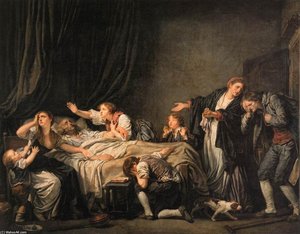
The Father's Curse: The Son Punished
 Acrylic On Canvas
- WallArt
- Rococo Sentimentality
 1777
1777 130.0 x 163.0 cm
 Louvre
A Descent into Sorrow and Moral Judgment
Jean-Baptiste Greuze's "The Father’s Curse: The Son Punished," painted in 1777, isn’t merely a depiction of a family scene; it’s a profound exploration of familial duty, transgression, and the weighty consequences of youthful rebellion. This oil on canvas, now residing within the hallowed halls of the Louvre, immediately draws the viewer into a tableau of palpable grief and simmering resentment. The composition is meticulously crafted – a frieze-like arrangement that unfolds with dramatic precision, mirroring the narrative’s emotional intensity. Greuze masterfully employs a muted palette dominated by somber browns, grays, and deep blues, creating an atmosphere thick with melancholy and foreboding. The figures are rendered with a remarkable degree of realism, yet imbued with an almost theatrical quality, as if caught in a moment frozen for eternity.
The Roots of Sentimentality and Moralizing Genre
Greuze, a pivotal figure in the transition from Rococo to Neoclassicism, carved out his unique niche within the burgeoning genre painting scene of 18th-century France. He wasn’t interested in grand historical narratives or mythological allegories; instead, he focused on capturing the raw emotions and moral dilemmas of everyday life – a trend known as “sentimentality.” “The Father’s Curse” exemplifies this approach perfectly. It's rooted in a biblical parable—the story of the prodigal son—but Greuze doesn’t simply retell it; he amplifies its emotional core, emphasizing the father’s anguish and the son’s profound regret. This focus on moral instruction was a hallmark of his work, reflecting the prevailing social values of the time, where art was often seen as a tool for shaping virtuous behavior.
A Study in Gesture and Dramatic Lighting
Greuze's technical skill is evident in every brushstroke. He utilizes dramatic chiaroscuro – the stark contrast between light and shadow – to heighten the emotional impact of the scene. The father, a towering figure consumed by grief, dominates the left side of the canvas, his outstretched hand conveying an overwhelming sense of condemnation. The son, hunched over and bearing the weight of his transgression, is rendered with a heartbreaking vulnerability. Notice how Greuze captures the subtle nuances of their gestures – the furrowed brows, the slumped shoulders, the averted gazes – each detail contributing to the overall narrative of despair and regret. The careful attention to anatomical accuracy, combined with an expressive use of color and light, elevates this painting beyond mere illustration; it’s a powerful work of art that speaks directly to the viewer's emotions.
Symbolism and the Weight of Inheritance
Beyond its immediate narrative, “The Father’s Curse” is rich in symbolic meaning. The setting – a dimly lit interior with a single window offering a glimpse of the outside world – suggests confinement and isolation. The dog lying at the bottom right corner could represent loyalty or perhaps even complicity in the family's discord. More profoundly, the painting explores the theme of inherited guilt and responsibility. The father’s curse isn’t simply a punishment for the son’s actions; it’s a legacy passed down through generations, a constant reminder of past transgressions. The image powerfully suggests that choices have consequences, and that familial bonds can be both a source of strength and a burden.
A Timeless Exploration of Human Emotion
“The Father’s Curse: The Son Punished” remains a compelling work of art centuries after its creation. Its exploration of universal themes – guilt, forgiveness, family loyalty, and the consequences of disobedience – continues to resonate with audiences today. Reproductions of this iconic painting offer a window into the emotional landscape of 18th-century France, while also serving as a poignant reminder of the enduring complexities of human relationships. It’s a testament to Greuze's ability to capture the raw essence of human experience and translate it onto canvas with remarkable skill and sensitivity.
Jean-Baptiste Greuze (1725 – 1805)
Jean-Baptiste Greuze (1725–1805): Französischer Maler des Rokoko, berühmt für seine emotionalen Genrebilder & Porträts, die Alltagsszenen und moralische Lehren darstellen. Entdecken Sie seine Meisterwerke!
Louvre (Paris, Frankreich)
Paris Frankreich Entdecken Sie den Louvre in Paris! Meisterwerke wie die Mona Lisa & Venus von Milo erwarten Sie. Eine Reise durch Kunstgeschichte vom alten Ägypten bis zur Renaissance. Louvre Musée du Louvre Frankreich Paris Louvre Museum Mona Lisa 8.7 Millionen (2024) 380.000+ Objekte Kunstmuseum 1793 Eine königliche Residenz 3 Wofür wurde der Louvre ursprünglich gebaut?
Über dieses Kunstwerk
- Titel: The Father's Curse: The Son Punished
- Künstler: Jean-Baptiste Greuze
- Jahr: 1777
- Originalmaße: 130.0 x 163.0 cm
- Format: Landscape
- Urheberrechtlicher Status: Gemeinfreiheit
- Ausstellung/Standort: Louvre
- Schöpferische Phase: Mature Rococo
- Kontext des Korpus: sentimentality , religious parable
- Verwendungszweck: Statement
Eckdaten
- Location: Louvre, Paris
- Year: 1777
- Influences: Religious parable
- Medium: Oil on canvas
- Notable elements: Dramatic family scene
- Subject or theme: Family conflict, morality
- Title: The Father’s Curse
QR-Code


