

 Vorschau anzeigen
 Versenden
 Teilen
 Details anzeigen

 Herunterladen
 Ähnliche Objekte
 Röntgenaufnahme
 Diashow
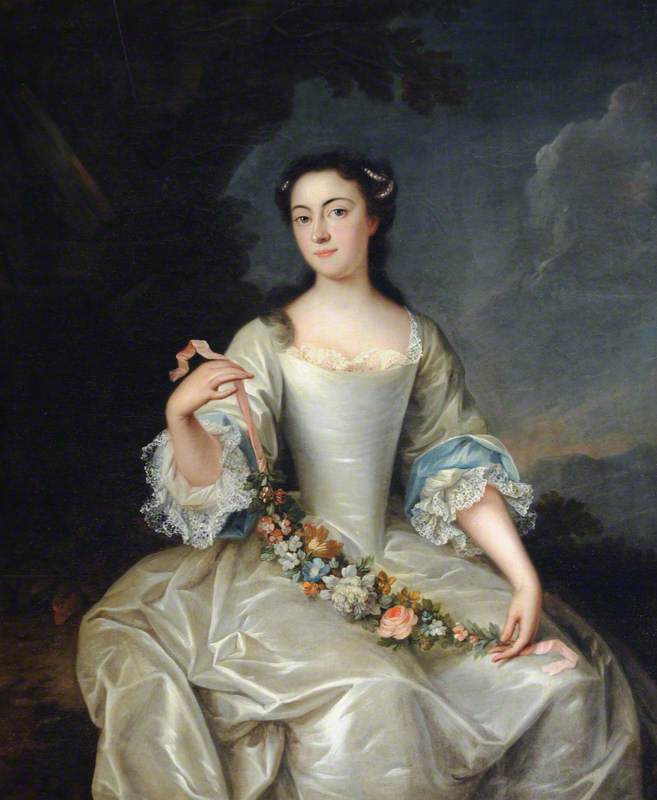
Mary Harpur (d.1752), Lady Holte ( )
 125.0 x 99.0 cm
 National Trust
 Weiterlesen
Handgefertigte Ölreproduktion
Handgemaltes Ölgemälde auf Leinwand in Ihrer Wunschgröße und mit Rahmen, auf Bestellung von unseren Künstlern angefertigt. ( Druck bestellen Bild kaufen)




































Wählen Sie aus unseren vordefinierten Formaten, die den ursprünglichen Proportionen des Kunstwerks entsprechen.

Sie können Ihre eigenen Maße eingeben, um einen bestimmten Rahmen oder Platz auszufüllen. Wenn die gewählte Größe nicht den Proportionen des Originalbildes entspricht, werden wir das Kunstwerk entweder beschneiden oder das Gemälde durch zusätzliche, handgemalte Elemente erweitern. Ein digitales Mockup wird Ihnen zur Genehmigung zugesandt, bevor die Produktion beginnt.
Bitte beachten Sie, dass die Bildschirmvorschau nicht die tatsächliche Beschneidung oder Erweiterung widerspiegelt. Nur das Mockup zeigt die endgültige Komposition exakt an.
Obwohl Sondermaße verfügbar sind, empfehlen wir, eine Größe aus der vordefinierten Liste zu wählen, um die ursprünglichen Proportionen beizubehalten.
Nach der Bestellung wird das ArtsDot.com-Team dem Kunden Anweisungen per E-Mail zusenden und eine Mockup-Vorschau bereitstellen.
Weltweiter Versand () in nur 3 bis 4 Wochen statt der üblichen 5 Wochen. (27 August). Keine Kompromisse bei der Qualität.

Kostenloser weltweiter Expressversand

Hochwertige Leinenleinwand

Umfassender Versicherungsschutz beim Versand

Zollgebühren-Rückerstattungsgarantie

Garantie für exakte Farbtreue

60 Tage Rückgaberecht (nur bei Mängeln)

100% Geld-zurück-Garantie

Mengenrabatt verfügbar
 Die Glasoption ist nur für Größen unter 110 cm verfügbar.

Mary Harpur (d.1752), Lady Holte ( )
Art der Reproduktion
Format der Reproduktion
-


Gesamtpreis
$ 263
Ähnliche Kunstwerke










Über den Künstler
The Knellerian Echo: The Life and Legacy of Isaac Whood
In the vibrant, shifting landscape of eighteenth-century London, few artists captured the dignified essence of the British aristocracy as faithfully as Isaac Whood. Born in 1689 in Lacey, Surrey, Whood emerged not merely as a painter, but as a master craftsman capable of channeling the profound aesthetic power of his era. While history often remembers him through the lens of his influences, Whood carved out a distinct space for himself within the prestigious circles of Lincoln's Inn Fields, establishing a reputation for portraits that resonated with both elegance and psychological depth.
Whood’s artistic journey was shaped by a lineage of greatness. His early training under the legendary William Hogarth provided him with a foundational understanding of the stylistic innovations of the Rococo period, yet it was his subsequent apprenticeship under Sir Godfrey Kneller that would define his creative soul. As a pupil of Kneller, Whood became an expert in the "Knellerian" style—a method characterized by luminous flesh tones, the delicate rendering of drapery, and a masterful command of chiaroscuro. This ability to manipulate light and shadow allowed him to breathe life into his subjects, creating portraits that felt less like static images and more like living presences.
A Mastery of Portraiture and Patronage
The breadth of Whood’s oeuvre, spanning approximately 150 paintings, reveals an artist deeply embedded in the social fabric of his time. He possessed a rare talent for capturing the specific nuances of character, particularly in his portraits of women, which were widely regarded as some of the finest of the period. His career was bolstered by significant aristocratic patronage, most notably from John Russell, the 4th Duke of Bedford. Through this connection, Whood contributed to the grand visual history of Woburn Abbey, painting numerous members of the illustrious Spencer and Russell families.
Whood’s technical repertoire extended beyond mere imitation; he was a painter of profound texture and composition. His works often displayed a restrained palette that eschewed the flamboyant ornamentation common among his contemporaries in favor of a more classical, enduring beauty. Notable examples of his skill include:
- Samuel Gale (1730): A striking depiction of the esteemed physician, where Whood utilizes dramatic lighting to convey a sense of dignified composure.
- Two Boys with Greyhounds: An evocative piece that captures the spirited energy of youth set against the noble, textured presence of the hounds.
- Portrait of a Lady in White Satin: A testament to his ability to render the tactile luxury of fabric and the soft glow of skin through Baroque techniques.
- Elizabeth, Marchioness of Lindsey (1736): A stunning display of exquisite detail and aristocratic grace.
Historical Significance and Artistic Endurance
Though often described as an imitator due to his devotion to Kneller’s aesthetic, such a label fails to capture the true essence of Whood’s contribution to British art. He was a vital custodian of a specific classical tradition, ensuring that the grandeur of the late seventeenth and early eighteenth centuries was preserved through meticulous realism. His work at prestigious institutions, such as Winchester College and Trinity College, Cambridge, serves as a permanent record of the era's intellectual and social elite.
Whood’s death on 24 February 1752 marked the end of a prolific career, yet his influence lingers in the halls of history. By blending the foundational principles learned from Hogarth with the sophisticated portraiture techniques of Kneller, Isaac Whood created a bridge between eras. His paintings remain more than mere historical artifacts; they are windows into the soul of an age defined by grace, status, and an unwavering pursuit of aesthetic perfection.
isaac whood
1689 - 1752
Kurzinfos
- Artistic Movement Or Style: Godfrey Kneller Style
- Artists Who Influenced This Artist: ['Godfrey Kneller']
- Date Of Birth: 1689
- Date Of Death: 1752
- Full Name: Isaac Whood
- Nationality: English
- Notable Artworks:
- Two Boys with Greyhounds
- Samuel Gale
- Place Of Birth: England

