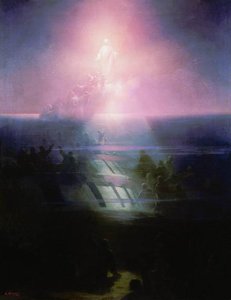
 Vorschau anzeigen
 Versenden
 Teilen
 Details anzeigen

 Herunterladen
 Ähnliche Objekte
 Röntgenaufnahme
 Diashow
 Stats
StatsGalleon in the Fog


 Weiterlesen
Handgefertigte Ölreproduktion
Handgemaltes Ölgemälde auf Leinwand in Ihrer Wunschgröße und mit Rahmen, auf Bestellung von unseren Künstlern angefertigt. ( Switch to Print Switch to Digital Image)




P118B $10

P118H $10

P118W $10

P438Z $10

P508JH $12

P508YH $12

P805H $10

P805Z $10

P919BZ $10

P919G $10

P919XJ $10

P959ZH $10

P968JZ $12

W106C $8

W218G $10

W218JH $8

W218Y $10

W307PJ $10

W316G $10

W316PJ $8

W316Y $10

W398PJ $8

W4111J $10

W500HY $15

W500JH $15

W692G $12

W849H $8

W940BG $15

W953PJ $8




Wählen Sie aus unseren vordefinierten Formaten, die den ursprünglichen Proportionen des Kunstwerks entsprechen.

Sie können Ihre eigenen Maße eingeben, um einen bestimmten Rahmen oder Platz auszufüllen. Wenn die gewählte Größe nicht den Proportionen des Originalbildes entspricht, werden wir das Kunstwerk entweder beschneiden oder das Gemälde durch zusätzliche, handgemalte Elemente erweitern. Ein digitales Mockup wird Ihnen zur Genehmigung zugesandt, bevor die Produktion beginnt.
Bitte beachten Sie, dass die Bildschirmvorschau nicht die tatsächliche Beschneidung oder Erweiterung widerspiegelt. Nur das Mockup zeigt die endgültige Komposition exakt an.
Obwohl Sondermaße verfügbar sind, empfehlen wir, eine Größe aus der vordefinierten Liste zu wählen, um die ursprünglichen Proportionen beizubehalten.
Nach der Bestellung wird das ArtsDot.com-Team dem Kunden Anweisungen per E-Mail zusenden und eine Mockup-Vorschau bereitstellen.
Weltweiter Versand () in nur 3 bis 4 Wochen statt der üblichen 5 Wochen. (7 September). Keine Kompromisse bei der Qualität.

Kostenloser weltweiter Expressversand

Hochwertige Leinenleinwand

Umfassender Versicherungsschutz beim Versand

Zollgebühren-Rückerstattungsgarantie

Garantie für exakte Farbtreue

100-Tage-Rückgaberecht (nur bei Mängeln)

100% Geld-zurück-Garantie

Mengenrabatt verfügbar
 Die Glasoption ist nur für Größen unter 110 cm verfügbar.

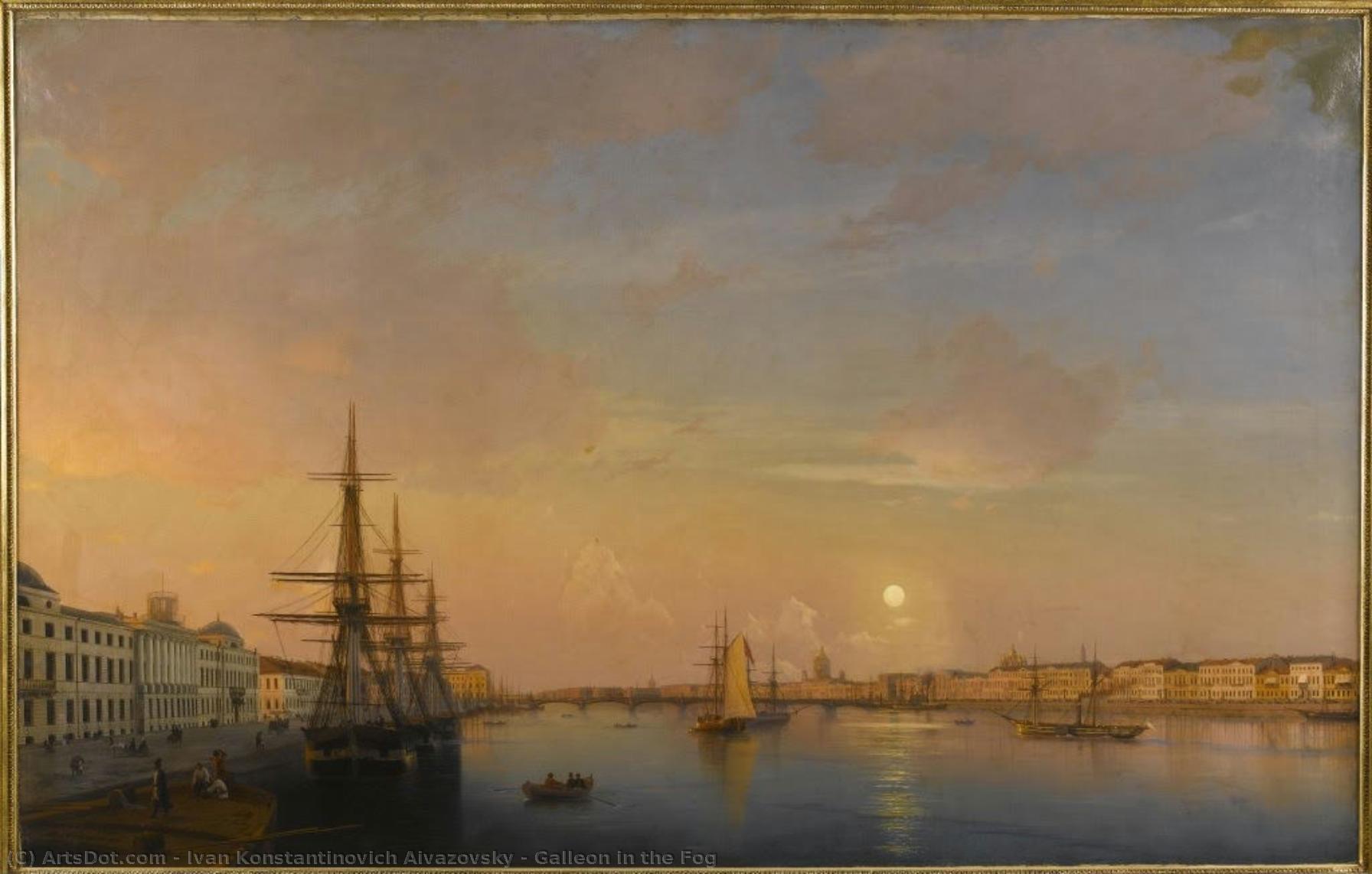
Galleon in the Fog
Art der Reproduktion
Format der Reproduktion
-


Gesamtpreis
$ 263
The Storm Within: Ivan Aivazovsky’s ‘Galleon in the Fog’
Ivan Konstantinovich Aivazovsky's “Galleon in the Fog” isn’t merely a seascape; it’s an immersion into the very soul of the sea. Painted around 1850, this monumental canvas captures not just a fleeting moment but a profound emotional experience – the raw power and unsettling beauty of a storm brewing on the Black Sea. Aivazovsky, born in Feodosia, Crimea, possessed an almost preternatural connection to the ocean; his life was inextricably linked to its moods, its rhythms, and its capacity for both breathtaking serenity and terrifying fury. This painting is a testament to that bond, a distillation of decades spent observing and translating the sea’s complex language onto canvas.
The scene unfolds with an almost claustrophobic intensity. A lone galleon, barely discernible through the swirling, impenetrable fog, struggles against the relentless onslaught of waves. The ship, rendered in muted tones of grey and brown, appears small and vulnerable, a tiny speck swallowed by the immensity of the storm. Aivazovsky masterfully employs a technique known as ‘atmospheric perspective’ – or ‘aerial perspective’ – to create an illusion of depth and distance. He achieves this through subtle gradations of color and tone; the distant horizon is washed out in pale blues and greys, while the foreground is dominated by dark, brooding hues. This creates a sense of vastness and isolation, drawing the viewer into the heart of the storm.
Romantic Sensibility: A Window to the Soul
Aivazovsky’s work firmly resides within the Romantic movement, a period characterized by an intense focus on emotion, imagination, and the sublime power of nature. Unlike earlier depictions of maritime scenes that prioritized accuracy and detail, Aivazovsky prioritizes capturing the *feeling* of being at sea – the apprehension, the awe, the vulnerability. The painting isn’t about charting a ship's course; it’s about conveying the psychological impact of confronting an overwhelming force.
The use of light is particularly striking. It’s not bright or cheerful; instead, it’s diffused and melancholic, filtered through the fog and reflected off the turbulent waves. Aivazovsky employs a technique called ‘chiaroscuro,’ using dramatic contrasts between light and shadow to heighten the emotional intensity of the scene. The flashes of white foam against the dark backdrop create a sense of drama and urgency, while the subtle gradations of grey evoke a feeling of unease and foreboding. The painting is not simply depicting a storm; it’s embodying its essence – a swirling vortex of chaos and beauty.
Echoes of History: A Crimean Painter's Vision
Born in Feodosia, Crimea, Aivazovsky’s life was deeply intertwined with the Black Sea. His family had roots in the region dating back centuries, and he spent his childhood immersed in its maritime culture. This intimate connection profoundly shaped his artistic vision. He wasn't just painting what he saw; he was translating his own experiences of the sea – its moods, its dangers, its allure – onto canvas.
Interestingly, Aivazovsky’s career spanned nearly six decades, and he continued to refine his technique throughout his life. He spent considerable time in Italy during his early years, studying with renowned artists and absorbing the influence of Italian landscape painting. However, it was his return to Russia that truly cemented his legacy as a master of marine art. His work was highly regarded by the Russian Imperial Court, and he received numerous accolades for his artistic achievements. The painting “Galleon in the Fog” is considered one of his most important works, exemplifying his mastery of light, color, and composition.
Symbolism and Emotional Resonance
Beyond its technical brilliance, "Galleon in the Fog" resonates with profound symbolic meaning. The lone galleon represents humanity’s vulnerability in the face of nature's power – a poignant reminder of our insignificance within the vastness of the universe. The fog itself symbolizes uncertainty and obscurity, while the storm embodies chaos and destruction. Yet, amidst this turmoil, there is also a sense of beauty and grandeur—a testament to the enduring allure of the sea.
Reproductions of “Galleon in the Fog” capture much of the original’s emotional depth, offering a captivating glimpse into Aivazovsky's artistic vision. It’s a piece that invites contemplation, prompting viewers to reflect on their own relationship with nature and the enduring mysteries of the sea.
Ähnliche Kunstwerke
Über den Künstler
Ivan Konstantinovich Aiwazowski: Ein Leben auf See
- Geboren: Feodosia, Russland (1817)
- Gestorben: 1900
- Herkunft: ArtsDot
- Stil: Russischer Romantischer Maler, Marinekunst
Frühes Leben und Ausbildung
- Ivan Konstantinovich Aiwazowski, getauft Hovhannes Aivazian, wurde am 29. Juli 1817 in Feodosia, Krim, in einer armenischen Familie geboren.
- Er erhielt seine frühe Schulbildung an der St.-Sargis-Armenisch-Kirche in Feodosia.
- Sein künstlerisches Talent wurde früh erkannt; er studierte Zeichnen unter Jacob Koch, einem lokalen Architekten.
- Im Jahr 1833 zog Aiwazowski nach Sankt Petersburg, um an der Kaiserlichen Akademie der Künste unter Maxim Worobjow zu studieren.
Karriere und künstlerische Entwicklung
- Aiwazowski reiste in den frühen 1840er Jahren ausgedehnt durch Europa und verbrachte Zeit in Italien.
- Nach seiner Rückkehr nach Russland wurde er zum Hauptmaler der russischen Marine ernannt, eine Position, die seine Karriere maßgeblich beeinflusste.
- Er entwickelte einen unverwechselbaren Stil, der sich durch dramatische und eindringliche Darstellungen von Meereslandschaften auszeichnete, oft mit turbulentem Wasser und mächtigen Stürmen.
- Aiwazowskis Werke zeigten häufig Seekämpfe und Szenen aus dem Seemannsleben und spiegelten seine enge Verbindung zur russischen Militär-Elite wider.
- Sein umfangreicher Output umfasste rund 6.000 Gemälde im Laufe seiner Karriere.
Hauptwerke und künstlerische Einflüsse
- Meeresansicht mit Vollmond: Ein Paradebeispiel für Aiwazowskis Meisterschaft in Licht und Atmosphäre bei der Darstellung des Meeres.
- Ein Schiff auf stürmischer See: Demonstriert seine Fähigkeit, die Kraft und Gefahr der Natur zu vermitteln.
- Der Gondoliere auf See bei Nacht: Zeigt sein Können, nächtliche Szenen mit bemerkenswerter Detailtreue einzufangen.
- Chaos (Die Schöpfung): Ein frühes Werk, das von Papst Gregor XVI. erworben wurde und eine göttliche Tat der Schöpfung darstellt.
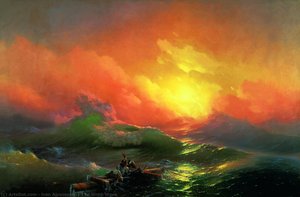
- Die Neunte Welle: Arguabelt sein berühmtestes Gemälde, das eine dramatische Szene von Schiffbruchüberlebenden zeigt, die sich an Trümmer klammern.
Historische Bedeutung und Vermächtnis
- Aiwazowski gilt als einer der größten Meister der Marinekunst in der russischen Geschichte.
- Seine Werke werden für ihren Romantik, ihre technische Fertigkeit und ihre Fähigkeit gelobt, kraftvolle Emotionen hervorzurufen.
- Er leistete einen bedeutenden Beitrag zur Entwicklung der russischen Landschaftsmalerei und beeinflusste Generationen von Künstlern.
- Aiwazowskis Gemälde sind weiterhin beliebt und werden weltweit in Museen und Galerien ausgestellt.
- Sein Vermächtnis inspiriert weiterhin Kunstliebhaber und Künstler gleichermaßen und festigt seine Position als eine herausragende Figur der Kunst des 19. Jahrhunderts.
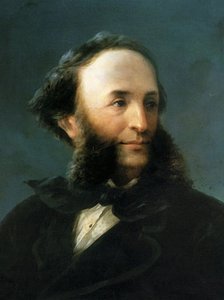
Iwan Aiwazowski
1817 - 1900 , Russland
Kurzinfos
- Bemerkenswerte Werke:
- Meereslandschaft mit Vollmond
- Ein Schiff in stürmischer See
- Der Gondoliere auf See bei Nacht
- Chaos (Die Schöpfung)
- Die Neunte Welle
- Geburtsdatum: 29. Juli 1817
- Künstler, Die Diesen Künstler Beeinflussten:
- Maxim Worobjow
- J.M.W. Turner
- Künstlerische Bewegung: Russischer Romantik, Marinekunst
- Nationalität: Russisch, Armenisch
- Vollständiger Name: Iwan Konstantinowitsch Aiwasowski
Ähnliche Artikel
Ivan Aivazovsky: Licht und Emotion – Die Meisterschaft der Marinemalerei im 19. Jahrhundert
Entdecken Sie die faszinierende Welt von Ivan Aivazovsky! Erfahren Sie mehr über den Meister der Marinemalerei, seine einzigartigen Techniken und die emotionale Tiefe seiner Seestücke. Jetzt lesen!

Romantic Realism's Finest: 10 Masterpieces for Your Home | ArtsDot
Explore 10 defining masterpieces of Romantic Realism! Discover Courbet, Millet & Daumier's powerful paintings—capturing emotion and social realities. Find museum-quality reproductions for your home at ArtsDot.com.
The Allure of the Horizon: A Comprehensive Exploration of Seascape Art Through History & Emotion
Explore the captivating world of seascape art! Discover its history, key artists & movements – from Dutch Masters to Impressionism. Expert insights for collectors and enthusiasts at ArtsDot.
The Azure Depths: Exploring Representations of the Ocean in Art History
Explore the rich history of ocean art! Discover Romantic seascapes, renowned artists like Aivazovsky & Harris, and expert guidance for collectors at ArtsDot.com.

Die Top 10 berühmter Gemälde im Reich der dunklen Töne |
Entdecken Sie die Top 10 berühmter Gemälde, beherrscht von dunklen Tönen! Von Caravaggio bis Manet – erfahren Sie die Geschichten hinter Meisterwerken der Kunstgeschichte. Finden Sie Ihre perfekte Reproduktion auf .