 Vorschau anzeigen
 Versenden
 Teilen
 Details anzeigen

 Herunterladen
 Ähnliche Objekte
 Röntgenaufnahme
 Diashow
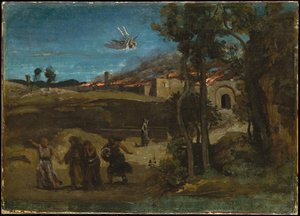
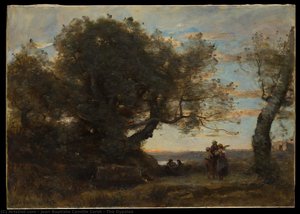
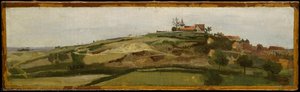
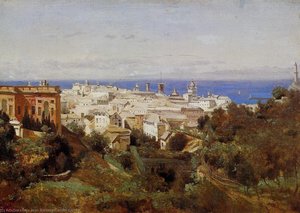
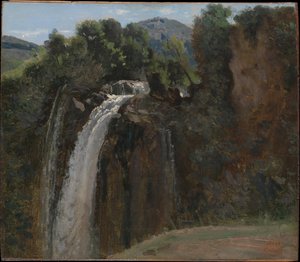
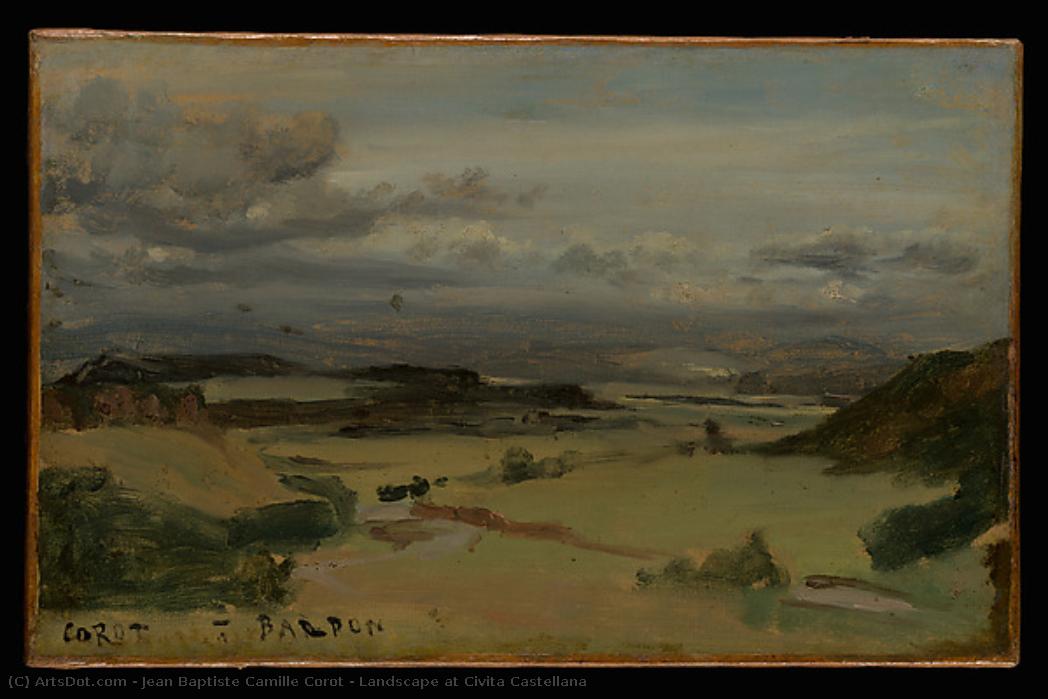
Landscape at Civita Castellana


 Weiterlesen
Giclée / Kunstdruck
Giclée- oder Leinwanddruck in Museumsqualität mit schneller Produktion und flexiblen Veredelungsoptionen. ( Handgemalte Reproduktion bestellen Bild kaufen)




P118B $10

P118H $10

P118W $10

P438Z $10

P508JH $12

P508YH $12

P805H $10

P805Z $10

P919BZ $10

P919G $10

P919XJ $10

P959ZH $10

P968JZ $12

W106C $8

W218G $10

W218JH $8

W218Y $10

W307PJ $10

W316G $10

W316PJ $8

W316Y $10

W398PJ $8

W4111J $10

W500HY $15

W500JH $15

W692G $12

W849H $8

W940BG $15

W953PJ $8




Wählen Sie aus unseren vordefinierten Formaten, die den ursprünglichen Proportionen des Kunstwerks entsprechen.

Sie können Ihre eigenen Maße eingeben, um ein bestimmtes Format oder einen speziellen Platz einzupassen. Wenn das von Ihnen gewählte Format nicht den Proportionen des Originalbildes entspricht, werden wir das Kunstwerk entweder beschneiden oder das Bild mit einem gespiegelten oder einfarbigen Rand erweitern. Ein digitaler Entwurf wird Ihnen zur Genehmigung zugesandt, bevor die Produktion beginnt.
Bitte beachten Sie, dass die Vorschau auf dem Bildschirm nicht den tatsächlichen Zuschnitt oder die Erweiterung widerspiegelt. Nur der Entwurf zeigt die endgültige Komposition präzise an.
Obwohl Sondermaße verfügbar sind, empfehlen wir die Auswahl eines Maßes aus der vordefinierten Liste, um die ursprünglichen Proportionen zu bewahren.
Weltweiter Versand () innerhalb von 2 Wochen statt der üblichen 4/5 Wochen. (29 August)

Kostenloser weltweiter Expressversand

Hochwertige Leinenleinwand

Umfassender Versicherungsschutz beim Versand

Zollgebühren-Rückerstattungsgarantie

Garantie für exakte Farbtreue

60 Tage Rückgaberecht (nur bei Mängeln)

100% Geld-zurück-Garantie

Mengenrabatt verfügbar
 Die Glasoption ist nur für Größen unter 110 cm verfügbar.

Landscape at Civita Castellana
Giclée / Kunstdruck
Format der Reproduktion
-


Gesamtpreis
$ 62
A Breath of Tuscan Light: Exploring Corot’s Landscape at Civita Castellana
Jean-Baptiste-Camille Corot's "Landscape at Civita Castellana," completed in 1827, stands as a testament to the Romantic preoccupation with capturing the sublime beauty of the natural world. More than just a picturesque depiction of the Tuscan countryside—a region that captivated artists and writers alike during the early 19th century—the painting embodies Corot’s revolutionary approach to landscape art, prioritizing immediacy and emotional resonance over meticulous topographical accuracy. Situated approximately thirty miles north of Rome, Civita Castellana offered Corot an unparalleled opportunity to observe the dramatic interplay between light and shadow across rolling hills and distant mountains. This journey into rural Italy wasn't merely a commission; it was a deeply personal exploration fueled by a lifelong fascination with the transformative power of nature.The Technique of Atmospheric Impressionism
Corot’s method distinguishes itself from earlier landscape traditions, rejecting academic conventions in favor of what would become known as atmospheric impressionism. Rather than painstakingly rendering every detail—a hallmark of Neoclassical painters—he sought to convey the essence of a scene through loose brushstrokes and subtle color gradations. He employed a palette dominated by muted greens, blues, and browns, skillfully blending pigments wet-on-wet to achieve an ethereal luminosity that captures the fleeting effects of sunlight filtering through clouds. The artist’s technique is characterized by rapid execution—a deliberate decision to seize upon the initial impression of the landscape—resulting in canvases imbued with a palpable sense of spontaneity and movement. Notice particularly how Corot utilizes thin washes of color to suggest distant mountains, creating an illusion of depth without resorting to linear perspective.Symbolism Within the Landscape
Beyond its technical brilliance, “Landscape at Civita Castellana” resonates with symbolic significance rooted in Romantic thought. The expansive vista represents not merely a visual spectacle but also a reflection of humanity’s relationship with the cosmos—a confrontation with both grandeur and vulnerability. The muted colors evoke feelings of tranquility and contemplation, inviting viewers to immerse themselves in the stillness of the countryside. Furthermore, Corot's depiction of the solitary figure—presumably himself—observing the landscape underscores the Romantic ideal of communion with nature as a pathway to spiritual enlightenment. This individual’s presence serves as a focal point for conveying the emotional impact of the scene, emphasizing the transformative potential of experiencing beauty firsthand.Historical Context and Artistic Legacy
Painted during a period marked by intellectual ferment—the rise of Romanticism challenged Enlightenment rationalism—Corot's work aligns with broader artistic trends aimed at elevating emotion over reason. He was among the vanguard of artists experimenting with new approaches to color and brushwork, paving the way for Impressionist painters like Claude Monet and Pierre-Auguste Renoir. “Landscape at Civita Castellana” remains a cornerstone of Corot’s oeuvre and exemplifies his unwavering commitment to portraying the sublime beauty of the natural world with unparalleled sensitivity and artistic innovation. Its enduring appeal lies in its ability to transport viewers back to 1827 Tuscany, capturing not only the visual splendor of the landscape but also the profound emotional experience of witnessing a moment of breathtaking artistry.A Timeless Inspiration
Today, reproductions of “Landscape at Civita Castellana” continue to inspire interior designers and art lovers alike. Its serene composition and masterful use of light serve as a reminder that true beauty resides in simplicity—in embracing the immediacy of observation and allowing oneself to be captivated by the transformative power of nature’s grandeur. The painting's legacy extends far beyond its artistic merits, embodying the Romantic spirit’s belief in art as a conduit for spiritual contemplation and offering an enduring testament to Corot’s genius.Ähnliche Kunstwerke
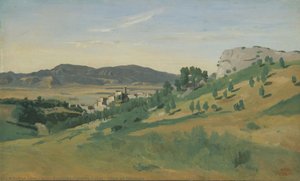
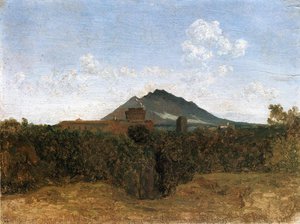
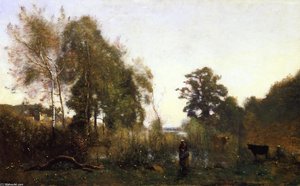

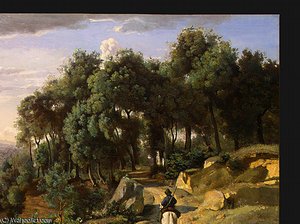
Über den Künstler
Frühe Jahre und Ausbildung
Jean-Baptiste-Camille Corot, ein renommierter französischer Landschafts- und Porträtmaler, wurde am 16. Juli 1796 in Paris geboren. Seine Familie, die zum Bürgertum gehörte, bot ihm eine Umgebung, die seine künstlerischen Neigungen förderte. Anfänglich lagen Corots Interessen woanders, doch er entdeckte um 1821 seine Leidenschaft für das Malen. Dies markierte den Beginn seiner produktiven Karriere, die später die Entwicklung des Impressionismus beeinflussen sollte.Künstlerische Laufbahn und bedeutende Werke
Corots künstlerischer Weg ist geprägt von einer Mischung aus neoklassischer Tradition und plein-air Innovationen. Er kombinierte sorgfältige Kompositionen mit der direkten Beobachtung der Natur im Freien, was zu einer einzigartigen Atmosphäre in seinen Werken führte. Zu seinen bemerkenswertesten Arbeiten zählen:- Die Ruhe (La Repose) (Öl auf Leinwand, ca. 1860er Jahre), ein fesselndes Werk, das Corots Meisterschaft in der Darstellung von Gelassenheit zeigt.
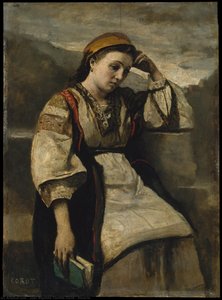
- Unterbrochenes Lesen (Lecture Interrompue) (Realismus, Öl, ca. 1850er Jahre), ein ergreifendes Beispiel für Corots Fähigkeit, den Alltag mit Tiefe und Emotion darzustellen.
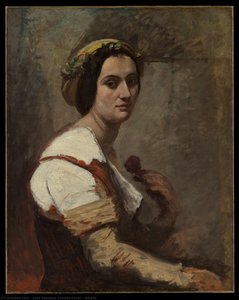
- Agostina (Realismus, Öl, ca. 1860er Jahre), ein beeindruckendes Porträt, das Corots Geschicklichkeit in der Darstellung des Wesens seiner Motive veranschaulicht.
Einflüsse und Entwicklung
Corots künstlerische Entwicklung wurde von verschiedenen Einflüssen geprägt. Er studierte zunächst bei den neoklassizistischen Malern Jacques-Louis David und Jean-Antoine Houdon, was seine frühen Werke beeinflusste. Später fand er Inspiration in der Landschaftsmalerei des 17. Jahrhunderts, insbesondere bei Meistern wie Claude Lorrain und Nicolas Poussin. Corot entwickelte jedoch seinen eigenen Stil, indem er die klassische Komposition mit den direkten Beobachtungen der Natur im Freien verband. Er gilt als Brücke zwischen dem Klassizismus und dem Impressionismus. Seine Plein-Air-Malerei war revolutionär für seine Zeit und ebnete den Weg für zukünftige Generationen von Künstlern, darunter die Impressionisten.Vermächtnis und Bedeutung
Corots umfangreicher Output hatte einen nachhaltigen Einfluss auf die Entwicklung der Landschaftsmalerei. Sein innovativer Ansatz, traditionelle Techniken mit plein-air Innovationen zu verbinden, ebnete den Weg für zukünftige Generationen von Künstlern. Obwohl er zu Lebzeiten nicht immer Anerkennung fand, wurde Corot nach seinem Tod als einer der wichtigsten französischen Maler des 19. Jahrhunderts anerkannt. Seine Werke werden heute in bedeutenden Museen auf der ganzen Welt ausgestellt und seine Bedeutung für die Kunstgeschichte ist unbestreitbar. Entdecken Sie mehr über Jean-Baptiste-Camille Corots Gemälde auf ArtsDot.com: https://ArtsDot.com/@/jean-baptiste-camille-corot Erfahren Sie mehr über das Musée Courbet auf Wikipedia: https://en.wikipedia.org/wiki/mus%c3%a9e_courbet_(ornans,_france)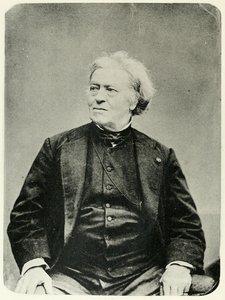
Jean-Baptiste-Camille Corot
1796 - 1875 , Frankreich
Kurzinfos
- Beeinflusste Künstler: ['Gustave Courbet']
- Bemerkenswerte Werke:
- Die Ruhe
- Unterbrochenes Lesen
- Agostina
- Geburtsdatum: 16. Juli 1796
- Geburtsort: Paris, Frankreich
- Künstlerische Richtung: Neoklassizismus, Pleinair
- Nationalität: Französisch
- Sterbedatum: 1875
- Vollständiger Name: Jean-Baptiste-Camille Corot
- Von Künstlern Beeinflusst: ['Keine Angaben']
Ähnliche Artikel

Die 10 legendärsten Aquarellwerke der Kunstgeschichte – Meisterwerke für Ihr Zuhause
Entdecken Sie die 10 legendärsten Aquarellwerke der Kunstgeschichte! Von Turner bis Monet – erleben Sie die Geschichten, Techniken & Farben dieser Meisterwerke. Finden Sie hochwertige Kunstdrucke auf ArtsDot.com und gestalten Sie Ihr Zuhause mit zeitloser Eleganz.

Ephemeral Visions: Exploring the Artistic Legacy & Contemporary Practice of Watercolor Painting
Explore the captivating world of watercolor painting! Discover its rich history, essential techniques, influential artists & collecting tips. A comprehensive guide for art enthusiasts from ArtsDot.

Flüchtige Visionen: Die Geschichte und emotionale Resonanz der Aquarellmalerei
Entdecken Sie die faszinierende Welt der Aquarellmalerei! Von historischen Ursprüngen bis zu modernen Techniken – wir bieten Expertenwissen, Inspiration und Tipps für Anfänger & Fortgeschrittene.

John Constable: Die 25 Meisterwerke des englischen Landschaftsgenies – ArtsDot
Entdecken Sie die 25 Meisterwerke von John Constable! Erleben Sie englische Landschaftsmalerei vom Hay Wain bis zur Stour Valley. Hochwertige Reproduktionen & Kunst für Ihr Zuhause auf ArtsDot.com.

Ephemeral Visions: Exploring the Artistic Legacy & Nuances of Watercolor Painting
Explore the captivating world of watercolor painting! Discover its rich history, essential techniques, influential artists & collecting tips from art experts. A comprehensive guide for enthusiasts.