 Vorschau anzeigen
 Versenden
 Teilen
 Details anzeigen

 Herunterladen
 Ähnliche Objekte
 Röntgenaufnahme
 Diashow
 Stats
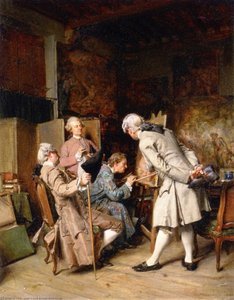
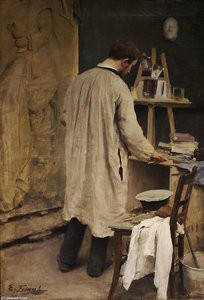
StatsAn Artist Showing his Work


 Weiterlesen
Giclée / Kunstdruck
Giclée- oder Leinwanddruck in Museumsqualität mit schneller Produktion und flexiblen Veredelungsoptionen. ( Handgemalte Reproduktion bestellen Switch to Digital Image)




P118B $10

P118H $10

P118W $10

P438Z $10

P508JH $12

P508YH $12

P805H $10

P805Z $10

P919BZ $10

P919G $10

P919XJ $10

P959ZH $10

P968JZ $12

W106C $8

W218G $10

W218JH $8

W218Y $10

W307PJ $10

W316G $10

W316PJ $8

W316Y $10

W398PJ $8

W4111J $10

W500HY $15

W500JH $15

W692G $12

W849H $8

W940BG $15

W953PJ $8




Wählen Sie aus unseren vordefinierten Formaten, die den ursprünglichen Proportionen des Kunstwerks entsprechen.

Sie können Ihre eigenen Maße eingeben, um ein bestimmtes Format oder einen speziellen Platz einzupassen. Wenn das von Ihnen gewählte Format nicht den Proportionen des Originalbildes entspricht, werden wir das Kunstwerk entweder beschneiden oder das Bild mit einem gespiegelten oder einfarbigen Rand erweitern. Ein digitaler Entwurf wird Ihnen zur Genehmigung zugesandt, bevor die Produktion beginnt.
Bitte beachten Sie, dass die Vorschau auf dem Bildschirm nicht den tatsächlichen Zuschnitt oder die Erweiterung widerspiegelt. Nur der Entwurf zeigt die endgültige Komposition präzise an.
Obwohl Sondermaße verfügbar sind, empfehlen wir die Auswahl eines Maßes aus der vordefinierten Liste, um die ursprünglichen Proportionen zu bewahren.
Weltweiter Versand () innerhalb von 2 Wochen statt der üblichen 4/5 Wochen. (8 September)

Kostenloser weltweiter Expressversand

Hochwertige Leinenleinwand

Umfassender Versicherungsschutz beim Versand

Zollgebühren-Rückerstattungsgarantie

Garantie für exakte Farbtreue

100-Tage-Rückgaberecht (nur bei Mängeln)

100% Geld-zurück-Garantie

Mengenrabatt verfügbar
 Die Glasoption ist nur für Größen unter 110 cm verfügbar.

An Artist Showing his Work
Giclée / Kunstdruck
Format der Reproduktion
-


Gesamtpreis
$ 62
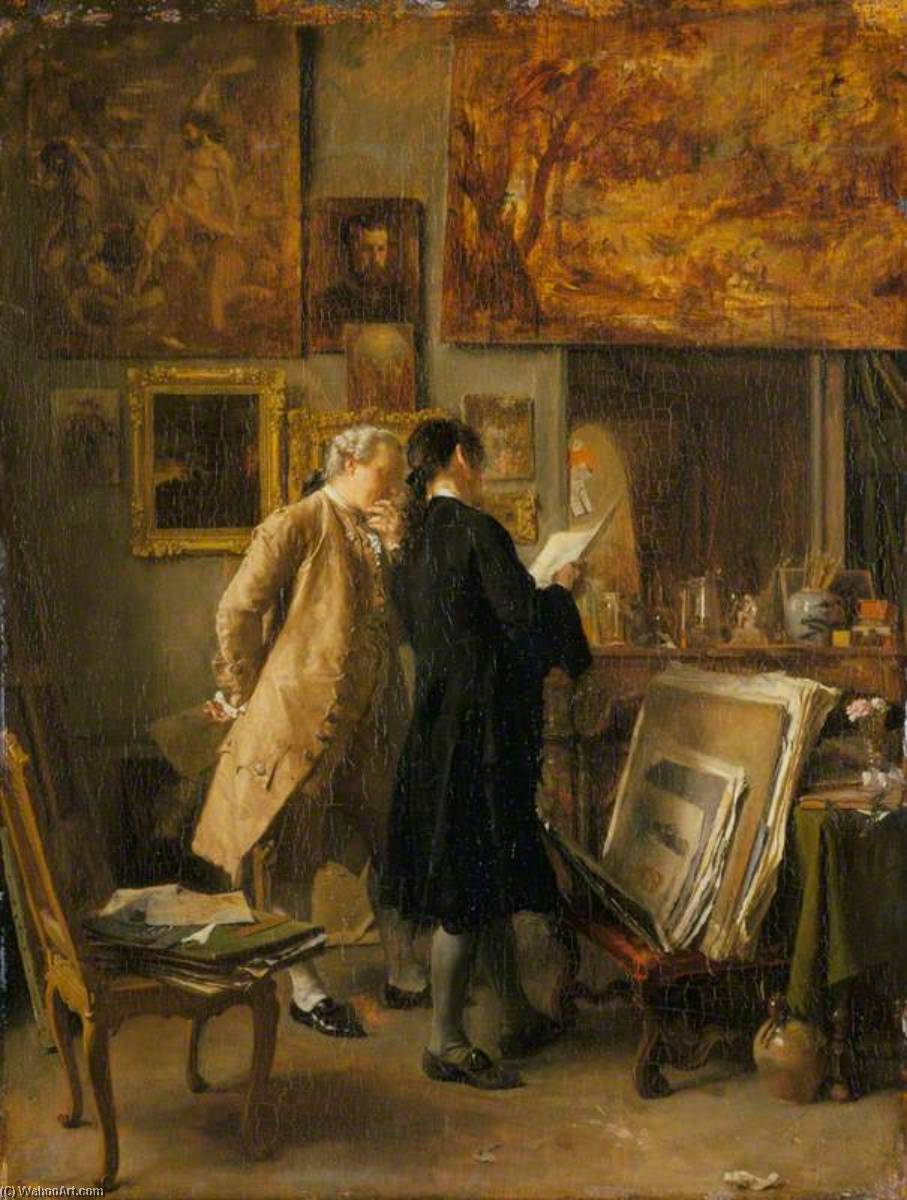
A Moment of Shared Observation: Decoding Meissonier’s “An Artist Showing His Work”
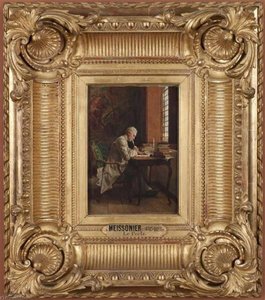
Jean-Louis Ernest Meissonier's "An Artist Showing His Work" is not merely a portrait; it’s a carefully constructed tableau vivant, a frozen moment brimming with intellectual and artistic exchange. Painted circa 1850 during the height of his career, this work offers a glimpse into the vibrant salon culture of mid-19th century France – a world where art was both a profession and a passionate pursuit. The scene unfolds within a modestly furnished room, dominated by an easel displaying Meissonier’s own paintings, subtly suggesting the artist's position as a respected figure within his milieu. The composition is deliberately restrained, eschewing dramatic gestures or overt displays of emotion in favor of a quiet, contemplative atmosphere. This deliberate restraint speaks volumes about Meissonier’s artistic philosophy – he wasn’t interested in grand spectacle but rather in capturing the nuances of human interaction and the subtle power dynamics inherent in artistic discourse.
- The Subjects: Two men are central to the scene, one clearly the artist himself (Meissonier), and the other a younger gentleman, likely an aspiring painter or art critic. Their postures – the artist gesturing towards his work with a measured hand, the observer leaning forward with intense scrutiny – convey a palpable sense of engagement.
- The Setting: The room itself is meticulously rendered, hinting at a comfortable yet slightly cluttered domestic space. Bookshelves line one wall, suggesting an intellectual environment, while a table laden with objects—bottles, books, and perhaps a partially consumed meal—adds to the scene’s realism and sense of everyday life.
- Color Palette: Meissonier employs a muted palette dominated by browns, ochres, and grays, creating a subdued and intimate atmosphere. The use of light is particularly effective, highlighting the faces of the figures and casting subtle shadows that add depth and dimension to the scene.
Meissonier’s Academic Roots and Realist Innovations
Jean-Louis Ernest Meissonier's artistic journey is a fascinating study in evolution. Initially trained under Léon Cogniet, he quickly absorbed the principles of French academic painting – a style characterized by meticulous detail, classical composition, and a focus on historical or mythological subjects. However, Meissonier’s true genius lay in his ability to synthesize these traditional techniques with emerging realist sensibilities. He was deeply influenced by the Dutch Masters—particularly Gabriel Metsu and Gerard Douw—whose intimate portraits of everyday life captivated him with their subtle lighting, atmospheric effects, and psychological depth. This influence is evident in “An Artist Showing His Work,” where Meissonier masterfully captures the fleeting expressions and nuanced interactions between his subjects, moving beyond mere representation to convey a sense of lived experience.
Meissonier’s dedication to historical painting, particularly his depictions of Napoleonic campaigns, earned him considerable fame. Yet, he consistently sought to elevate these grand narratives through meticulous realism, meticulously recreating uniforms, weaponry, and battle scenes with astonishing accuracy. “An Artist Showing His Work,” however, offers a departure from this heroic subject matter, focusing instead on the quieter realm of artistic exchange.Symbolism and the Dialogue of Art
Beyond its surface depiction, “An Artist Showing His Work” is rich in symbolic meaning. The act of showing one’s work represents not just a professional obligation but also an invitation to critique, judgment, and ultimately, artistic validation. The younger gentleman's intense gaze suggests a desire for knowledge and understanding—he seeks to absorb the artist’s wisdom and gain insight into his creative process. The subtle tension between the two men hints at a potential rivalry or a complex relationship built on mutual respect and intellectual curiosity. The room itself can be interpreted as a microcosm of the art world – a space where ideas are exchanged, reputations are forged, and artistic legacies are established.
- The Easel: The central focus of the painting, the easel symbolizes the artist’s creative output and his position within the artistic community.
- The Observer's Posture: His attentive gaze signifies a genuine interest in the artist’s work and a desire for intellectual engagement.
- The Room Itself: Represents the environment of artistic discourse, where ideas are debated and reputations are shaped.
A Legacy of Detail and Intimacy
“An Artist Showing His Work” stands as a testament to Meissonier’s extraordinary skill and his ability to capture the essence of human interaction with remarkable precision. The painting's meticulous detail—from the texture of the fabrics to the subtle nuances of facial expression—demands close observation, inviting viewers to linger and decipher the unspoken dynamics between the figures. It is a poignant reminder that even in the most seemingly ordinary moments, there lies a wealth of meaning waiting to be discovered. Reproductions of this captivating work offer an opportunity to bring this intimate scene into your home, serving as a beautiful conversation piece and a window into the world of 19th-century French art.
Ähnliche Kunstwerke
Über den Künstler
Frühes Leben und Ausbildung
Jean-Louis Ernest Meissonier, ein renommierter französischer Maler und Bildhauer, wurde am 21. Februar 1815 in Lyon, Frankreich, geboren. Sein Vater, Charles, erwartete, dass er ihm in dessen Fußstapfen treten und ein erfolgreicher Geschäftsmann werden würde, doch Meissoniers Leidenschaft galt der Malerei. Im Alter von siebzehn Jahren erhielt er die Erlaubnis seiner Eltern, eine künstlerische Karriere zu verfolgen. Seine frühe Ausbildung umfasste das Studium bei Léon Cogniet und wurde durch die niederländischen Meister beeinflusst, die er im Louvre studierte. Diese Grundlage sollte später seinen unverwechselbaren Stil prägen.Aufstieg zur Prominenz
Meissoniers Durchbruch gelang ihm mit seinem Gemälde *Les Bourgeois Flamands* (flämische Bürger), auch bekannt als *Der Besuch beim Burgomeister*, das in der Salon-Ausstellung von 1831 gezeigt wurde. Dieses Werk, heute Teil der Sammlung von Sir Richard Wallace im Hertford House in London, markierte den Beginn seines Erfolgs mit mikroskopisch detaillierten Miniaturen in Ölfarben.- Meissoniers nachfolgende Werke, wie *Das Schachspiel* (1841), *Der junge Mann beim Cello* (1842) und *Der Maler in seinem Atelier* (1843), festigten seinen Ruf für akribische Handwerkskunst.
- Seine Heirat mit Emma Steinhel, einer protestantischen Frau aus Straßburg, im Jahr 1838 markierte einen bedeutenden persönlichen Meilenstein.
- Meissoniers Engagement in der Nationalgarde während der Juni-Tage von 1848 unterstrich sein Engagement für die republikanische Regierung.
Künstlerisches Schaffen und Vermächtnis
Meissonier wird oft als der französische Metsu bezeichnet, ein Hinweis auf den niederländischen Maler Gabriel Metsu, der für seine Miniaturen von bürgerlichen Hausszenen bekannt war. Meissoniers Werke zeichnen sich durch ihre mikroskopischen Details aus und umfassen:- *Halt an einer Taverne*, im Besitz des Duc de Morny.
- *Die Schlägerei*, im Besitz von Königin Victoria.
- *Die Spieler und der Streit* (*La Rixe*), die dem englischen Hof von Napoleon III. geschenkt wurde.
Einflüsse und Bedeutung
Meissonier war ein bedeutender Vertreter des französischen Klassizismus im 19. Jahrhundert. Seine akribische Detailgenauigkeit und die Darstellung bürgerlicher Szenen spiegeln den Zeitgeist seiner Epoche wider. Er beeinflusste zahlreiche nachfolgende Künstler und trug zur Entwicklung der akademischen Malerei bei. Seine Werke sind heute in bedeutenden Museen weltweit zu sehen, darunter das Musée d'Orsay in Paris. Meissonier hinterließ ein bleibendes Vermächtnis als Meister der Miniaturenmalerei und als Chronist des französischen Bürgertums im 19. Jahrhundert.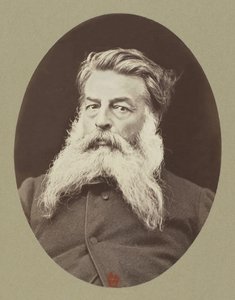
Jean-Louis Ernest Meissonier
1815 - 1891 , Frankreich
Kurzinfos
- Bemerkenswerte Werke:
- Les bourgeois flamands
- Das Schachspiel
- Der junge Cellist
- Halt an einer Herberge
- Der Kaiser bei Solferino
- Einflussreiche Künstler:
- Gabriel Metsu
- Léon Cogniet
- Geburtsdatum: 21. Februar 1815
- Geburtsort: Lyon, Frankreich
- Künstlerischer Stil: Französischer Klassizismus
- Nationalität: Französisch
- Sterbedatum: 1891
- Vollständiger Name: Jean-Louis Ernest Meissonier
Ähnliche Artikel

Echoes of Society: Exploring Social Realism's Enduring Legacy in Art
Explore the powerful world of Social Realism art! Discover key artists, masterpieces & its profound social commentary. Expert insights into this influential movement's history and enduring legacy.

Romantic Realism's Finest: 10 Masterpieces for Your Home | ArtsDot
Explore 10 defining masterpieces of Romantic Realism! Discover Courbet, Millet & Daumier's powerful paintings—capturing emotion and social realities. Find museum-quality reproductions for your home at ArtsDot.com.
The Evocative Embrace of Reality: Exploring Romantic Realism in 19th-Century Painting
Explore the captivating world of Romantic Realism! Discover key artists like Courbet & Millet, masterpieces, and the social context behind this influential art movement. Expert insights for collectors at ArtsDot.
Jean-Louis Ernest Meissonier: Realismus, historische Erzählung und künstlerische Perfektion
Entdecken Sie das Werk von Jean-Louis Ernest Meissonier – Meister des Realismus und der Historienmalerei! Detaillierte Analysen, Hintergrundinformationen & Informationen zum Kauf von Reproduktionen auf ArtsDot.com.
The Poetic Truth of Observation: Exploring 19th-Century Realism in Painting
Explore the captivating world of 19th-century Realism! Discover key artists like Courbet & Millet, masterpieces, and the powerful social commentary behind this influential art movement. Expert insights at ArtsDot.