 Vorschau anzeigen
 Versenden
 Teilen
 Details anzeigen

 Herunterladen
 Ähnliche Objekte
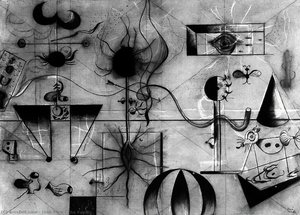
 Röntgenaufnahme
 Diashow
 Stats
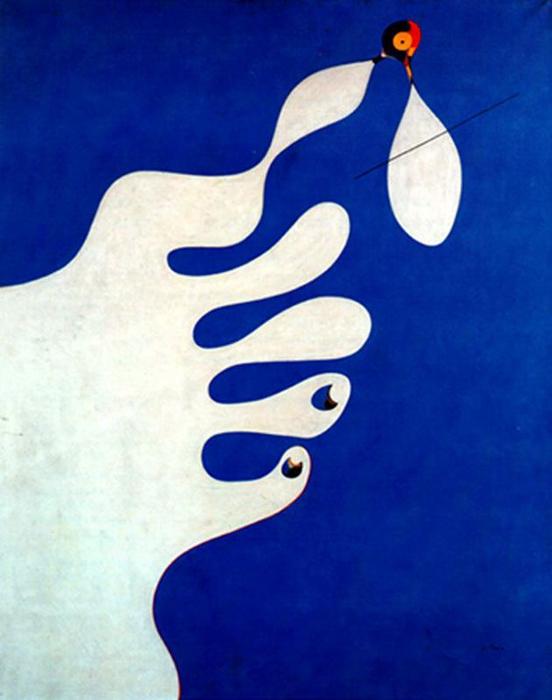
StatsMano apresando un pájaro


 Weiterlesen
Giclée / Kunstdruck
Giclée- oder Leinwanddruck in Museumsqualität mit schneller Produktion und flexiblen Veredelungsoptionen. ( Handgemalte Reproduktion bestellen Switch to Digital Image)




P118B $10

P118H $10

P118W $10

P438Z $10

P508JH $12

P508YH $12

P805H $10

P805Z $10

P919BZ $10

P919G $10

P919XJ $10

P959ZH $10

P968JZ $12

W106C $8

W218G $10

W218JH $8

W218Y $10

W307PJ $10

W316G $10

W316PJ $8

W316Y $10

W398PJ $8

W4111J $10

W500HY $15

W500JH $15

W692G $12

W849H $8

W940BG $15

W953PJ $8




Wählen Sie aus unseren vordefinierten Formaten, die den ursprünglichen Proportionen des Kunstwerks entsprechen.

Sie können Ihre eigenen Maße eingeben, um ein bestimmtes Format oder einen speziellen Platz einzupassen. Wenn das von Ihnen gewählte Format nicht den Proportionen des Originalbildes entspricht, werden wir das Kunstwerk entweder beschneiden oder das Bild mit einem gespiegelten oder einfarbigen Rand erweitern. Ein digitaler Entwurf wird Ihnen zur Genehmigung zugesandt, bevor die Produktion beginnt.
Bitte beachten Sie, dass die Vorschau auf dem Bildschirm nicht den tatsächlichen Zuschnitt oder die Erweiterung widerspiegelt. Nur der Entwurf zeigt die endgültige Komposition präzise an.
Obwohl Sondermaße verfügbar sind, empfehlen wir die Auswahl eines Maßes aus der vordefinierten Liste, um die ursprünglichen Proportionen zu bewahren.
Weltweiter Versand () innerhalb von 2 Wochen statt der üblichen 4/5 Wochen. (7 September)

Kostenloser weltweiter Expressversand

Hochwertige Leinenleinwand

Umfassender Versicherungsschutz beim Versand

Zollgebühren-Rückerstattungsgarantie

Garantie für exakte Farbtreue

100-Tage-Rückgaberecht (nur bei Mängeln)

100% Geld-zurück-Garantie

Mengenrabatt verfügbar
 Die Glasoption ist nur für Größen unter 110 cm verfügbar.

Mano apresando un pájaro
Giclée / Kunstdruck
Format der Reproduktion
-


Gesamtpreis
$ 62
Mano apresando un pájaro: A Catalan Dreamscape by Joan Miró
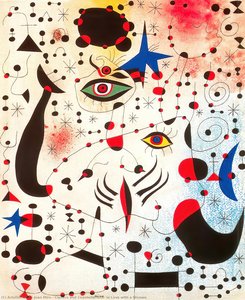
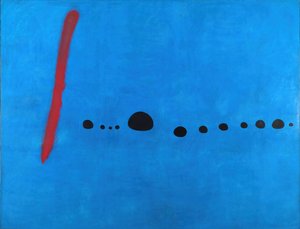
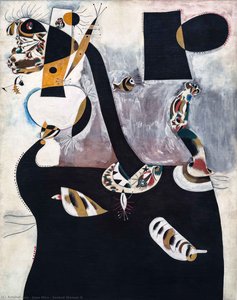
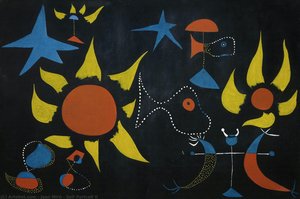
Joan Miró’s “Mano apresando un pájaro” (Hand Pressing a Bird) is more than just an abstract composition; it's a deeply personal and evocative exploration of the subconscious, rendered in the signature blue hues that define much of his oeuvre. Painted by one of the most significant figures in 20th-century art, this piece embodies Miró’s unique ability to translate dreams, memories, and Catalan identity onto canvas with a poetic visual language. The artwork immediately draws the viewer into a world where logic yields to intuition, and familiar forms—a hand, a bird, an apple, a clock—collide in a dance of symbolic meaning.
A Visionary’s Palette and Technique
- Style: Miró's style is characterized by its vibrant use of color, particularly blues, reds, and yellows, combined with biomorphic shapes and playful distortions. “Mano apresando un pájaro” exemplifies this approach, employing bold strokes and a seemingly spontaneous application of paint to create a dynamic and energetic surface.
- Technique: Miró frequently utilized a technique he called "automatism," allowing his hand to move freely across the canvas, guided by instinct rather than conscious control. This process resulted in works that appear both chaotic and meticulously planned, reflecting the artist’s desire to tap into the realm of the unconscious. The layering of paint creates depth and texture, inviting close inspection and encouraging multiple interpretations.
- Color Palette: The dominant blue color evokes a sense of tranquility and mystery, while also referencing the Catalan landscape—the Mediterranean Sea and the sky—a recurring theme in Miró’s work.
Symbolism and Interpretation
The central image – a hand reaching out to capture a bird – is rich with symbolic potential. The hand, often interpreted as representing humanity's desire for connection or control, attempts to grasp the fleeting nature of freedom embodied by the bird. This gesture can be seen as an allegory for the artist’s own pursuit of creative expression and his struggle to reconcile himself with the world around him. The apple, a traditional symbol of temptation and knowledge, adds another layer of complexity, while the clock suggests the passage of time and the ephemeral nature of existence. Miró's work frequently explores themes of childhood, memory, and the relationship between humans and nature.
Historical Context and Catalan Identity
"Mano apresando un pájaro" was created during a period of significant artistic innovation in Europe, yet Miró remained steadfastly rooted in his Catalan heritage. Influenced by the organic forms of Antoni Gaudí’s architecture and the rugged beauty of the Catalan landscape, Miró's work reflects a deep connection to his homeland. This piece is part of a larger body of work that explores themes of Catalan identity and folklore, often incorporating elements of traditional Catalan art and culture. The artwork speaks to a broader movement within 20th-century art—a rejection of representational realism in favor of subjective expression and the exploration of inner worlds.
Emotional Impact and Artistic Significance
Ultimately, “Mano apresando un pájaro” is a profoundly moving work that invites viewers to contemplate fundamental questions about life, freedom, and the human condition. Its dreamlike quality and evocative symbolism create an atmosphere of mystery and wonder, prompting introspection and encouraging multiple interpretations. As one of Joan Miró’s most iconic pieces, it stands as a testament to his genius and his enduring legacy as a visionary artist.
Ähnliche Kunstwerke
Über den Künstler
**frühes Leben und Karriere**
joan miró, ein renommierter spanischer Maler, Bildhauer und Keramiker, wurde am 20. April 1893 in Barcelona, Spanien, geboren. Seine Familie, von jüdischen (Marrano oder Konverso) Wurzeln, hatte einen bedeutenden Einfluss auf sein frühes Leben. Mirós Vater, Miquel Miró Adzerias, war Goldschmied und Uhrmacher, was möglicherweise der Künstlersein Interesse an komplizierten Details inspirierte.**Künstlerische Entwicklung**
Miró begann mit sieben Jahren mit Zeichenunterricht in einer privaten Schule in Barcelona. Später nahm er am Kunstakademie La Llotja auf, trotz Ablehnung durch seinen Vater. Dies markierte den Beginn von Mirós künstlerischer Reise, die schließlich zu seiner Pionierarbeit im Surrealismus und abstrakter Kunst führte.**Bekannte Werke und Kooperationen**
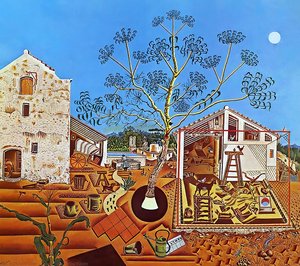
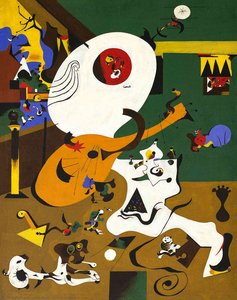
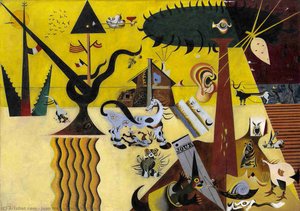
* The Farm (1922), ein Gemälde, das Mirós Übergang zu einem individuelleren Stil zeigt, mit nationalistischen Zügen. * Zusammenarbeit mit Max Ernst bei der Gestaltung von Sergei Diaghilews Ballett 1926, die die Technik des Grattage begründete. * The Dutch Interiors (1928), eine Reihe von Gemälden, inspiriert von Hendrik Martenszoon Sorth und Jan Steen, die Mirós einzigartigen Stil zeigt.**Museen und Vermächtnis**
* Die Fundació Joan Miró in Barcelona, gegründet 1975, die Mirós Werke präsentiert. * Die Fundació Pilar i Joan Miró in Palma de Mallorca, gegründet 1981, festigte Mirós Vermächtnis weiter.**Wichtige Werke und ihre Bedeutung**
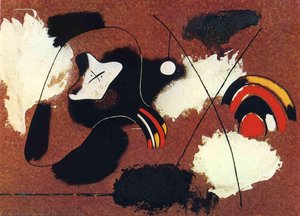
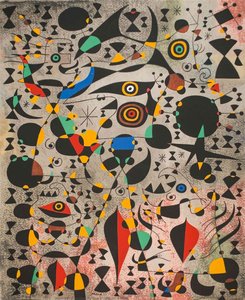
- Painting (1933), ein abstraktes Ölgemälde, das Mirós surrealistische Vision veranschaulicht.
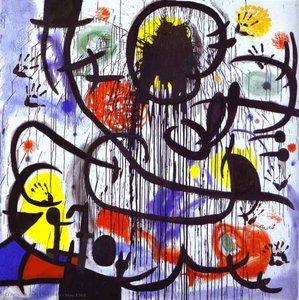
- Pintura 11, ein weiteres bemerkenswertes abstraktes Werk, das Mirós einzigartigen Stil zeigt.
- The Ear of Corn (37 x 46 cm), ein surrealistisches Werk, das komplizierte Details zeigt.
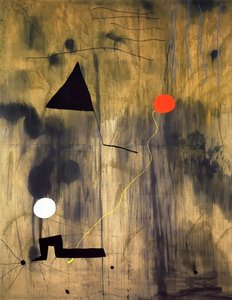
- The Birth of Day, ein abstraktes Kunstwerk, das Mirós Beiträge zur abstrakten Kunst weiter festigt.
**Fazit**
Mirós Vermächtnis als Pionier des Surrealismus und der abstrakten Kunst ist unbestreitbar. Seine Werke, die in verschiedenen Museen ausgestellt werden, darunter die Fundació Joan Miró, inspirieren weiterhin Künstler und Kunstliebhaber gleichermaßen. Für weitere Informationen über Mirós Werke besuchen Sie [https://ArtsDot.com/@/joan-miro](https://ArtsDot.com/@/joan-miro) oder erkunden Sie seine bemerkenswerten Werke unter [https://ArtsDot.com/@@/8ewky5-joan-miro-painting](https://ArtsDot.com/@@/8ewky5-joan-miro-painting).- Mehr Kunstwerke von Joan Miró auf ArtsDot.com
- Entdecken Sie das Museum Fundació Joan Miró in Barcelona, Spanien
- Erkunden Sie die Biografie und bemerkenswerten Werke des Künstlers unter [https://en.wikipedia.org/wiki/joan_mir%c3%b3](https://en.wikipedia.org/wiki/joan_mir%c3%b3)
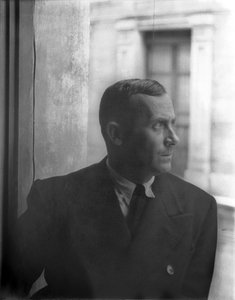
Joan Miró
1893 - 1983 , Spanien
Kurzinfos
- Beeinflusste Künstler:
- Vincent van Gogh
- Paul Cézanne
- Bemerkenswerte Werke:
- Die Farm (1922)
- Dutch Interiors (1928)
- Gemälde (1933)
- Geburtsdatum: 20. April 1893
- Geburtsort: Barcelona, Spanien
- Künstlerischer Stil: Surrealismus, abstrakte Kunst
- Nationalität: Spanisch
- Todatum: 1983
- Vollständiger Name: Joan Miró i Ferrà
Ähnliche Artikel
Joan Mirós Meisterwerke: Die Top 25 für Kunstliebhaber & stilvolles Wohnen
Entdecken Sie die Top 25 Gemälde von Joan Miró! Tauchen Sie ein in die Welt des Surrealismus, abstrakter Kunst & katalanischer Farben. Hochwertige Kunstdrucke & Reproduktionen für Ihr Zuhause – jetzt auf ArtsDot.com!

Kandinsky: Die 25 Meisterwerke des Abstrakten – Kunst für Ihr Zuhause | ArtsDot
Entdecken Sie die 25 bedeutendsten Gemälde von Wassily Kandinsky! Tauchen Sie ein in die Welt der abstrakten Kunst, des Expressionismus und der Farbkomposition. Hochwertige Kunstdrucke & Inspiration für Ihr Zuhause auf ArtsDot.com.

Serene Blue Backgrounds: Discover Soulful Art to Transform Your Space with Timeless Elegance
Transform your home with soulful blue art. From serene Monet impressions to modern textured sculptures, discover curated masterpieces designed to inspire calm. Explore expert art consultations and bespoke hand-painted reproductions to create your personal sanctuary.
Die Top 10 Gemälde in Schattierungen von 'Slate Blue': Kunst für Ihr Zuhause
Entdecken Sie die Top 10 Gemälde in faszinierenden 'Slate Blue' Tönen! Von Monet bis Manet – erleben Sie Kunstgeschichte und lassen Sie sich von Meisterwerken inspirieren. Hochwertige Kunstdrucke auf
Abstrakter Expressionismus: Die 10 Meisterwerke, die eine Kunstbewegung prägten |
Entdecken Sie die 10 Meisterwerke des Abstrakten Expressionismus! Von Jackson Pollock bis Mark Rothko – erfahren Sie die Geschichten hinter ikonischen Gemälde und finden Sie hochwertige Reproduktionen für Ihr Zuhause. Jetzt bei entdecken!