 Vorschau anzeigen
 Versenden
 Teilen
 Details anzeigen

 Herunterladen
 Ähnliche Objekte
 Röntgenaufnahme
 Diashow
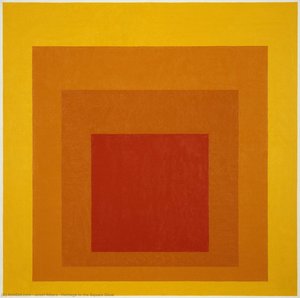
Study for Homage to the Square. Departing in Yellow


 Weiterlesen
Handgefertigte Ölreproduktion
Handgemaltes Ölgemälde auf Leinwand in Ihrer Wunschgröße und mit Rahmen, auf Bestellung von unseren Künstlern angefertigt. ( Druck bestellen Bild kaufen)




P118B $10

P118H $10

P118W $10

P438Z $10

P508JH $12

P508YH $12

P805H $10

P805Z $10

P919BZ $10

P919G $10

P919XJ $10

P959ZH $10

P968JZ $12

W106C $8

W218G $10

W218JH $8

W218Y $10

W307PJ $10

W316G $10

W316PJ $8

W316Y $10

W398PJ $8

W4111J $10

W500HY $15

W500JH $15

W692G $12

W849H $8

W940BG $15

W953PJ $8




Wählen Sie aus unseren vordefinierten Formaten, die den ursprünglichen Proportionen des Kunstwerks entsprechen.

Sie können Ihre eigenen Maße eingeben, um einen bestimmten Rahmen oder Platz auszufüllen. Wenn die gewählte Größe nicht den Proportionen des Originalbildes entspricht, werden wir das Kunstwerk entweder beschneiden oder das Gemälde durch zusätzliche, handgemalte Elemente erweitern. Ein digitales Mockup wird Ihnen zur Genehmigung zugesandt, bevor die Produktion beginnt.
Bitte beachten Sie, dass die Bildschirmvorschau nicht die tatsächliche Beschneidung oder Erweiterung widerspiegelt. Nur das Mockup zeigt die endgültige Komposition exakt an.
Obwohl Sondermaße verfügbar sind, empfehlen wir, eine Größe aus der vordefinierten Liste zu wählen, um die ursprünglichen Proportionen beizubehalten.
Nach der Bestellung wird das ArtsDot.com-Team dem Kunden Anweisungen per E-Mail zusenden und eine Mockup-Vorschau bereitstellen.
Weltweiter Versand () in nur 3 bis 4 Wochen statt der üblichen 5 Wochen. (25 August). Keine Kompromisse bei der Qualität.

Kostenloser weltweiter Expressversand

Hochwertige Leinenleinwand

Umfassender Versicherungsschutz beim Versand

Zollgebühren-Rückerstattungsgarantie

Garantie für exakte Farbtreue

60 Tage Rückgaberecht (nur bei Mängeln)

100% Geld-zurück-Garantie

Mengenrabatt verfügbar
 Die Glasoption ist nur für Größen unter 110 cm verfügbar.

Study for Homage to the Square. Departing in Yellow
Art der Reproduktion
Format der Reproduktion
-


Gesamtpreis
$ 263
Beschreibung des Kunstwerks
A Geometric Meditation on Color and Perception
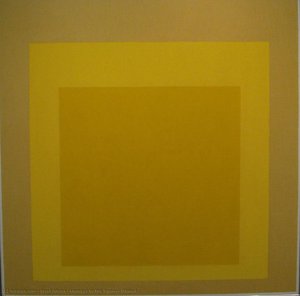
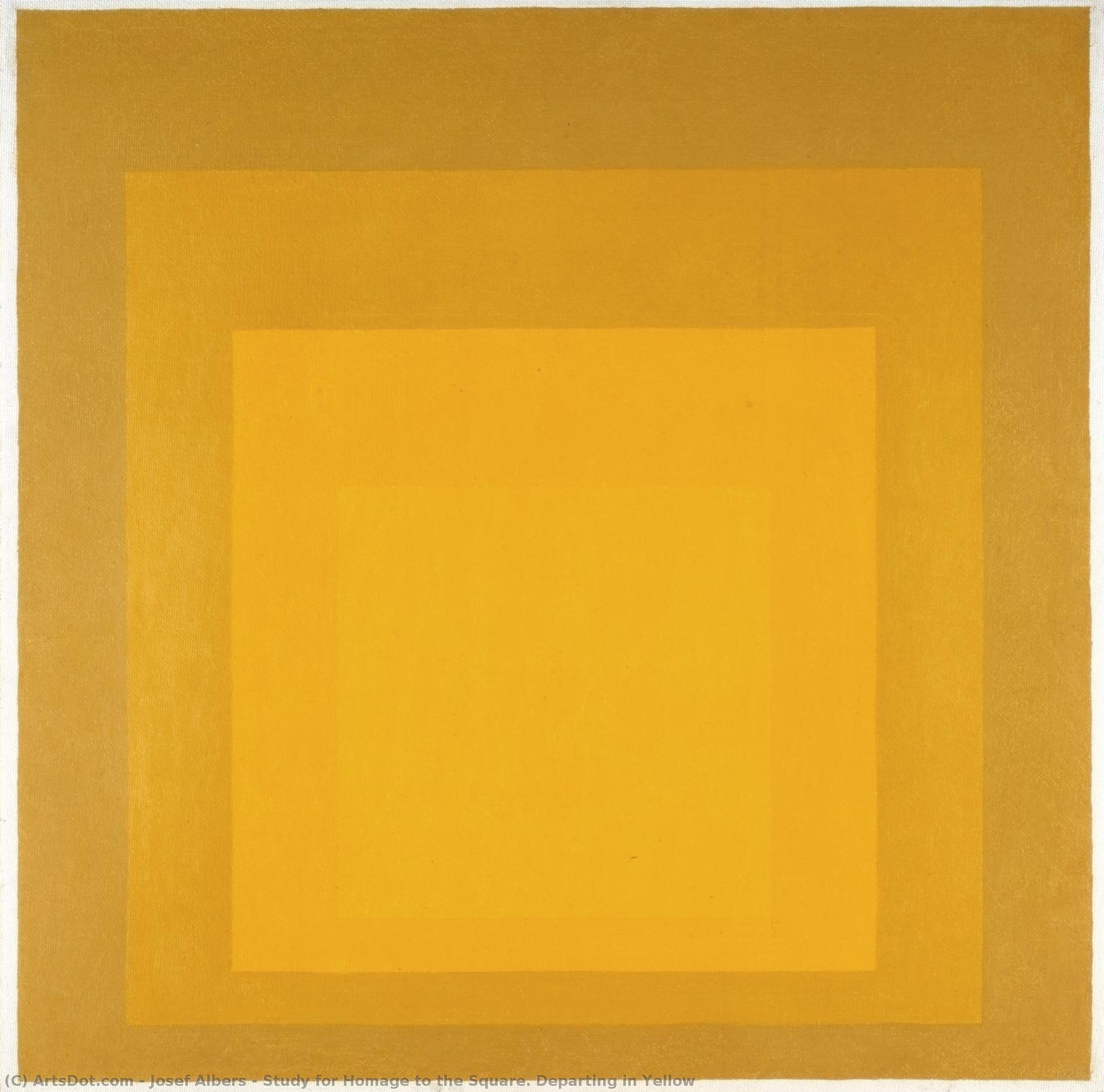
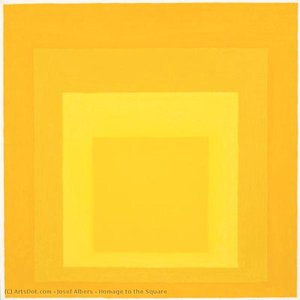
Josef Albers’ “Study for Homage to the Square: Departing in Yellow” isn't merely a painting; it’s an invitation into a carefully constructed world of color, balance, and subtle psychological exploration. Created in 1964 during his prolific period dedicated to understanding the interaction between hues, this work exemplifies Albers’ groundbreaking approach to abstraction – moving beyond representational imagery to delve directly into the fundamental properties of color itself. The piece immediately commands attention with its stark simplicity: a large square divided into four smaller squares, each subtly shifting in tone and saturation. This foundational structure, the “Homage to the Square,” became a cornerstone of Albers’ teaching and artistic practice, allowing him to systematically investigate how colors influence one another, creating an ever-evolving dialogue on the canvas.
- The Palette: The dominant color is a vibrant, almost luminous yellow-orange – Naples Yellows, as noted in archival research – that transitions smoothly into lighter shades within the inner squares. This gradient isn’t random; it's meticulously calculated to demonstrate how adjacent colors affect our perception of each other.
- Geometric Precision: Lines are clean and decisive, defining the boundaries between the squares with sharp edges, a deliberate choice that emphasizes order and control. The composition is rigorously geometric, reflecting Albers’ fascination with mathematical principles and their application to art.
- Minimalist Texture: The surface appears remarkably smooth and flat, devoid of visible brushstrokes or texture. This controlled application of paint speaks to Albers' desire to strip away extraneous elements, focusing solely on the interaction between color itself.
Exploring the Theory of Color Interaction
Albers’ “Homage to the Square” series was born from a deep investigation into the nature of perception and how we experience color. He believed that colors didn't exist in isolation but rather influenced each other, creating a dynamic interplay of visual effects. His research culminated in his seminal book, *Interaction of Color*, which outlined these principles through countless experiments and observations. This particular study exemplifies those theories beautifully – the subtle shifts in hue within each square demonstrate how adjacent tones can intensify or diminish one another, altering our overall perception of the composition. The piece isn’t about depicting a specific scene or object; it's about illustrating the fundamental rules governing color relationships.
Albers famously stated that “color is not what we see, but what we feel,” and this sentiment is powerfully embodied in this work. It invites the viewer to engage with the painting on an emotional level, allowing their own associations and experiences of color to shape their interpretation.Historical Context & Albers’ Legacy
To understand “Study for Homage to the Square: Departing in Yellow,” it's crucial to consider Josef Albers’ broader artistic journey. He began his career as a schoolteacher, developing a keen eye for detail and an appreciation for craftsmanship – skills that would later inform his approach to art. His time at the Bauhaus profoundly influenced his aesthetic sensibilities, introducing him to principles of functional design and geometric abstraction. Following the Bauhaus's closure, Albers continued to refine his theories and techniques, ultimately establishing himself as a leading figure in American Abstract Expressionism. The “Homage to the Square” series represents a culmination of this lifelong exploration, demonstrating his mastery of color theory and his commitment to pushing the boundaries of artistic expression.
Albers’ influence extends far beyond the art world. His teaching methods—emphasizing observation, experimentation, and critical thinking—have shaped generations of artists and designers, leaving a lasting legacy on contemporary visual culture.A Timeless Exploration of Perception
“Study for Homage to the Square: Departing in Yellow” is more than just a visually striking artwork; it’s a profound meditation on color, perception, and the relationship between art and the viewer. Its enduring appeal lies in its simplicity, its intellectual rigor, and its ability to evoke a sense of quiet contemplation. Whether viewed as a scientific study or an emotional experience, this piece continues to challenge our understanding of how we see and feel the world around us. Reproductions capture the subtle nuances of color and form that are essential to appreciating Albers’ genius, offering a window into his meticulously crafted visual language.
Ähnliche Kunstwerke
Über den Künstler
Frühes Leben und Ausbildung
- Geboren: 19. März 1888, Bottrop, Deutschland
- Gestorben: 25. März 1976, New Haven, Connecticut, USA
- Josef Albers wuchs in einer Familie von Handwerkern auf, was eine frühe Wertschätzung für Materialien und Techniken förderte.
- Er arbeitete zunächst von 1908 bis 1913 als Lehrer, bevor er von 1913 bis 1915 an der Königlichen Kunstschule in Berlin eine künstlerische Ausbildung absolvierte.
- Frühe künstlerische Erkundungen umfassten Holzschnitt, Glasmalerei und Malerei. Sein erster öffentlicher Auftrag war ein Glasfenster, „Rosa Mystica Ora Pro Nobis“, im Jahr 1918.
Bauhaus-Zeit und Entwicklung der Theorie
- Im Jahr 1922 trat Albers als Dozent am Bauhaus hinzu, zunächst unterrichtend im Vorbereitungskurs 'Werklehre' (Werkstattpraxis) innerhalb der Designabteilung.
- Seine Zeit am Bauhaus prägte maßgeblich seine künstlerische Philosophie und seinen Ansatz zur Farblehre.
- Er begann systematisch die Wahrnehmungseffekte von Farbverhältnissen zu untersuchen, wobei er sich von der gegenständlichen Kunst abwandte hin zur Abstraktion.
- Der Einfluss von Künstlern wie Paul Klee und Wassily Kandinsky ist in seinen frühen Werken erkennbar, obwohl er eine einzigartige Methodik entwickelte, die auf empirischer Beobachtung anstatt auf metaphysischer Interpretation basierte.
Homage to the Square und chromatische Untersuchungen
- Ab 1949 begann Albers mit seiner berühmtesten Serie, "Homage to the Square". Dieses fortlaufende Projekt bestand aus Gemälden mit ineinander verschachtelten Quadraten innerhalb von Quadraten, die untersuchten, wie Farben interagieren und sich gegenseitig beeinflussen.
- Die Reihe sollte keine Feier der Geometrie sein, sondern vielmehr eine systematische Untersuchung der Farbwahrnehmung und ihrer trügerischen Natur.
- Albers dokumentierte seine Experimente mit Farbe in seinem bahnbrechenden Buch "Interaction of Color" (1963) sorgfältig, das seine Theorie darlegte, wie Farben sich gegenseitig durch interne und oft irreführende Logik steuern.
Lehrerisches Erbe und Einfluss
- Nachdem er das Black Mountain College 1950 verlassen hatte, leitete Albers die Designabteilung der Yale University bis zu seinem Ruhestand im Jahr 1958.
- Er war ein sehr einflussreicher Lehrer, der handwerkliche Experimente und kritische Beobachtung betonte.
- Bemerkenswerte Schüler waren Ruth Asawa, Ray Johnson, Robert Rauschenberg, Cy Twombly und Susan Weil, die alle von seinem Ansatz in der Kunstproduktion beeinflusst wurden.
Historische Bedeutung
- Josef Albers gilt als eine Schlüsselgestalt bei der Entwicklung der abstrakten Kunst und der Farblehre.
- Seine "Homage to the Square"-Reihe ist ikonisch für ihre Erforschung von Wahrnehmungsphänomenen und ihrer minimalistischen Ästhetik geblieben.
- "Interaction of Color" bleibt ein grundlegendes Werk für Künstler, Designer und Pädagogen, die sich mit den Komplexitäten von Farbverhältnissen auseinandersetzen möchten.
- Albers' Betonung empirischer Beobachtung und systematischer Experimente beeinflusste Generationen von Künstlern und festigte seine Position als Pionier der abstrakten Kunst.
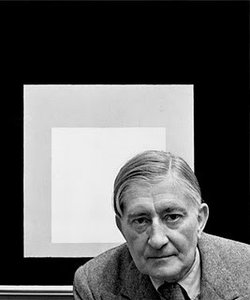
Josef Albers
1888 - 1976 , Deutschland
Kurzinfos
- Beeinflusste Künstler:
- Matisse
- Cézanne
- Klee
- Kandinsky
- Bemerkenswerte Werke: ['Homage to the Square']
- Geburtsdatum: 19. März 1888
- Geburtsort: Bottrop, Deutschland
- Künstlerische Richtung: Abstrakte Kunst
- Nationalität: Deutsch-Amerikanisch
- Sterbedatum: 25. März 1976
- Vollständiger Name: Josef Albers
- Von Künstlern Beeinflusst:
- Paul Klee
- Wassily Kandinsky
Ähnliche Artikel
Josef Albers: Die Hommage an das Quadrat und die Grundlagen der Wahrnehmung
Entdecken Sie das faszinierende Werk von Josef Albers und seine 'Hommage an das Quadrat'. Erfahren Sie mehr über Farbtheorie, Gestaltpsychologie und seinen Einfluss auf die moderne Kunst. Jetzt lesen!

Geometrische Abstraktion: Die 10 Meisterwerke, die Kunstgeschichte prägten | ArtsDot.com
Entdecken Sie die 10 Meisterwerke der geometrischen Abstraktion! Von Kandinsky bis Mondrian – erleben Sie die Geschichte, Farben & Formen dieser revolutionären Kunstrichtung. Hochwertige Kunstreproduktionen auf ArtsDot.com
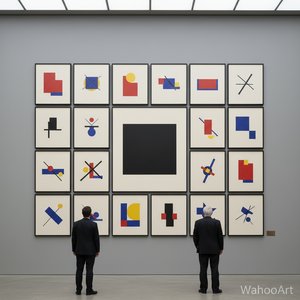
Kazimir Malevich: Die 25 Meisterwerke des Suprematismus für Ihr Zuhause | ArtsDot
Entdecken Sie die 25 Meisterwerke von Kazimir Malevich! Tauchen Sie ein in die Welt des Suprematismus, abstrakter Kunst & geometrischer Formen. Hochwertige Kunstdrucke und Reproduktionen auf ArtsDot.com – für Ihr Zuhause.

Beyond Form & Color: Geometric Abstraction's Enduring Legacy in Art History
Explore the captivating world of geometric abstraction! Discover its origins, key artists like Malevich & Mondrian, and why this movement remains highly valued by art collectors today. Expert insights at ArtsDot.

Beyond Form & Color: Geometric Abstraction's Evolution in 20th/21st Century Art
Explore the evolution of geometric abstraction from Cubism to contemporary art. Discover key artists like Malevich & Mondrian, investment insights, and expert collecting advice at ArtsDot.