 Vorschau anzeigen
 Versenden
 Teilen
 Details anzeigen

 Herunterladen
 Ähnliche Objekte
 Röntgenaufnahme
 Diashow
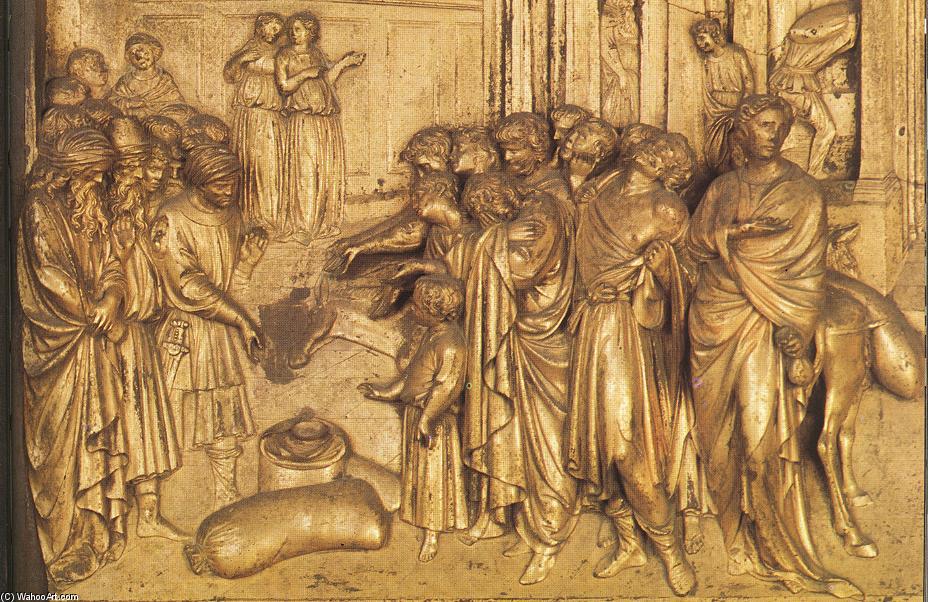
Discovery of the Golden Cup (detail)


 Weiterlesen
Giclée / Kunstdruck
Giclée- oder Leinwanddruck in Museumsqualität mit schneller Produktion und flexiblen Veredelungsoptionen. ( Handgemalte Reproduktion bestellen Bild kaufen)




P118B $10

P118H $10

P118W $10

P438Z $10

P508JH $12

P508YH $12

P805H $10

P805Z $10

P919BZ $10

P919G $10

P919XJ $10

P959ZH $10

P968JZ $12

W106C $8

W218G $10

W218JH $8

W218Y $10

W307PJ $10

W316G $10

W316PJ $8

W316Y $10

W398PJ $8

W4111J $10

W500HY $15

W500JH $15

W692G $12

W849H $8

W940BG $15

W953PJ $8




Wählen Sie aus unseren vordefinierten Formaten, die den ursprünglichen Proportionen des Kunstwerks entsprechen.

Sie können Ihre eigenen Maße eingeben, um ein bestimmtes Format oder einen speziellen Platz einzupassen. Wenn das von Ihnen gewählte Format nicht den Proportionen des Originalbildes entspricht, werden wir das Kunstwerk entweder beschneiden oder das Bild mit einem gespiegelten oder einfarbigen Rand erweitern. Ein digitaler Entwurf wird Ihnen zur Genehmigung zugesandt, bevor die Produktion beginnt.
Bitte beachten Sie, dass die Vorschau auf dem Bildschirm nicht den tatsächlichen Zuschnitt oder die Erweiterung widerspiegelt. Nur der Entwurf zeigt die endgültige Komposition präzise an.
Obwohl Sondermaße verfügbar sind, empfehlen wir die Auswahl eines Maßes aus der vordefinierten Liste, um die ursprünglichen Proportionen zu bewahren.
Weltweiter Versand () innerhalb von 2 Wochen statt der üblichen 4/5 Wochen. (31 August)

Kostenloser weltweiter Expressversand

Hochwertige Leinenleinwand

Umfassender Versicherungsschutz beim Versand

Zollgebühren-Rückerstattungsgarantie

Garantie für exakte Farbtreue

60 Tage Rückgaberecht (nur bei Mängeln)

100% Geld-zurück-Garantie

Mengenrabatt verfügbar
 Die Glasoption ist nur für Größen unter 110 cm verfügbar.

Discovery of the Golden Cup (detail)
Giclée / Kunstdruck
Format der Reproduktion
-


Gesamtpreis
$ 62
A Renaissance Revelation: Unveiling Ghiberti’s ‘Discovery of the Golden Cup’
Lorenzo Ghiberti's “Discovery of the Golden Cup,” a pivotal panel from his celebrated pair adorning the Baptistery doors in Florence, isn’t merely a depiction of a biblical scene; it’s a concentrated distillation of Renaissance ideals – humanism, perspective, and an exquisite understanding of material. Crafted between 1425 and 1452, this bronze relief transcends its narrative to become a profound meditation on knowledge, revelation, and the inherent beauty of the natural world. The panel captures a moment of intense curiosity and discovery, radiating with a quiet drama that continues to captivate viewers centuries later. It’s a testament to Ghiberti's mastery of capturing not just form but also the very essence of human experience.
The scene unfolds within a meticulously rendered architectural setting – a courtyard or garden bathed in the soft, diffused light characteristic of Florentine Renaissance art. At the heart stands a figure, likely Joseph, holding aloft a golden cup, an object of immediate fascination for those gathered around him. The figures surrounding this central moment are not static; they’re engaged in conversation, contemplation, and a palpable sense of wonder. Ghiberti masterfully employs contrapposto – the subtle shift in weight and posture – to imbue each figure with life and individuality. Notice how the gestures, expressions, and clothing details subtly convey their reactions to this momentous discovery.
The Language of Bronze: Technique and Artistic Innovation
Ghiberti’s skill as a bronze sculptor is immediately apparent in the remarkable detail achieved within this relatively small panel. The surface texture is incredibly rich, showcasing an almost tactile quality – you can practically feel the smoothness of the skin, the folds of the drapery, and the gleam of the golden cup. This level of realism was revolutionary for its time, pushing the boundaries of what was possible with bronze casting. Ghiberti’s technique involved a complex process of modeling in wax, creating a full-scale replica, then using this model to build up the bronze layer by layer. The result is an astonishingly lifelike representation, achieved through painstaking labor and unparalleled skill.
Furthermore, Ghiberti's understanding of perspective—a cornerstone of Renaissance art—is brilliantly demonstrated here. The figures recede into the background with a convincing sense of depth, creating a believable spatial environment. The use of light and shadow is equally sophisticated, enhancing the three-dimensionality of the relief and adding to its dramatic impact. The subtle gradations in tone suggest not just form but also texture and surface quality, further contributing to the panel’s overall realism.
Symbolism and Renaissance Humanism
Beyond its technical brilliance, “Discovery of the Golden Cup” is laden with symbolic meaning. The golden cup itself represents divine grace or revelation – a tangible symbol of knowledge and understanding bestowed upon humanity. The act of discovery—the unveiling of this precious object—mirrors the broader Renaissance quest for knowledge and enlightenment. It’s a celebration of human curiosity, intellect, and the pursuit of truth. The figures surrounding Joseph aren't merely observers; they are participants in this intellectual journey, representing the diverse perspectives and reactions that accompany moments of profound insight.
The panel also reflects the humanist values of the Renaissance, which emphasized the dignity and potential of humankind. Ghiberti’s focus on human emotion and interaction—the expressions of wonder, curiosity, and contemplation—contrasts sharply with the more stylized depictions of medieval art. This shift towards realism and emotional depth marked a fundamental change in artistic priorities, reflecting a renewed interest in classical antiquity and the celebration of human experience.
A Legacy Enduring: The Gates of Paradise and Beyond
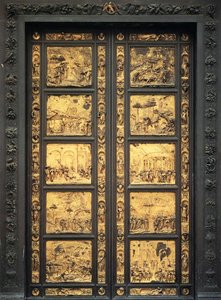
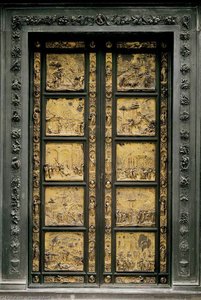
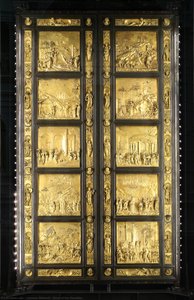
“Discovery of the Golden Cup” is but one panel within Ghiberti’s monumental “Gates of Paradise,” which adorned the Florence Baptistery. These doors, completed in 1452, are considered among the greatest achievements of Renaissance sculpture. Michelangelo famously dubbed them "The Gates of Paradise," a testament to their beauty and artistic merit. Ghiberti's work profoundly influenced generations of artists, shaping the course of Western art for centuries to come. His legacy continues to inspire awe and admiration, reminding us of the power of art to capture not just reality but also the very essence of human experience.
Ähnliche Kunstwerke

Über den Künstler
Lorenzo Ghiberti: Leben und Vermächtnis
Frühes Leben und Ausbildung
- Lorenzo di Bartolo – später bekannt als Lorenzo Ghiberti – wurde 1378 in Pelago, in der Nähe von Florenz, Italien, geboren. Seine künstlerische Reise begann unter der Anleitung seines Stiefvaters, Bartolo di Michele, einem Goldschmied.
- Er erhielt eine formale Malerausbildung von Gherardo Starnina und erweiterte so seine Fähigkeiten über die Metallverarbeitung hinaus.
- Durch den Ausbruch der Pest im Jahr 1400 wurde er nach Rimini geschickt, wo er für Carlo I Malatesta arbeitete und mit Fresken zusammenarbeitete und seine künstlerischen Sensibilitäten weiterentwickelte.
Der Baptisterium-Wettbewerb und Früher Erfolg
- Im Jahr 1401 kehrte Ghiberti nach Florenz zurück und nahm an einem renommierten Wettbewerb zur Gestaltung der Bronzetüren für das Baptisterium von Florenz teil.
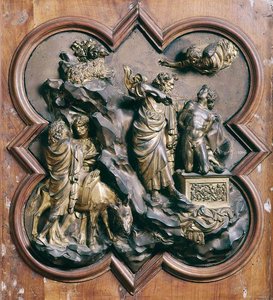
- Er besiegte seine Konkurrenten, darunter Filippo Brunelleschi, mit seinem Panel, das das *Opfer des Isaak* darstellt, und demonstrierte bemerkenswerte Fähigkeiten und Innovation.
- Dieser Sieg leitete seine Karriere ein und sicherte ihm die Beauftragung mit den Nordtüren des Baptisteriums.
Die Nord- und Südtafeln
- Ghiberti verbrachte über zwei Jahrzehnte damit, die Nordtüren (ab 1424 fertiggestellt) zu schaffen, die Szenen aus dem Leben des Johannes des Täufers darstellen.
- Seine Werkstatt wurde zu einem Zentrum künstlerischen Talents und förderte zukünftige Meister wie Donatello, Masolino und Paolo Uccello.
- Nach dem Erfolg der Nordtüren wurde Ghiberti beauftragt, eine zweite Reihe – die Osttüren (ab 1452 fertiggestellt) – zu erstellen.
Die “Tore des Paradieses”
- Die Osttüren, die von Michelangelo berühmt als die "*Tore des Paradieses*" bezeichnet werden, repräsentieren Ghibertis Meisterwerk.
- Diese Türen stellen Szenen aus dem Alten Testament dar und zeichnen sich durch eine bisher ungeahnte Realismus, Perspektive und künstlerische Detailgenauigkeit aus.
- Jedes Panel ist ein Zeugnis seiner Meisterschaft in der Bronzeguss- und Relieftechnik.
Künstlerischer Stil und Einflüsse
- Ghibertis Stil vereinte gotische Eleganz mit den aufkommenden Prinzipien des Renaissance-Humanismus.
- Er ließ sich von der klassischen Antike inspirieren und integrierte Elemente römischer Kunst und Skulpturen in seine Arbeit.
- Seine sorgfältige Detailgenauigkeit, naturalistischen Darstellungen und innovative Verwendung der Perspektive setzten ihn von seinen Zeitgenossen ab.
Commentarii und Vermächtnis
- Ghiberti verfasste *Commentarii*, ein wertvolles Werk über Kunstgeschichte, Theorie und Technik – das als eine der frühesten Autobiografien eines Künstlers gilt.
- Er starb 1455 in Florenz und hinterließ ein bleibendes Vermächtnis als einer der wichtigsten Bildhauer der Frührenaissance.
- Seine Arbeit beeinflusste nachfolgende Generationen von Künstlern nachhaltig, indem sie den Verlauf der westlichen Kunstgeschichte prägte.
Historische Bedeutung
- Ghibertis Beiträge waren entscheidend für die Etablierung Florenz als führendes künstlerisches Zentrum während der Renaissance.
- Die "*Tore des Paradieses*" wurden zu einem Symbol florentinischer städtischer Stolz und künstlerischer Leistung.
- Seine innovativen Techniken und humanistischen Themen halfen, die ästhetischen Ideale der Epoche zu definieren und den Weg für zukünftige Meister wie Leonardo da Vinci und Michelangelo zu ebnen.
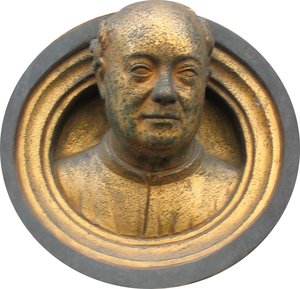
Lorenzo Ghiberti
1378 - 1455 , Italien
Kurzinfos
- Artistic Movement Or Style: Frührenaissance / Internationale Gotik
- Artists Or Movements Influenced By This Artist:
- Donatello
- Masolino
- Michelangelo
- Artists Who Influenced This Artist:
- Bartolo di Michele
- Gherardo Starnina
- Date Of Birth: Um 1378
- Date Of Death: 1455
- Full Name: Lorenzo di Bartolo Ghiberti
- Nationality: Italienisch
- Notable Artworks:
- Himmelstüren
- Nordtüren
- Sakristeischrank
- Place Of Birth: Pelago, Italien
Ähnliche Artikel

Die 10 legendärsten Bronzestatuen: Meisterwerke, die Kunstgeschichte schrieben | ArtsDot
Entdecken Sie die 10 legendärsten Bronzestatuen der Kunstgeschichte! Von Rodin bis Michelangelo – erfahren Sie die Geschichten hinter ikonischen Skulpturen und finden Sie hochwertige Reproduktionen für Ihr Zuhause. Jetzt bei ArtsDot entdecken!

Bronze-Meisterwerke: Die 10 Skulpturen, die Kunstgeschichte schrieben | ArtsDot
Entdecken Sie die 10 legendärsten Bronze Skulpturen der Kunstgeschichte! Von Michelangelo bis Rodin – erfahren Sie die Geschichten hinter den Meisterwerken und lassen Sie sich von Wanddeko-Ideen inspirieren. Hochwertige Kunstdrucke auf ArtsDot.com.

The Enduring Legacy of Bronze: A Historical & Artistic Exploration for the Collector
Explore the rich history & enduring appeal of bronze sculpture with expert insights for collectors at ArtsDot. Learn about casting techniques, iconic artists, collecting tips & contemporary interpretations.

The Enduring Legacy of Bronze Sculpture: A Collector's Guide to Form & Cultural Significance
Explore the rich history & enduring appeal of bronze sculpture with expert insights for collectors at ArtsDot. Learn about casting techniques, iconic artists, and collecting tips to build a discerning art collection.
The Enduring Legacy of Bronze: History, Technique & Artistic Expression for the Collector
Explore the rich history & enduring appeal of bronze sculpture with expert insights for collectors at ArtsDot. Learn about casting techniques, iconic artists, and collecting tips.