 Vorschau anzeigen
 Versenden
 Teilen
 Details anzeigen

 Herunterladen
 Ähnliche Objekte
 Röntgenaufnahme
 Diashow
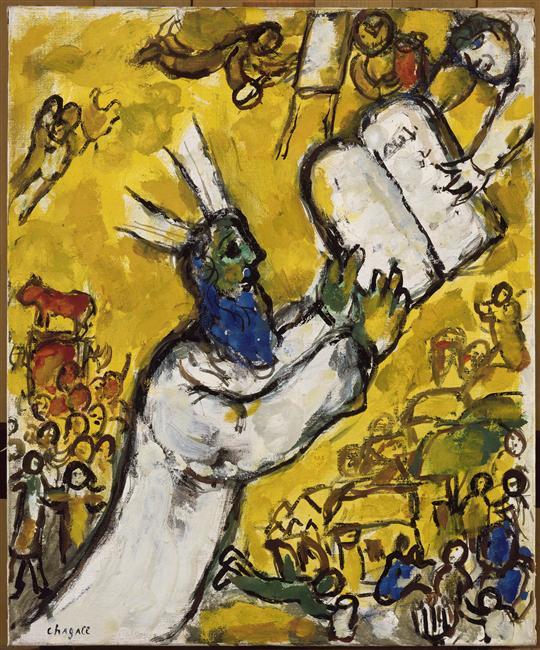
Moses Receiving the Tablets of Law (9) Übersetzung Deutsch: Moisés empfangt die Tafeln der Gesetzgebung
 Acryl auf Leinwand
- Wandkunst
- Naïve Art (Primitivism)
 1963
1963- Moderne
 46.0 x 38.0 cm
 Weiterlesen
Giclée / Kunstdruck
Giclée- oder Leinwanddruck in Museumsqualität mit schneller Produktion und flexiblen Veredelungsoptionen. ( Handgemalte Reproduktion bestellen Bild kaufen)




P118B $10

P118H $10

P118W $10

P438Z $10

P508JH $12

P508YH $12

P805H $10

P805Z $10

P919BZ $10

P919G $10

P919XJ $10

P959ZH $10

P968JZ $12

W106C $8

W218G $10

W218JH $8

W218Y $10

W307PJ $10

W316G $10

W316PJ $8

W316Y $10

W398PJ $8

W4111J $10

W500HY $15

W500JH $15

W692G $12

W849H $8

W940BG $15

W953PJ $8




Wählen Sie aus unseren vordefinierten Formaten, die den ursprünglichen Proportionen des Kunstwerks entsprechen.

Sie können Ihre eigenen Maße eingeben, um ein bestimmtes Format oder einen speziellen Platz einzupassen. Wenn das von Ihnen gewählte Format nicht den Proportionen des Originalbildes entspricht, werden wir das Kunstwerk entweder beschneiden oder das Bild mit einem gespiegelten oder einfarbigen Rand erweitern. Ein digitaler Entwurf wird Ihnen zur Genehmigung zugesandt, bevor die Produktion beginnt.
Bitte beachten Sie, dass die Vorschau auf dem Bildschirm nicht den tatsächlichen Zuschnitt oder die Erweiterung widerspiegelt. Nur der Entwurf zeigt die endgültige Komposition präzise an.
Obwohl Sondermaße verfügbar sind, empfehlen wir die Auswahl eines Maßes aus der vordefinierten Liste, um die ursprünglichen Proportionen zu bewahren.
Weltweiter Versand () innerhalb von 2 Wochen statt der üblichen 4/5 Wochen. (20 August)

Kostenloser weltweiter Expressversand

Hochwertige Leinenleinwand

Umfassender Versicherungsschutz beim Versand

Zollgebühren-Rückerstattungsgarantie

Garantie für exakte Farbtreue

60 Tage Rückgaberecht (nur bei Mängeln)

100% Geld-zurück-Garantie

Mengenrabatt verfügbar
 Die Glasoption ist nur für Größen unter 110 cm verfügbar.

Moses Receiving the Tablets of Law (9) Übersetzung Deutsch: Moisés empfangt die Tafeln der Gesetzgebung
Giclée / Kunstdruck
Format der Reproduktion
-


Gesamtpreis
$ 62
Sammlerstück-Beschreibung
Marc Chagall: A Life Painted in Dreams
Marc Chagall (1887-1985) was a Russian and French artist. An early modernist, he was associated with the École de Paris, as well as several major artistic styles and created works in a wide range of artistic formats, including painting, drawings, book illustrations, stained glass, stage sets, ceramics, tapestries and fine art prints. Chagall was born Moishe Shagal in 1887, into a Hasidic Jewish family in Liozna, near Vitebsk, Belarus, but at that time in the Pale of Settlement of the Russian Empire. Before World War I, he travelled between Saint Petersburg, Paris, and Berlin. During that period, he created his own mixture and style of modern art, based on his ideas of Eastern European and Jewish folklore. He spent the wartime years in his native Belarus, becoming one of the country’s most distinguished artists and a member of the modernist avant-garde, founding the Vitebsk Arts College. He later worked in and near Moscow in difficult conditions during hard times in Russia following the Bolshevik Revolution, before leaving again for Paris in 1923. During World War II, he escaped occupied France to the United States, where he lived in New York City for seven years before returning to France in 1948. Art critic Robert Hughes referred to Chagall as “the quintessential Jewish artist of the twentieth century”. According to art historian Michael J. Lewis, Chagall was considered to be “the last survivor of the first generation of European modernists”. For decades, he “had also been respected as the world’s pre-eminent Jewish artist”. He was known for his ability to blend reality with fantasy, creating unique and captivating scenes. His use of naïve art techniques added a sense of innocence and purity to the painting, making it both visually appealing and emotionally powerful. Chagall's work continued to inspire artists today, and his contributions to the naïve art movement were undeniable.Naïve Art Movement
Naïve art, also known as primitivism, is characterized by its simplicity and lack of formal training. This movement was popularized in the early 20th century and often featured dreamlike scenes with a focus on spirituality. Chagall's work fits perfectly into this category, as he drew inspiration from his Jewish heritage and biblical stories. He explored themes of exile, faith, and folklore—elements deeply rooted in Jewish tradition—translating them into vibrant visual language.Painting Description
- Title: Moses Receiving the Tablets of Law (9)
- Artist: Marc Chagall
- Year Created: 1963
- Dimensions: 46 x 38 cm
- Medium: Charcoal, Gouache, Oil on Canvas
Symbolism and Composition
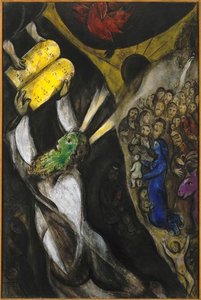
The painting captures the essence of faith and spirituality through its vibrant colors and detailed composition. Moses, a central figure in Jewish history, is shown in a moment of divine communication. The birds symbolize freedom and spiritual ascension, representing hope amidst adversity—a recurring motif throughout Chagall’s oeuvre. He explored themes of exile, faith, and folklore—elements deeply rooted in Jewish tradition—translating them into vibrant visual language. Chagall's use of naïve art techniques added a sense of innocence and purity to the painting, making it both visually appealing and emotionally powerful.Chagall’s Style
Marc Chagall was known for his ability to blend reality with fantasy, creating unique and captivating scenes. His style combined elements of Cubism, Surrealism, and Expressionism, resulting in images that are both recognizable and dreamlike. He achieved this effect through flattened perspectives, distorted figures, and fantastical landscapes—techniques that defied conventional artistic conventions. Chagall's distinctive visual language speaks to universal themes of longing, memory, and the human condition.- Moses Receiving the Tablets of Law (9)
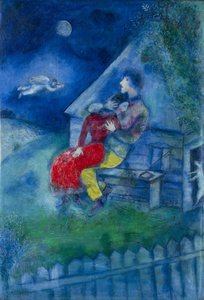
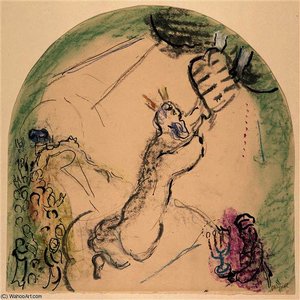
- Painting by 'Marc Chagall' | Marc Chagall:Moses receiving the Tablets of Law (33 x 33 cm,Naive Art / Primitivism,Ink,)
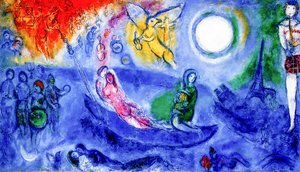
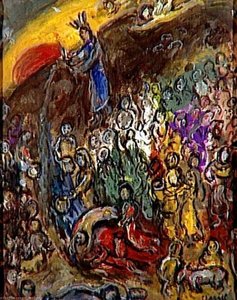
- Painting by 'Marc Chagall' | Marc Chagall:Moses receiving the Tablets of Law (33 x 32 cm,Naive Art / Primitivism,Ink,)
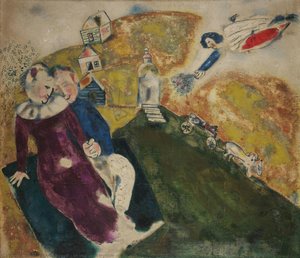
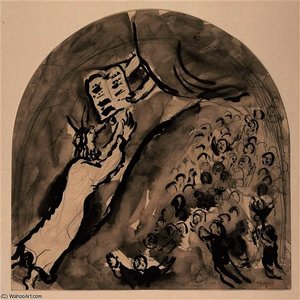
- Painting by 'Marc Chagall' | Marc Chagall:Moses receiving the Tablets of Law (33 x 32 cm,Naive Art / Primitivism,Ink,)
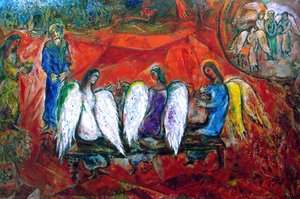
- Painting by 'Marc Chagall' | Marc Chagall:Moses receiving the Tablets of Law (33 x 32 cm,Naive Art / Primitivism,Ink,)
For more information on naïve art and Marc Chagall's contributions to this movement, visit Wikipedia.org - Naïve Art. Photo Description: The painting is a colorful depiction of Moses receiving the tablets from God. The scene features several people in various positions, including one person holding a book above their head. There are also two birds visible in the painting, with one located near the top left corner and another towards the center-right area. The main focus is on Moses, who appears to be standing in front of a crowd of people. He is holding his hands up as if he's receiving the tablets from God. The image captures the essence of faith and spirituality through its vibrant colors and detailed composition. Size: 46 x 38 cm Date: 1963 Photo Description: The painting is a colorful depiction of Moses receiving the tablets from God. The scene features several people in various positions, including one person holding a book above their head. There are also two birds visible in the painting, with one located near the top left corner and another towards the center-right area. The main focus is on Moses, who appears to be standing in front of a crowd of people. He is holding his hands up as if he's receiving the tablets from God. The image captures the essence of faith and spirituality through its vibrant colors and detailed composition. Size: 46 x 38 cm Date: 1963 ARTIST INFORMATION: ================== Artist: Marc Chagall Birth Year: 1887 Death Year: 1985 Birth City: Liovana Birth Country: Belarus Biography:
A Life Painted in Dreams: The World of Marc Chagall
Marc Chagall (1887-1985) was a Russian and French artist. An early modernist, he was associated with the École de Paris, as well as several major artistic styles and created works in a wide range of artistic formats, including painting, drawings, book illustrations, stained glass, stage sets, ceramics, tapestries and fine art prints. Chagall was born Moishe Shagal in 1887, into a Hasidic Jewish family in Liozna, near Vitebsk, Belarus, but at that time in the Pale of Settlement of the Russian Empire. Before World War I, he travelled between Saint Petersburg, Paris, and Berlin. During that period, he created his own mixture and style of modern art, based on his ideas of Eastern European and Jewish folklore. He spent the wartime years in his native Belarus, becoming one of the country’s most distinguished artists and a member of the modernist avant-garde, founding the Vitebsk Arts College. He later worked in and near Moscow in difficult conditions during hard times in Russia following the Bolshevik Revolution, before leaving again for Paris in 1923. During World War II, he escaped occupied France to the United States, where he lived in New York City for sevenÄhnliche Kunstwerke
Über den Künstler
Marc Chagall: Ein Leben in Farbe und Vorstellungskraft
Frühes Leben und Einflüsse
- Geburt und Hintergrund: Marc Zakharowitsch Chagall wurde am 6. Juli 1887 (O.S. 24. Juni) in Liozna, nahe Witebsk, Weißrussland, in einer hasidischen jüdischen Familie geboren.
- Die Wirkung von Witebsk: Seine Kindheit in Witebsk, bekannt als das „Russische Toledo“, prägte seine künstlerische Vision maßgeblich. Die einzigartige Mischung aus Kulturen und die malerische Landschaft – Kirchen, Synagogen, belebte Märkte – wurden wiederkehrende Motive in seinem Werk.
- Frühes künstlerisches Talent: Trotz der bescheidenen Mittel seiner Familie zeigte Chagall schon früh ein Talent für Kunst, lernte zunächst bei einem lokalen Schilderermaler und verfolgte dann eine formale Ausbildung.
Künstlerische Entwicklung und Stil
- Frühe Ausbildung: Er studierte in St. Petersburg bei Léon Bakst und später in Paris an der Académie de la Grande Chaumière, wo er sich mit avantgardistischen Bewegungen auseinandersetzte.
- Stilistische Verschmelzung: Chagalls Stil ist eine einzigartige Synthese verschiedener Einflüsse. Er übernahm Elemente aus dem Kubismus, der Symbolik und dem Fauvismus, aber passte sich nie vollständig einer einzelnen Bewegung an und schmiedete seinen eigenen, unverwechselbaren Weg.
- Wesentliche Merkmale: Sein Werk ist durch lebendige Farben, traumhafte Bilder, fantastische Kreaturen und ein Gefühl der Nostalgie für seine Kindheit in Witebsk gekennzeichnet. Oft sind schwebende Figuren, verzerrte Perspektiven und symbolische Darstellungen zu sehen.
Wichtige Werke und Leistungen
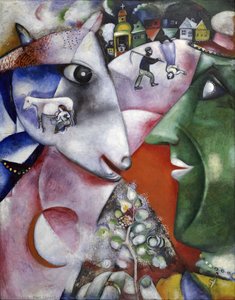
- Frühe Meisterwerke: Gemälde wie „Ich und das Dorf“ (1911) demonstrieren seine frühe Erkundung von Erinnerung, Identität und der Beziehung zwischen dem Einzelnen und der Gemeinschaft.
- Russische Revolution & Rückkehr nach Witebsk: Nach der Russischen Revolution kehrte Chagall nach Witebsk zurück und engagierte sich in kulturellen Initiativen, gründete eine Kunstschule. Bald wurde er jedoch von den Beschränkungen des neuen Regimes enttäuscht.
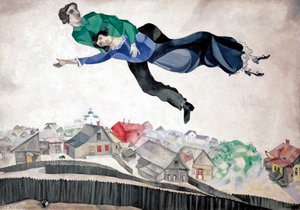
- Internationale Anerkennung: Er zog schließlich nach Frankreich und etablierte sich dort erfolgreich. Bedeutende Werke dieser Zeit sind „Über Witebsk“ (1920-1922) und zahlreiche Gemälde, die von biblischen Geschichten inspiriert sind, wie z. B. „Jakobs Traum“.
- Spätere Aufträge: Chagall erhielt im späteren Leben bedeutende Aufträge, darunter das Deckenfresko des Pariser Opernhauses (1964), Fensterglasfenster für die Synagoge des Hadassah Hebrew University Medical Center in Jerusalem und die Reims Kathedrale.
Einflüsse und Vermächtnis
- Künstlerische Einflüsse: Er wurde von Künstlern wie Vladimir Lukich Borowikowski, dessen Porträts er bewunderte, sowie den breiteren Strömungen der frühen Moderne beeinflusst.
- Einfluss auf nachfolgende Künstler: Chagalls Werk hat Generationen von Künstlern mit seiner lyrischen Qualität, emotionaler Tiefe und immensen Vorstellungskraft inspiriert. Sein Einfluss ist in Surrealismus und anderen Bewegungen zu sehen, die Fantasie und Symbolik umarmten.
- Historische Bedeutung: Er gilt als eine der wichtigsten Figuren der Kunst des 20. Jahrhunderts, die den Übergang zwischen europäischer Moderne und jüdischer kultureller Identität schloss. Seine Fähigkeit, persönliche Erfahrungen, Folklore und universelle Themen zu synthetisieren, resonnieren weiterhin weltweit bei Publikum.
- Der „Typische jüdische Künstler“: Chagall wird oft als der „typische jüdische Künstler des 20. Jahrhunderts“ bezeichnet, aufgrund seiner wiederholten Auseinandersetzung mit jüdischen Themen, Traditionen und Erfahrungen in seinem Kunstwerk.
Tod und Erinnerung
- Letzte Jahre: Marc Chagall malte und schuf bis zu seinem Tod am 28. März 1985 im Alter von 97 Jahren in Saint-Paul-de-Vence, Frankreich, weiter.
- Nachhaltiges Vermächtnis: Sein Werk wird in wichtigen Museen auf der ganzen Welt ausgestellt und sichert so, dass seine lebendige und fantasievolle Vision auch für zukünftige Generationen Kunstliebhaber inspiriert und fesselt.
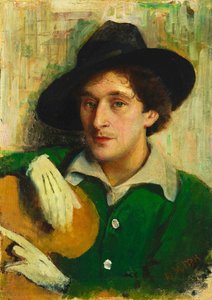
Marc Chagall
1887 - 1985 , Belarus
Kurzinfos
- Beeinflusste Künstler: ['Surrealismus']
- Bemerkenswerte Werke:
- Ich und das Dorf
- Über Witebsk
- Jakobs Traum
- Die Schleierkistel
- Freilassung
- Erdbeeren Bella und Ida am Tisch
- Neulich verheiratete Paare mit Paris
- Tschitschikows Abschied von Manilow
- Der Hahn
- Geburtsdatum: 06. Juli 1887
- Geburtsort: Liozna, Belarus
- Künstlerische Einflüsse: ['Vladimir Lukich Borovikovsky']
- Künstlerischer Stil: Kubismus, Symbolismus, Fauvismus
- Nationalität: Russisch, Französisch
- Todatum: 28. März 1985
- Vollständiger Name: Marc Chagall
Ähnliche Artikel
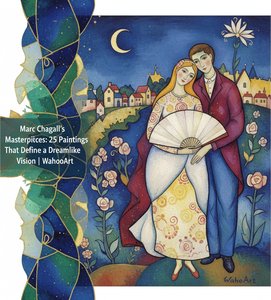
Marc Chagalls Meisterwerke: Die Top 25 Kunstwerke für Ihr Zuhause | ArtsDot
Entdecken Sie die Top 25 Kunstwerke von Marc Chagall! Tauchen Sie ein in seine traumhaften Welten, jüdische Motive & expressiven Farben. Hochwertige Kunstreproduktionen auf ArtsDot.com – für Ihr Zuhause.
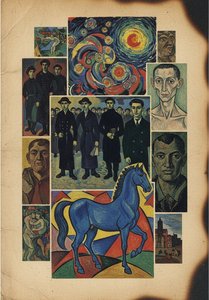
Deutsche Expressionismus Meisterwerke: Die 10 wichtigsten Kunstwerke für Ihr Zuhause
Entdecken Sie die 10 bedeutendsten Werke des Deutschen Expressionismus! Kirchner, Nolde & Co. – ihre Geschichten, Techniken und zeitlose Schönheit. Hochwertige Kunstdrucke auf ArtsDot.com kaufen und Ihr Zuhause mit emotionaler Kunst bereichern. Jetzt entdecken!
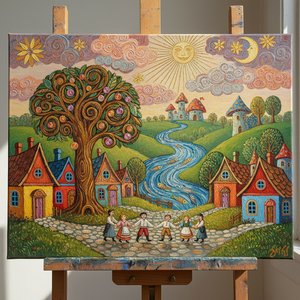
The Unconventional Vision: Exploring the Characteristics, History & Enduring Appeal of Naïve Art
Explore the captivating world of naïve art! Discover its history, characteristics, key artists & collecting tips from ArtsDot's experts. Find your perfect piece today.
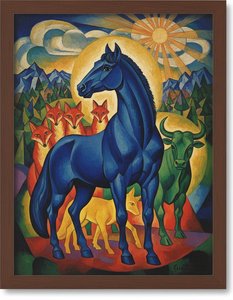
Franz Marc: Expressionismus, Spiritualität und die Tier-Symbolik eines modernen Meisters
Entdecken Sie das faszinierende Werk von Franz Marc! Erfahren Sie mehr über seine spirituelle Kunst, die Tierdarstellungen und seinen Einfluss auf den Expressionismus. Expertenanalyse & Hintergrundinformationen.
The Untamed Vision: Exploring Naïve Art & Primitivism's Rejection of Convention
Explore the revolutionary world of Naïve Art & Primitivism! Discover how artists challenged academic traditions with raw emotion & unique styles. Learn about Picasso, Rousseau & more at ArtsDot.