 Vorschau anzeigen
 Versenden
 Teilen
 Details anzeigen

 Herunterladen
 Ähnliche Objekte
 Röntgenaufnahme
 Diashow
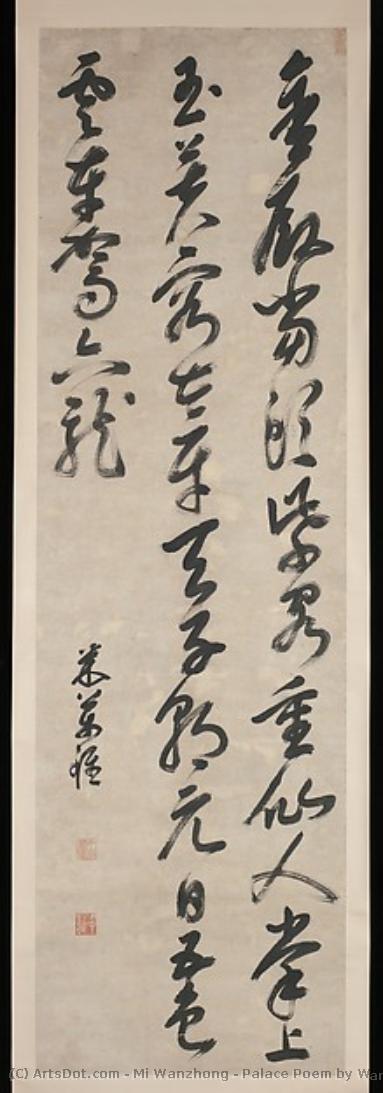
Palace Poem by Wang Jian (d. 830?)
 337.0 x 93.0 cm
 Weiterlesen
Erwerben Sie ein hochauflösendes, optimiertes digitales Bild, das der Online-Vorschau weit überlegen ist.
Jede Datei wird von unseren hauseigenen Spezialisten mit modernsten Werkzeugen und fachmännischer manueller Retusche sorgfältig vorbereitet. Wir stellen sicher, dass jedes Bild eine außergewöhnliche Klarheit, präzise Farbgenauigkeit und feinste Details aufweist.
Die endgültige Datei wird innerhalb von 72 Stunden per E-Mail zugestellt und ist für den sofortigen Einsatz in professionellen, redaktionellen und Druckumgebungen optimiert. Es handelt sich um dieselbe Qualität, der führende Designstudios, Verlage und Galerien vertrauen.
Digitales Bild
Laden Sie eine hochauflösende Datei für die persönliche Präsentation, den Druck und kreative Projekte herunter. ( Druck bestellen Handgemalte Reproduktion bestellen)
In jeder Bestellung digitaler Bilder enthalten
Professionelle digitale Bereitstellung, garantiert
Wenn Sie sich für ArtsDot.com entscheiden, erhalten Sie nicht nur ein Bild – Sie erhalten ein professionell aufbereitetes digitales Kunstwerk, das mit höchster Präzision erstellt und durch eine Zufriedenheitsgarantie abgesichert wird. Hier ist alles, was automatisch mit Ihrer Bestellung geliefert wird:

Schnelle E-Mail-Zustellung
Ihre hochauflösende digitale Bilddatei wird Ihnen innerhalb von 72 Stunden nach der Bestellung per E-Mail zugestellt – bereit zur sofortigen Verwendung.

KI-optimierte digitale Datei
Ihre Kunstwerke werden professionell mithilfe fortschrittlicher KI-Tools und manueller Bearbeitung optimiert, um maximale Detailtreue, Klarheit und Farbgenauigkeit zu gewährleisten.

Lebenslanger kostenloser Neudruckservice
Datei versehentlich gelöscht oder verloren? Keine Sorge – wir senden sie Ihnen jederzeit kostenlos erneut zu.

Keine Einfuhrgebühren – jemals
Genießen Sie Ihr Kunstwerk sofort ohne Zollgebühren, Einfuhrabgaben oder Versandkosten – digitale Downloads sind immer steuerfrei.

Garantierte Farbtreue
Wir garantieren, dass Ihr digitales Bild mithilfe professioneller Werkzeuge und Farbmanagement die Originalfarben so präzise wie möglich wiedergibt.

100-Tage-Zufriedenheitsgarantie
Sollten Sie mit Ihrem digitalen Bild nicht zufrieden sein, werden wir es überarbeiten oder Ihnen innerhalb von 100 Tagen 100% erstatten – ohne Wenn und Aber.

100% Geld-zurück-Garantie
Nicht zufrieden? Erhalten Sie innerhalb von 100 Tagen nach Erhalt Ihrer digitalen Datei eine vollständige Rückerstattung – ohne Angabe von Gründen.

Rabatte bei Großbestellungen
3 Bilder kaufen, 10% sparen – 5 Bilder kaufen, 15% sparen – Ab 10 Bildern 20% sparen. Ideal für kreative Projekte, Galerien und Agenturen.
Ähnliche Kunstwerke









Biografie des Künstlers
The Enigmatic Vision of Zdzisław Beksiński
Zdzisław Beksiński, a name synonymous with haunting surrealism and dystopian landscapes, remains one of the most compelling and unsettling figures in 20th-century art. Born in Sanok, Poland, on February 24, 1929, his life was marked by both artistic fervor and profound personal tragedy. Unlike many artists who consciously cultivate a specific style or message, Beksiński’s work emerged from an intensely private, almost obsessive inner world. He resisted categorization, famously refusing to provide titles for most of his paintings, sculptures, and photographs, believing that naming them would limit the viewer's interpretation and impose a narrative where none was intended. His early life, overshadowed by the horrors of World War II – he witnessed the Katyn Massacre as a child when his father was executed by the Soviets – undoubtedly cast a long shadow over his artistic sensibility, though he rarely spoke directly about its influence. He studied architecture at the Kraków Academy of Fine Arts, but quickly abandoned it for painting, finding greater freedom in expressing his visions through this medium. His initial works were rooted in realism and impressionism, gradually evolving into the uniquely disturbing aesthetic that would define his career.From Realism to Nightmarish Visions
The transition from Beksiński’s early realistic paintings to his signature style was a slow but deliberate process. In the 1960s, he began experimenting with textured surfaces and abstract forms, influenced by Art Informel and the work of artists like Francis Bacon. However, it wasn't until the late 1960s and early 1970s that his distinctive vision fully materialized. This period saw the emergence of what became known as his “fantastic period,” characterized by decaying architecture, skeletal figures, distorted bodies, and unsettling landscapes bathed in a perpetual twilight. He often worked with oil on hardboard, building up layers of paint to create incredibly detailed and tactile surfaces. His technique was meticulous and painstaking; he would spend weeks, even months, on a single piece, obsessively refining every detail. He described his process as an attempt to externalize the images that haunted his dreams, stating that he didn’t *create* these visions but rather *discovered* them. This sense of discovery is palpable in his work; it feels less like a deliberate construction and more like an excavation of something ancient and terrifying lurking beneath the surface of reality. His early fantastic paintings, while disturbing, often possessed a strange beauty, a melancholic grandeur that drew viewers into their unsettling world.The Triad of Artistic Expression: Painting, Sculpture, Photography
While Beksiński is most celebrated for his paintings, he was remarkably prolific across multiple artistic disciplines. In the 1970s and 80s, he began to explore sculpture, creating haunting figures from resin, plaster, and other materials. These sculptures often echoed the themes found in his paintings – decay, fragmentation, and a sense of existential dread. They were frequently more overtly grotesque than his paintings, pushing the boundaries of taste and challenging viewers with their visceral intensity. Simultaneously, he developed a passion for photography, capturing stark, atmospheric images that complemented his other work. His photographs often featured desolate landscapes, abandoned buildings, and decaying objects, further reinforcing the themes of transience and mortality.- Painting: The core of Beksiński’s artistic output, characterized by detailed dystopian scenes.
- Sculpture: Often more visceral and grotesque than his paintings, exploring similar themes in three dimensions.
- Photography: Atmospheric images that complemented his painting and sculpture, focusing on decay and desolation.