 Vorschau anzeigen
 Versenden
 Teilen
 Details anzeigen

 Herunterladen
 Ähnliche Objekte
 Röntgenaufnahme
 Diashow
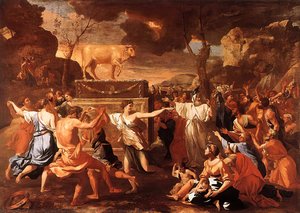
Adoraton of the Golden Calf d1

 Weiterlesen
Giclée / Kunstdruck
Giclée- oder Leinwanddruck in Museumsqualität mit schneller Produktion und flexiblen Veredelungsoptionen. ( Handgemalte Reproduktion bestellen Bild kaufen)




P118B $10

P118H $10

P118W $10

P438Z $10

P508JH $12

P508YH $12

P805H $10

P805Z $10

P919BZ $10

P919G $10

P919XJ $10

P959ZH $10

P968JZ $12

W106C $8

W218G $10

W218JH $8

W218Y $10

W307PJ $10

W316G $10

W316PJ $8

W316Y $10

W398PJ $8

W4111J $10

W500HY $15

W500JH $15

W692G $12

W849H $8

W940BG $15

W953PJ $8




Wählen Sie aus unseren vordefinierten Formaten, die den ursprünglichen Proportionen des Kunstwerks entsprechen.

Sie können Ihre eigenen Maße eingeben, um ein bestimmtes Format oder einen speziellen Platz einzupassen. Wenn das von Ihnen gewählte Format nicht den Proportionen des Originalbildes entspricht, werden wir das Kunstwerk entweder beschneiden oder das Bild mit einem gespiegelten oder einfarbigen Rand erweitern. Ein digitaler Entwurf wird Ihnen zur Genehmigung zugesandt, bevor die Produktion beginnt.
Bitte beachten Sie, dass die Vorschau auf dem Bildschirm nicht den tatsächlichen Zuschnitt oder die Erweiterung widerspiegelt. Nur der Entwurf zeigt die endgültige Komposition präzise an.
Obwohl Sondermaße verfügbar sind, empfehlen wir die Auswahl eines Maßes aus der vordefinierten Liste, um die ursprünglichen Proportionen zu bewahren.
Weltweiter Versand () innerhalb von 2 Wochen statt der üblichen 4/5 Wochen. (27 August)

Kostenloser weltweiter Expressversand

Hochwertige Leinenleinwand

Umfassender Versicherungsschutz beim Versand

Zollgebühren-Rückerstattungsgarantie

Garantie für exakte Farbtreue

60 Tage Rückgaberecht (nur bei Mängeln)

100% Geld-zurück-Garantie

Mengenrabatt verfügbar
 Die Glasoption ist nur für Größen unter 110 cm verfügbar.

Adoraton of the Golden Calf d1
Giclée / Kunstdruck
Format der Reproduktion
-


Gesamtpreis
$ 62
A Portrait of Antiquity Revisited: Exploring Nicolas Poussin’s “Adoration of the Golden Calf”
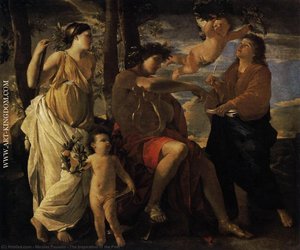
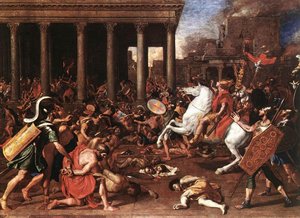
The painting "Adoration of the Golden Calf" by Nicolas Poussin, though its precise dimensions and date remain elusive, stands as a testament to the enduring power of classical ideals within Baroque art. Captured in an image that speaks volumes about faith, reverence, and human aspiration, this artwork transcends mere visual representation; it invites contemplation on themes of piety and divine majesty—a hallmark of Poussin’s artistic legacy.- Subject Matter: The scene depicts a group of figures gathered around a golden calf – an idol fashioned in commemoration of the Israelites' worship of Baal after Moses led them out of Egypt. This biblical narrative serves as the foundation for the composition, highlighting the importance of religious devotion and the dangers of idolatry.
- Style: Poussin’s style is undeniably Classical, drawing heavily from Roman sculpture and architectural models. He eschews dramatic theatricality favored by many contemporaries, opting instead for a serene stillness that prioritizes clarity of form and harmonious balance. This deliberate restraint contributes to the painting's profound emotional impact.
Technique: Mastering Illusionism and Atmospheric Depth
Poussin’s masterful technique exemplifies the principles of illusionistic painting—a method championed by artists like Raphael and Michelangelo—where artists strive to create an appearance of three-dimensionality on a two-dimensional surface. He achieves this remarkable feat through meticulous layering of glazes, subtly modulating colors and textures to simulate natural light and shadow. The artist skillfully employs atmospheric perspective, blurring distant landscapes and diminishing color intensity to convey the grandeur and vastness of the biblical setting. This technique wasn’t merely about replicating reality; it was about elevating the viewer's experience by transporting them into a realm of idealized beauty.Historical Context: Rome and the Renaissance Revival
Painted during Poussin’s formative years in Rome (1624-1640), “Adoration of the Golden Calf” reflects the broader artistic revival occurring at the time—the rediscovery and emulation of classical art forms following centuries of medieval dominance. The Catholic Church actively commissioned artists to depict biblical narratives with moral seriousness, aiming to inspire piety and reaffirm faith amidst religious upheaval. Poussin’s work aligns perfectly with this intellectual climate, embodying the humanist ideals that celebrated human reason and virtue alongside divine grace.Symbolism: Faith, Piety, and Divine Revelation
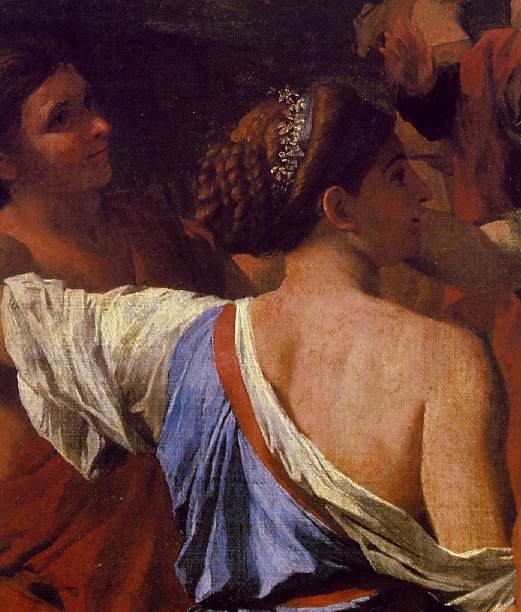
Beyond its formal beauty, “Adoration of the Golden Calf” is rich in symbolic significance. The golden calf itself represents idolatry—the worship of false gods—a transgression against God’s covenant with Moses. However, the figures surrounding it are depicted with solemn dignity, suggesting a profound contemplation of faith and divine revelation. The woman gazing at her symbolizes humility and devotion, while the gesture of offering incense underscores the importance of prayer and spiritual aspiration. Poussin's deliberate use of iconography reinforces the painting’s moral message—a reminder that true piety resides in acknowledging God’s supremacy.Ähnliche Kunstwerke
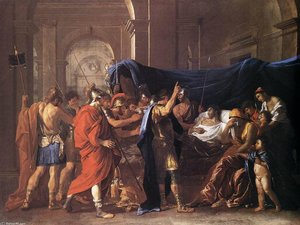
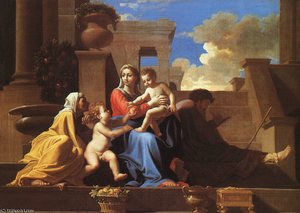
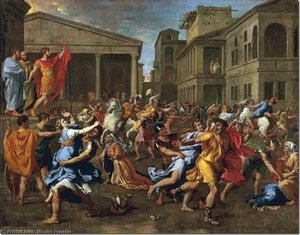
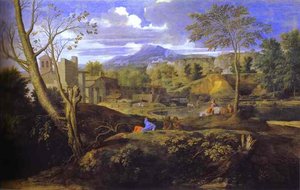
Über den Künstler
frühes Leben und Ausbildung
Nikos Poussin, geboren im Juni 1594, war die Quintessenz der französischen Barockmalerei des Klassikers. Obwohl er den Großteil seiner Karriere in Rom verbrachte, blieb er tief in den französischen künstlerischen Traditionen verwurzelt. Seine frühen Tage als Maler waren von Unsicherheit umhüllt, aber bereits im Jahr 1612 hatte er formale Studien in Paris begonnen und sich von weniger bekannten Künstlern beeinflussen lassen, bevor er 1624 nach Rom zog.Künstlerischer Stil und Einflüsse
Poussins Ästhetik, die für ihre kohärente Komposition und Priorisierung der Linearität bekannt ist, legte einen Präzedenzfall fest, der Meister wie Jacques-Louis David und Paul Cézanne noch bis ins 20. Jahrhundert beeinflusste. Sein unverwechselbarer Stil kristallisierte sich in herausragenden Werken wie Der Tod des Germanikers und seiner einflussreichen Sieben Sakramente-Serie.Bekannte Werke und Museen
- Nikos Poussin: Selbstporträt 1 (Barock, Öl), ein Beweis für seine Meisterschaft in der Technik.
- Bacchanten vor einem Tempel (74 x 101 cm, Legion of Honor, San Francisco, USA, Öl auf Leinwand), das seine Fähigkeit zur Balance von Komposition und Erzählung demonstriert.
- Das Musée des Beaux-Arts de Carcassonne, ein Muss für Kunstliebhaber, beherbergt eine beeindruckende Sammlung westlicher Gemälde vom 17. bis zum 20. Jahrhundert.
Vermächtnis und Einfluss
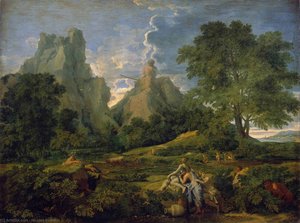
Poussins Loyalität blieb Rom, wo er schließlich darauf konzentrierte sich, weitreichende Landschaften in seine Kunst zu integrieren. Seine Reife als Künstler wird in Werken wie Orion, der von der Sonne geblendet sucht und Die Jahreszeiten verkörpert, die eine Ära strenger Komposition einleitet, die von der ruhigen Schönheit der Natur durchdrungen ist.Erfahren Sie mehr mit ArtsDot.com
Entdecken Sie die Meisterwerke des Musée France und tauchen Sie ein in die Welt der französischen Barockmalerei mit Musée Picasso, Musée des Beaux-Arts de Carcassonne und anderen bemerkenswerten Museen. Besuchen Sie Nikos Poussins Seite auf ArtsDot.com, um mehr über seine Werke zu erfahren und den Kontext, in dem sie entstanden sind.Referenzen
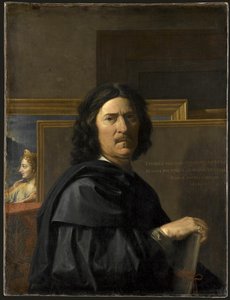
Nikolaus Poussin
1594 - 1665 , Frankreich
Kurzinfos
- Bemerkenswerte Werke:
- Der Tod des Germanicus
- Die Sieben Sakramente
- Eine römische Straße
- Orion auf der Suche nach der Sonne
- Die Jahreszeiten
- Geburtsdatum: Juni 1594
- Geburtsort: Le Havre, Frankreich
- Künstler, Die Ihn Beeinflussten:
- Raphael
- Titian
- Künstlerische Bewegung: Barock
- Nationalität: Französisch
- Todatum: 1665
- Vollständiger Name: Nicolas Poussin
- Von Ihm Beeinflusste Künstler:
- Jacques-Louis David
- Paul Cézanne
Ähnliche Artikel
Nicolas Poussin: Klassizismus, Allegorie und Ordnung in der französischen Malerei des 17. Jahrhunderts
Entdecken Sie Nicolas Poussins Meisterwerke und seinen Einfluss auf den französischen Klassizismus. Analyse von Allegorie, Komposition und der Bedeutung seiner Kunst im 17. Jahrhundert.

Baroque Classicism: Reconciling Drama & Order in 17th-Century Art
Explore the captivating world of Baroque Classicism! Discover its history, key artists like Caravaggio & Rubens, and defining characteristics. Expert insights & high-quality reproductions at ArtsDot.

The Dramatic Flourish: Exploring the Baroque Movement's Enduring Legacy in Art History
Explore the dramatic world of Baroque art! Discover iconic artists like Caravaggio & Rubens, defining techniques, and its lasting impact on art history. Expert insights for collectors & enthusiasts at ArtsDot.
Barocke Meisterwerke: Die 10 Gemälde, die eine Epoche prägten | ArtsDot
Entdecken Sie die 10 prägendsten Meisterwerke des Barock! Von Caravaggio bis Rembrandt – erleben Sie die Dramatik, Pracht & Emotionen dieser Epoche. Hochwertige Reproduktionen auf ArtsDot.com.
The Enduring Legacy of Classicism: Principles, Evolution & Influence in Western Art
Explore the enduring legacy of Classicism in Western art! Discover its historical context, key principles, iconic masterpieces & lasting influence. Learn about Renaissance and Neoclassical movements with ArtsDot.