 Vorschau anzeigen
 Versenden
 Teilen
 Details anzeigen

 Herunterladen
 Ähnliche Objekte
 Röntgenaufnahme
 Diashow
 Statistiken
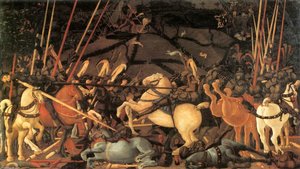
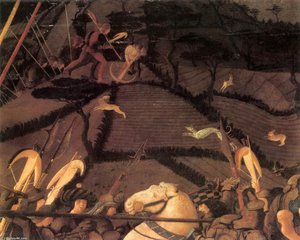
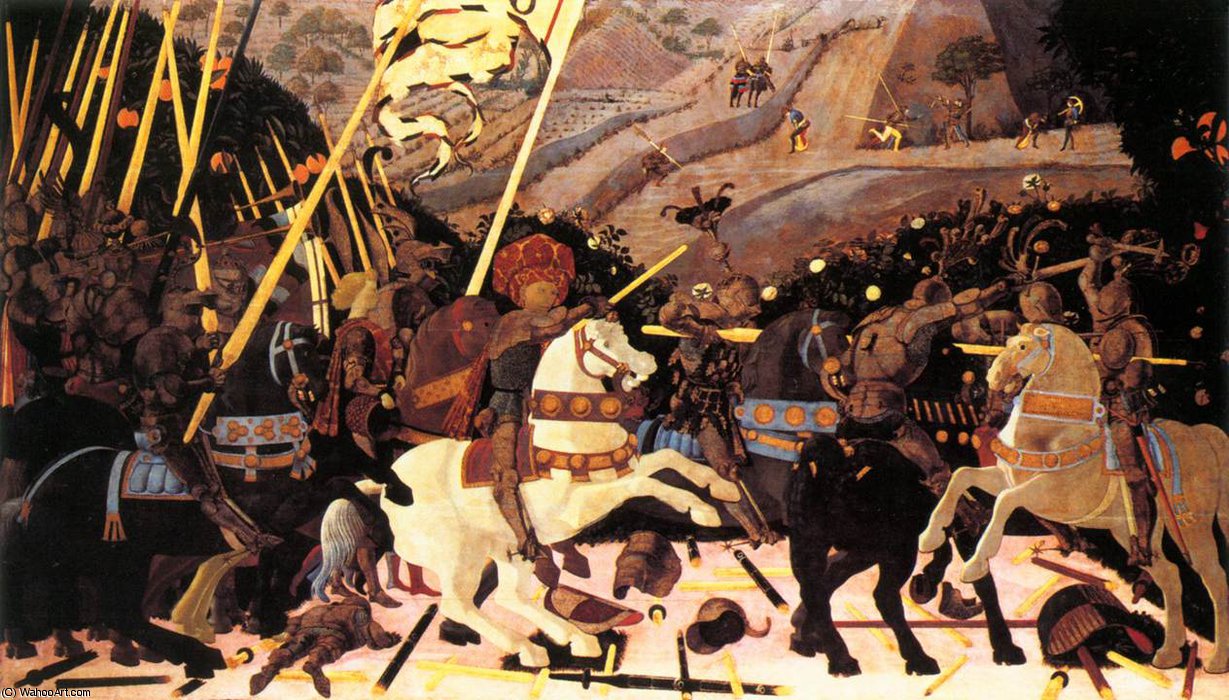
Battle of San Romano - Niccolò da Tolentino


 Weiterlesen
Giclée / Kunstdruck
Giclée- oder Leinwanddruck in Museumsqualität mit schneller Produktion und flexiblen Veredelungsoptionen. ( Handgemalte Reproduktion bestellen Zum digitalen Bild wechseln)




P118B $10

P118H $10

P118W $10

P438Z $10

P508JH $12

P508YH $12

P805H $10

P805Z $10

P919BZ $10

P919G $10

P919XJ $10

P959ZH $10

P968JZ $12

W106C $8

W218G $10

W218JH $8

W218Y $10

W307PJ $10

W316G $10

W316PJ $8

W316Y $10

W398PJ $8

W4111J $10

W500HY $15

W500JH $15

W692G $12

W849H $8

W940BG $15

W953PJ $8




Wählen Sie aus unseren vordefinierten Formaten, die den ursprünglichen Proportionen des Kunstwerks entsprechen.

Sie können Ihre eigenen Maße eingeben, um ein bestimmtes Format oder einen speziellen Platz einzupassen. Wenn das von Ihnen gewählte Format nicht den Proportionen des Originalbildes entspricht, werden wir das Kunstwerk entweder beschneiden oder das Bild mit einem gespiegelten oder einfarbigen Rand erweitern. Ein digitaler Entwurf wird Ihnen zur Genehmigung zugesandt, bevor die Produktion beginnt.
Bitte beachten Sie, dass die Vorschau auf dem Bildschirm nicht den tatsächlichen Zuschnitt oder die Erweiterung widerspiegelt. Nur der Entwurf zeigt die endgültige Komposition präzise an.
Obwohl Sondermaße verfügbar sind, empfehlen wir die Auswahl eines Maßes aus der vordefinierten Liste, um die ursprünglichen Proportionen zu bewahren.
Weltweiter Versand () innerhalb von 2 Wochen statt der üblichen 4/5 Wochen. (9 September)

Kostenloser weltweiter Expressversand

Hochwertige Leinenleinwand

Umfassender Versicherungsschutz beim Versand

Zollgebühren-Rückerstattungsgarantie

Garantie für exakte Farbtreue

100-Tage-Rückgaberecht (nur bei Mängeln)

100% Geld-zurück-Garantie

Mengenrabatt verfügbar
 Die Glasoption ist nur für Größen unter 110 cm verfügbar.

Battle of San Romano - Niccolò da Tolentino
Giclée / Kunstdruck
Format der Reproduktion
-


Gesamtpreis
$ 62
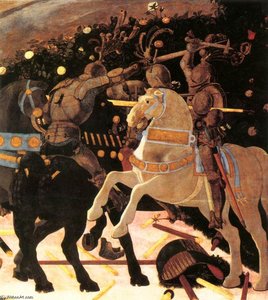
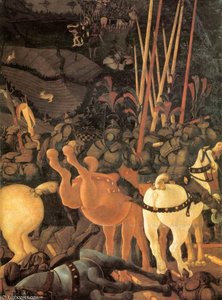
A Triumph of Visionary Perspective: Paolo Uccello’s Battle of San Romano
Paolo Uccello, born Paolo di Dono in 1397 amidst the verdant hills surrounding Florence, stands as a singular beacon within the Early Renaissance—a painter who transcended mere representation to forge an entirely new path for artistic expression. His moniker, “Uccello,” playfully referencing the diminutive bird, speaks volumes about his fascination with avian imagery and foreshadows his dedication to capturing movement and dynamism on canvas. Yet, this whimsical inclination masks a mind rigorously focused on unlocking the mathematical secrets of visual space, striving to translate geometric principles into breathtaking artworks that defied convention. He wasn’t merely an artist; he was a pioneer, a cartographer of perception, meticulously crafting scenes like “The Battle of San Romano” to demonstrate the revolutionary advancements of linear perspective. His formative years were spent under the tutelage of Lorenzo Ghiberti, whose workshop fostered an environment ripe for intellectual exploration and artistic innovation. This mentorship instilled in Uccello not only technical mastery but also a profound appreciation for humanist ideals—a lineage that undoubtedly shaped his worldview and fueled his ambition to elevate painting beyond traditional illusionism. The influence of Brunelleschi’s groundbreaking dome construction at Florence Cathedral served as an undeniable inspiration, prompting Uccello to grapple with the challenge of accurately depicting depth and dimensionality on a flat surface – a feat previously unattainable by artists.The Battle: A Dramatic Rendering of Florentine Military Might
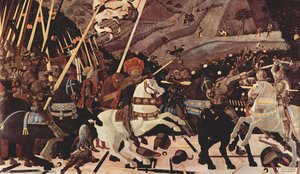
“The Battle of San Romano,” comprising three monumental panels executed in egg tempera on wooden planks, represents more than just a depiction of a pivotal historical event; it embodies Uccello’s audacious experimentation with perspective and his masterful command of color and composition. Commissioned by the Bartolini Salimbeni family between 1435 and 1460—a testament to Florentine patronage during the Renaissance—the painting commemorates the clash between Florentine and Sienese armies at San Romano in 1432, a conflict emblematic of the broader political tensions gripping Tuscany. The scene captures the visceral energy of combat with remarkable precision, showcasing a squadron of horses engaged in fierce melee, their riders locked in desperate struggles for dominance.Technique & Innovation: Mastering Linear Perspective
Uccello’s genius lay not merely in capturing the drama of battle but in fundamentally altering how artists approached spatial representation. He painstakingly calculated vanishing points and orthogonals—lines converging at a distant horizon—creating an illusion of depth that was unprecedented in its time. This meticulous attention to mathematical accuracy distinguishes “The Battle” from earlier Florentine paintings, establishing it as a cornerstone of Renaissance artistic achievement. Furthermore, Uccello employed a vibrant palette dominated by reds, yellows, and blues, skillfully layering colors to convey texture and luminosity—a technique characteristic of Florentine painting during this period. The artist’s deliberate use of color contributes significantly to the overall emotional impact of the artwork, conveying both the brutality of warfare and the grandeur of Florentine ambition.Symbolism & Emotional Resonance: Beyond Mere Representation
Beyond its technical brilliance, “The Battle” resonates with deeper symbolic meanings reflecting humanist ideals prevalent during the Renaissance. The depiction of noble warriors embodies courage, honor, and loyalty—values central to Florentine culture at the time. Moreover, the meticulous detail in portraying the horses’ musculature and movement underscores Uccello's fascination with anatomical accuracy, mirroring the burgeoning interest in scientific observation that characterized the era. Ultimately, “The Battle of San Romano” transcends its historical subject matter, inviting viewers into a realm of visual splendor and intellectual contemplation—a timeless masterpiece demonstrating the transformative power of artistic innovation.Ähnliche Kunstwerke
Über den Künstler
frühes Leben und Ausbildung
Paolo Uccello, geboren Paolo di Dono, war ein angesehener italienischer Maler und Mathematiker aus Florenz. Er war bekannt für seine bahnbrechende Arbeit an der visuellen Perspektive in der Kunst. Geboren im Jahr 1397, ist das frühe Leben von Uccello nicht gut dokumentiert, aber es ist bekannt, dass er ab 1412 bis 1416 die berühmte Bildhauerin Lorenzo Ghiberti als Lehrling hatte.Karriere und bedeutende Werke
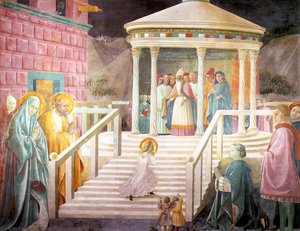
Uccellos Karriere erstreckte sich über vier Jahrzehnte, in denen er zahlreiche Kunstwerke produzierte, darunter Gemälde, Fresken und Altäre. Zu seinen bekanntesten Werken gehören:- Geburt der Jungfrau (Frührenaissance, Öl), ein Gemälde, das seine Verwendung der Perspektive zur Schaffung eines Gefühls von Tiefe demonstriert.
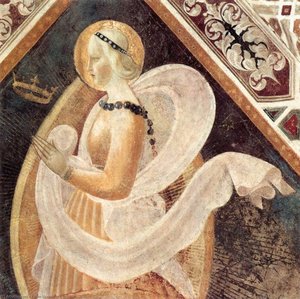
- Fresken San Miniato al Monte 03 (Frührenaissance, Öl), eine Fresko, die seine innovative Verwendung von Farbe und Licht demonstriert.
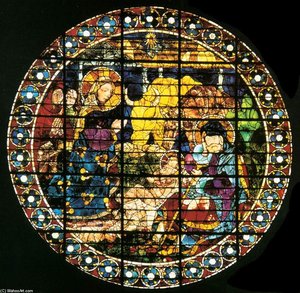
- Anbetung des Kindes (Frührenaissance, Öl), ein Gemälde mit einer detaillierten und naturalistischen Darstellung der menschlichen Form.
- Studio di Cavaliere (Frührenaissance, Öl), ein Selbstporträt, das seine selbstbewusste Verwendung autonomer Themen in der Kunst demonstriert.
Einfluss und Vermächtnis
Uccellos Werk hatte einen bedeutenden Einfluss auf die Entwicklung der Renaissancekunst. Seine Verwendung der Perspektive und sein Schwerpunkt auf die Schaffung eines Gefühls von Tiefe in seinen Gemälden beeinflussten zahlreiche Künstler, darunter Albrecht Dürer, der ebenfalls für seine bahnbrechende Arbeit im Bereich der Perspektive bekannt war. Wichtige Kunstbewegungen:- Die Frührenaissancekunstbewegung
- Italienische Renaissance
- Spätes Gotik
- Paolo Uccello (1397-1475)
- Albrecht Dürer (1471-1528)
- Lorenzo Ghiberti (1379-1455)
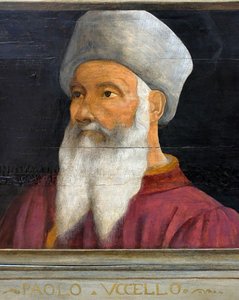
Paolo Uccello
1397 - 1475 , Italien
Kurzinfos
- Beeinflusste Künstler: ['Albrecht Dürer']
- Bemerkenswerte Werke:
- Schlacht von San Romano
- Geburt der Jungfrau
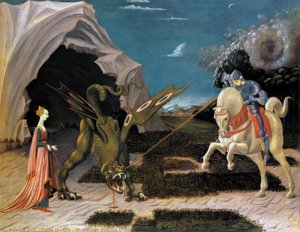
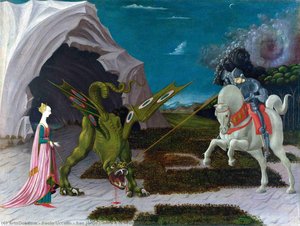
- St. Georg und Drache
- Geburtsdatum: 1397
- Geburtsort: Pratovecchio, Italien
- Künstlerische Bewegung: Frührenaissance
- Künstlerische Einflüsse:
- Lorenzo Ghiberti
- Donatello
- Nationalität: Italienisch
- Todatum: 1475
- Vollständiger Name: Paolo Uccello
Ähnliche Artikel

The Enduring Legacy of Fine Art Prints: Technique, History & Aesthetic Impact
Explore the rich history & techniques of fine art prints. Discover investment potential, assess authenticity, and learn how to preserve your collection with expert guidance. Trusted insights for discerning collectors.
Illuminating Surfaces: A Comprehensive Exploration of Tempera on Panel Painting Techniques & Historical Significance
Explore the rich history & techniques of tempera painting! Discover Renaissance masters like Botticelli & Fra Angelico, conservation insights, and the enduring legacy of this captivating art form. Learn more now!

Giclée Prints: Archival Quality & Aesthetic Nuances for the Discerning Collector
Explore the world of giclée prints with ArtsDot. Learn about archival quality, aesthetic nuances & investment potential. Expert guidance for discerning art collectors seeking museum-quality reproductions and lasting value.
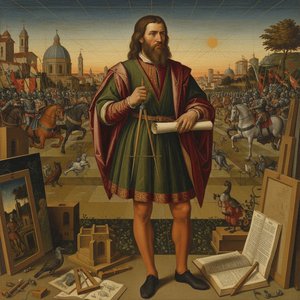
Paolo Uccello: Pionier der Perspektive und die Renaissance-Suche nach visueller Wahrheit
Entdecken Sie Paolo Uccello, einen Pionier der Renaissance und seine revolutionären Perspektivtechniken. Erfahren Sie mehr über sein Leben, ikonische Werke wie die 'Schlacht von San Romano' und seinen Einfluss auf die Kunstgeschichte.

Echoes of Time: Exploring the Enduring Appeal & Historical Context of Vintage Art Prints
Explore the captivating world of vintage art prints! Discover their history, collecting tips & enduring appeal. Expert insights on chromolithography and building a legacy collection with ArtsDot.