 Vorschau anzeigen
 Versenden
 Teilen
 Details anzeigen

 Herunterladen
 Ähnliche Objekte
 Röntgenaufnahme
 Diashow
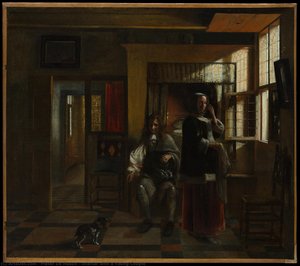
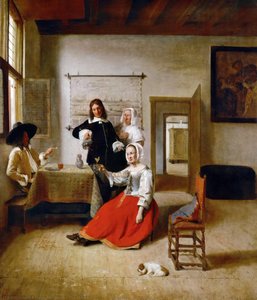
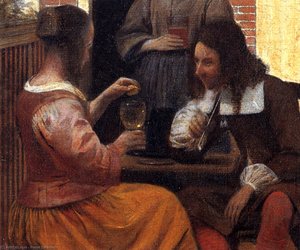
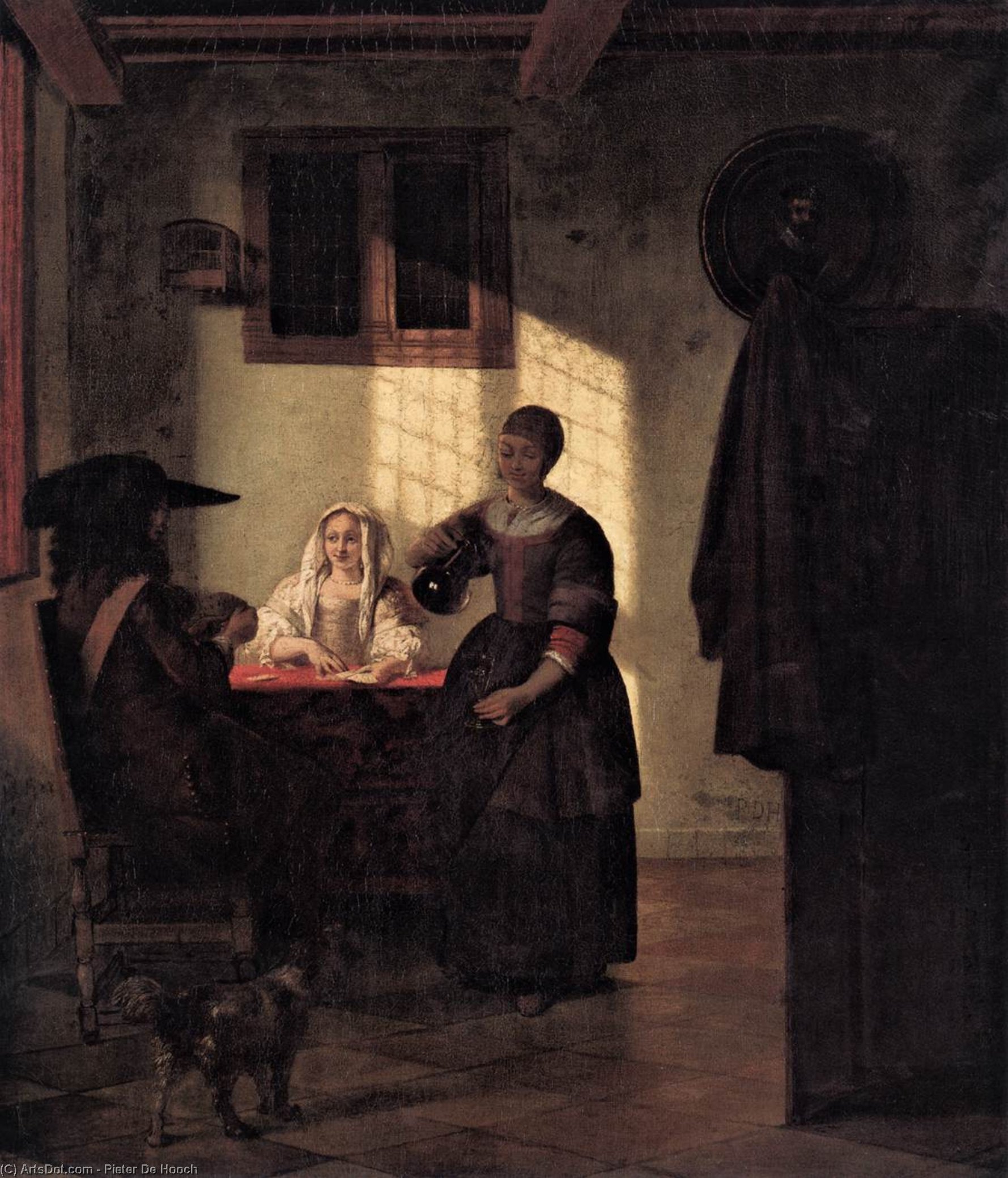
A Couple Playing Cards, with a Serving Woman
 Oil On Canvas
- WallArt
- Dutch Golden Age
 1670
1670 69.0 x 58.0 cm
 Metropolitan Museum of Art
 Weiterlesen
Handgefertigte Ölreproduktion
Handgemaltes Ölgemälde auf Leinwand in Ihrer Wunschgröße und mit Rahmen, auf Bestellung von unseren Künstlern angefertigt. ( Druck bestellen Bild kaufen)




P118B $10

P118H $10

P118W $10

P438Z $10

P508JH $12

P508YH $12

P805H $10

P805Z $10

P919BZ $10

P919G $10

P919XJ $10

P959ZH $10

P968JZ $12

W106C $8

W218G $10

W218JH $8

W218Y $10

W307PJ $10

W316G $10

W316PJ $8

W316Y $10

W398PJ $8

W4111J $10

W500HY $15

W500JH $15

W692G $12

W849H $8

W940BG $15

W953PJ $8




Wählen Sie aus unseren vordefinierten Formaten, die den ursprünglichen Proportionen des Kunstwerks entsprechen.

Sie können Ihre eigenen Maße eingeben, um einen bestimmten Rahmen oder Platz auszufüllen. Wenn die gewählte Größe nicht den Proportionen des Originalbildes entspricht, werden wir das Kunstwerk entweder beschneiden oder das Gemälde durch zusätzliche, handgemalte Elemente erweitern. Ein digitales Mockup wird Ihnen zur Genehmigung zugesandt, bevor die Produktion beginnt.
Bitte beachten Sie, dass die Bildschirmvorschau nicht die tatsächliche Beschneidung oder Erweiterung widerspiegelt. Nur das Mockup zeigt die endgültige Komposition exakt an.
Obwohl Sondermaße verfügbar sind, empfehlen wir, eine Größe aus der vordefinierten Liste zu wählen, um die ursprünglichen Proportionen beizubehalten.
Nach der Bestellung wird das ArtsDot.com-Team dem Kunden Anweisungen per E-Mail zusenden und eine Mockup-Vorschau bereitstellen.
Weltweiter Versand () in nur 3 bis 4 Wochen statt der üblichen 5 Wochen. (27 August). Keine Kompromisse bei der Qualität.

Kostenloser weltweiter Expressversand

Hochwertige Leinenleinwand

Umfassender Versicherungsschutz beim Versand

Zollgebühren-Rückerstattungsgarantie

Garantie für exakte Farbtreue

60 Tage Rückgaberecht (nur bei Mängeln)

100% Geld-zurück-Garantie

Mengenrabatt verfügbar
 Die Glasoption ist nur für Größen unter 110 cm verfügbar.

A Couple Playing Cards, with a Serving Woman
Art der Reproduktion
Format der Reproduktion
-


Gesamtpreis
$ 263
Beschreibung des Kunstwerks
A Moment of Quiet Refinement: Pieter de Hooch’s “A Couple Playing Cards, with a Serving Woman”
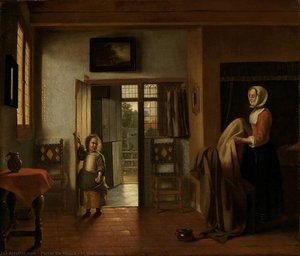
Pieter de Hooch's "A Couple Playing Cards, with a Serving Woman," painted around 1665-75, is more than just a charming domestic scene; it’s a meticulously crafted window into the burgeoning middle class of 17th-century Holland. This intimate tableau, now housed within the Robert Lehman Collection at The Metropolitan Museum of Art in New York City, captures a fleeting moment of leisure and social interaction – a carefully orchestrated ballet of light, gesture, and subtle detail that speaks volumes about the era’s values and artistic sensibilities. De Hooch, a master of the “kamergezicht” (room view), eschewed grand historical narratives or dramatic events in favor of capturing the quiet rhythms of everyday life, imbuing his paintings with an unparalleled sense of realism and psychological depth. The scene unfolds within a modestly furnished interior – a dining room bathed in soft, diffused light that streams through an open doorway, creating a luminous rectangle on the wall. A couple, dressed in the fashionable attire of the time, are deeply engrossed in a game of cards, their faces animated with concentration and perhaps a touch of friendly rivalry. The man, likely a merchant or professional, leans forward intently, while his companion, her features partially obscured by a lace shawl, responds with a thoughtful expression. A serving woman stands gracefully behind the table, presenting them with a tray laden with tea cups – a symbol of hospitality and social grace. A dog, curled up at the base of a chair on the left, adds a touch of domestic warmth to the composition, grounding the scene in the realities of family life. The inclusion of a clock hanging on the wall subtly anchors the painting within its temporal context, reminding us that this is not merely a snapshot of an isolated moment but part of a larger, unfolding narrative. De Hooch’s technical mastery is immediately apparent in his masterful use of light and shadow. He employs a technique known as “chiaroscuro,” carefully modulating the intensity of illumination to create a sense of depth and volume within the room. The light source, positioned to the left, casts long shadows across the floor and walls, lending an atmospheric quality to the scene. The artist’s attention to detail is equally remarkable – from the intricate folds of the fabrics to the delicate rendering of the tea cups and the subtle expressions on the faces of the figures. He utilizes a muted palette of browns, creams, and grays, creating a harmonious and understated visual effect that perfectly complements the painting's contemplative mood. The brushstrokes are loose and suggestive, contributing to the overall sense of immediacy and spontaneity. The historical context surrounding this work is crucial to understanding its significance. The Dutch Golden Age (roughly 1600-1700) witnessed an unprecedented period of economic prosperity, artistic innovation, and cultural flourishing in the Netherlands. The rise of a wealthy merchant class fueled demand for art that reflected their newfound status and aspirations. De Hooch’s paintings, like “A Couple Playing Cards,” captured this shift by depicting scenes of refined domesticity – a testament to the values of order, moderation, and social harmony that were increasingly embraced by the emerging middle class. The open doorway, a recurring motif in de Hooch's work, symbolizes access to the outside world, inviting the viewer into the private sphere of the family home. It also suggests a degree of voyeurism, as if we are privileged observers of this intimate moment.- Symbolism: The game of cards represents social interaction and leisure, while the serving woman embodies hospitality and domesticity. The dog symbolizes loyalty and companionship.
- Technique: De Hooch’s masterful use of chiaroscuro creates a sense of depth and atmosphere. His loose brushstrokes contribute to the painting's immediacy and spontaneity.
- Historical Context: The painting reflects the values and aspirations of the Dutch middle class during the Golden Age, emphasizing order, moderation, and social harmony.
Bringing De Hooch’s Intimacy Home: A High-Quality Reproduction
ArtsDot offers meticulously crafted, hand-painted reproductions of Pieter de Hooch's "A Couple Playing Cards, with a Serving Woman," allowing you to bring this exquisite masterpiece into your own space. Our skilled artisans replicate the artist’s nuanced techniques and delicate color palette with unparalleled precision, ensuring that every detail – from the subtle play of light on the fabrics to the expressions on the figures’ faces – is faithfully reproduced. We use only archival-quality materials and printing methods to guarantee that your reproduction will retain its beauty and vibrancy for generations to come. Whether you're seeking a statement piece for a formal living room or a calming addition to a study, this reproduction offers an authentic connection to one of the Dutch Golden Age’s most beloved artists. Consider how the painting’s muted tones and intimate composition can complement your existing décor, creating a space that is both elegant and inviting. A ArtsDot reproduction of “A Couple Playing Cards, with a Serving Woman” isn't just a print; it’s an investment in art history, a testament to De Hooch’s genius, and a beautiful reminder of the quiet pleasures of life.Ähnliche Kunstwerke

Über den Künstler
Frühe Jahre und Ausbildung
Pieter de Hooch, eine bedeutende Figur des niederländischen Goldenen Zeitalters, wurde am 20. Dezember 1629 in Rotterdam, Niederlande, geboren. Er war der älteste von fünf Kindern von Hendrick Hendricksz de Hooch, einem Ziegelbrenner, und Annetge Pieters, einer Hebamme. Über seine frühen Jahre ist wenig bekannt, aber es wird angenommen, dass er in Rotterdam, Delft und Amsterdam arbeitete. De Hoochs künstlerische Ausbildung fand in Haarlem unter dem Landschaftsmaler Nicolaes Berchem statt, zusammen mit Jacob Ochtervelt. Diese Zeit legte den Grundstein für seinen späteren Erfolg als Maler ruhiger häuslicher Szenen mit einem offenen Durchgang.Künstlerischer Stil und Themen
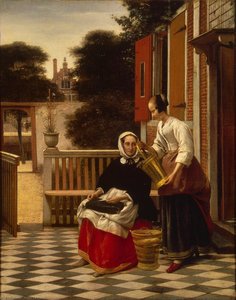
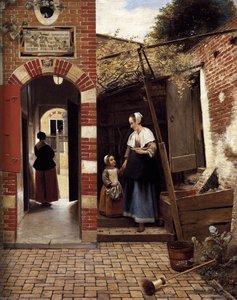
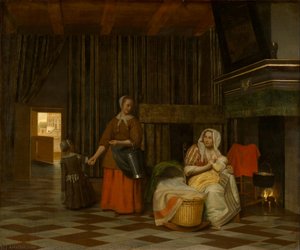
De Hoochs Werk zeichnet sich durch seine Liebe zum Detail, Naturalismus und die Verwendung von Licht aus. Seine Gemälde zeigten oft das Alltagsleben und spiegelten die Werte und Bestrebungen der aufstrebenden Mittelschicht wider. Ein bemerkenswertes Beispiel für diesen Stil ist „Der Innenhof eines Hauses in Delft“ (1658), das seine Fähigkeit zeigt, die alltäglichen Details des Lebens einzufangen. De Hoochs Werk teilt Themen und Kompositionen mit Emanuel de Witte, aber sein Fokus auf Menschen und ihre Beziehungen unterscheidet ihn. Dies wird in „Eine Frau stillt ein Kind“ (1658) und „Eine Frau mit einem Baby im Schoß“ (1658) deutlich, die sein Interesse an häuslichen Szenen demonstrieren.Wichtige Werke und Vermächtnis
Zu De Hoochs bekanntesten Werken gehören:- „Der fröhliche Trinker“ (ca. 1650)
- „Kartenspieler in einem sonnendurchfluteten Raum“ (1658)
- „Eine Frau bereitet Brot und Butter für einen Jungen vor“ (1661)
Entwicklung und Einflüsse
De Hooch entwickelte seinen Stil im Laufe seiner Karriere weiter. In seinen frühen Jahren zeigte er Szenen mit Soldaten in Ställen und Tavernen, beeinflusst von Adriaen van Ostade. Später konzentrierte er sich auf detailliertere Darstellungen häuslicher Innenräume, die durch seine meisterhafte Lichtführung gekennzeichnet sind. Ab etwa 1660 zog De Hooch nach Amsterdam, wo sein Stil beschreibender wurde und seine Szenen in luxuriösen Umgebungen angesiedelt waren. Diese Werke vermissen jedoch die Subtilität seiner Delft-Phase. Ein wichtiger Einfluss war sicherlich Nicolaes Berchem, der ihm die Grundlagen des Malens beibrachte. Auch Emanuel de Witte beeinflusste ihn thematisch, obwohl De Hooch sich stärker auf menschliche Beziehungen konzentrierte.Historische Bedeutung
Pieter de Hooch gilt als einer der bedeutendsten niederländischen Genre-Maler und als Meister der Innenraumdarstellung. Seine Fähigkeit, eine Atmosphäre von Ruhe und Intimität zu schaffen, machte ihn berühmt. Die Erfindung des „Durchgangsfensters“ (*doorkirkjie*) ermöglichte es ihm, die Außenwelt in seine Gemälde zu integrieren und so ein Gefühl von Tiefe und Perspektive zu erzeugen. Seine Werke spiegeln das Leben der aufstrebenden bürgerlichen Schicht im 17. Jahrhundert wider und bieten einen wertvollen Einblick in die niederländische Gesellschaft dieser Zeit.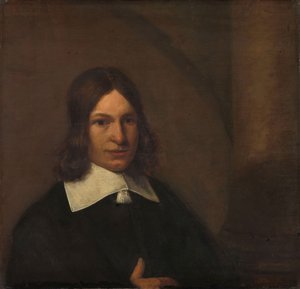
Pieter de Hooch
1629 - 1694 , Niederlande
Kurzinfos
- Beeinflusste Künstler: ['Emanuel de Witte']
- Bemerkenswerte Werke:
- Der fröhliche Trinker
- Kartenspieler in einem sonnigen Raum
- Eine Frau bereitet Brot und Butter zu
- Frau liest einen Brief
- Geburtsdatum: 20. Dezember 1629
- Geburtsort: Rotterdam, Niederlande
- Künstlerischer Stil: Realismus, Goldenes Zeitalter
- Nationalität: Niederländisch
- Sterbedatum: 1694
- Vollständiger Name: Pieter de Hooch
- Von Künstlern Beeinflusst: ['Nicolaes Berchem']
Ähnliche Artikel
Pieter de Hooch: Meister der Stille und des holländischen Lebens im Goldenen Zeitalter
Entdecken Sie das Werk von Pieter de Hooch, Meister des holländischen Goldenen Zeitalters! Analysen, Hintergrundinformationen und hochwertige Reproduktionen seiner berühmten Genremalerei finden Sie bei ArtsDot.

Die 10 Meisterwerke des Goldenen Zeitalters der niederländischen Malerei |
Entdecken Sie die 10 Meisterwerke des Niederländischen Goldenen Zeitalters! Von Rembrandt bis Vermeer – erleben Sie Kunstgeschichte, Techniken & Emotionen. Hochwertige Gemäldereproduktionen für Ihr Zuhause auf .
Willem van de Velde der Ältere: Meister der Seemalererei und Chronist des Niederländischen Goldenen Zeitalters
Entdecken Sie das Werk von Willem van de Velde der Ältere, dem Meister der Seemalerei des Niederländischen Goldenen Zeitalters. Erfahren Sie mehr über sein Leben, seine Techniken und seinen Einfluss auf die Kunstgeschichte – jetzt bei ArtsDot!

Golden Age Reflections: Dutch Baroque Painting & Cultural Innovation
Explore the Dutch Golden Age of painting! Discover key artists like Vermeer & ter Borch, their innovative techniques, and the rich cultural context behind these Baroque masterpieces. Learn about collecting & appreciating this iconic art period.

Illuminating Innovation: Exploring the Dutch Golden Age of Painting
Explore the Dutch Golden Age of painting with ArtsDot. Discover Rembrandt, Vermeer & other Masters. Learn about key characteristics, iconic artworks, and lasting influence. Expert insights for collectors & enthusiasts.