In echtem Maßstab anzeigen
 Versenden als Grußkarte
 Teilen
 Details anzeigen

 Herunterladen
 Ähnliche Objekte
 Röntgenaufnahme
 Diashow
 Besucherstatistiken
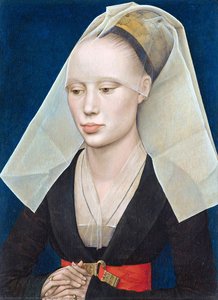
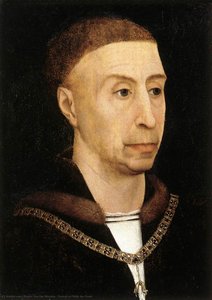
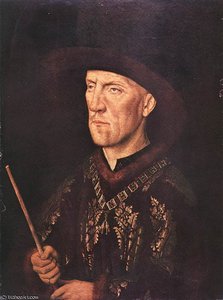
Portrait of Philippe le Bon


 Mehr anzeigen
Giclée / Kunstdruck
Giclée- oder Leinwanddruck in Museumsqualität mit schneller Produktion und flexiblen Veredelungsoptionen. ( Handgemalte Reproduktion kaufen Zum digitalen Bild wechseln)




P118B $10

P118H $10

P118W $10

P438Z $10

P508JH $12

P508YH $12

P805H $10

P805Z $10

P919BZ $10

P919G $10

P919XJ $10

P959ZH $10

P968JZ $12

W106C $8

W218G $10

W218JH $8

W218Y $10

W307PJ $10

W316G $10

W316PJ $8

W316Y $10

W398PJ $8

W4111J $10

W500HY $15

W500JH $15

W692G $12

W849H $8

W940BG $15

W953PJ $8




Wählen Sie aus unseren vordefinierten Formaten, die den ursprünglichen Proportionen des Kunstwerks entsprechen.

Sie können Ihre eigenen Maße eingeben, um ein bestimmtes Format oder einen speziellen Platz einzupassen. Wenn das von Ihnen gewählte Format nicht den Proportionen des Originalbildes entspricht, werden wir das Kunstwerk entweder beschneiden oder das Bild mit einem gespiegelten oder einfarbigen Rand erweitern. Ein digitaler Entwurf wird Ihnen zur Genehmigung zugesandt, bevor die Produktion beginnt.
Bitte beachten Sie, dass die Vorschau auf dem Bildschirm nicht den tatsächlichen Zuschnitt oder die Erweiterung widerspiegelt. Nur der Entwurf zeigt die endgültige Komposition präzise an.
Obwohl Sondermaße verfügbar sind, empfehlen wir die Auswahl eines Maßes aus der vordefinierten Liste, um die ursprünglichen Proportionen zu bewahren.
Weltweiter Versand () innerhalb von 2 Wochen statt der üblichen 4/5 Wochen. (17 September)

Kostenloser weltweiter Expressversand

Hochwertige Leinenleinwand

Vollständiger Versicherungsschutz beim Versand

Zollgebühren-Rückerstattungsgarantie

Garantie für exakte Farbtreue

100-tägiges Rückgaberecht (nur bei Mängeln)

100% Geld-zurück-Garantie

Angebot für Mengenrabatt
 Die Glasoption ist nur für Größen unter 110 cm verfügbar.

Portrait of Philippe le Bon
Giclée / Kunstdruck
Format der Reproduktion
-


Gesamtpreis
$ 62
A Window Into Burgundian Majesty
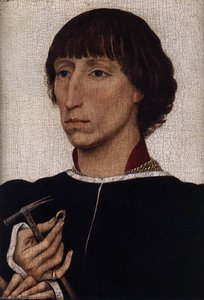
The painting “Portrait of Philippe le Bon,” attributed to the legendary master Rogier van der Weyden, stands as an arresting testament to the artistic fervor and intellectual sophistication of the Burgundian court in the mid-fifteenth century. More than just a depiction of royalty, it is a carefully constructed visual narrative that speaks volumes about power, piety, and the humanist ideals prevalent during this transformative period in European history. Created sometime between 1435 and 1440, the work captures the essence of a Duke whose influence stretched across much of Europe, presenting a face that is both a political statement and a deeply personal encounter.
To gaze upon this portrait is to witness the birth of psychological realism in Northern Renaissance art. Van der Weysebden, often celebrated as a “Master of Emotion,” moved away from the rigid, stylized conventions of his predecessors. Instead, he sought to capture the inner life of his subject. In Philippe le Bon, we see a contemplative gaze directed outwards, conveying both solemn dignity and a profound seriousness. This deliberate choice reflects the burgeoning humanist movement, which championed keen observation and empathy as essential pathways to understanding the human experience. For the modern collector, this piece offers more than mere decoration; it provides a window into a soul, making it an ideal centerpiece for those who value art that evokes deep contemplation.
The Alchemy of Oil and Light
The technical execution of this masterpiece showcases Van der Weyden's unparalleled skill in oil paintsmanship—a technique that was rapidly gaining prominence during this era. Unlike the flatter, more opaque nature of tempera, the use of oil allowed for subtle gradations of tone and color, achieving a luminosity previously unattainable in European painting. The artist meticulously built up layers of glaze upon glaze, creating an astonishingly rich surface texture that captures the nuances of light and shadow with breathtaking accuracy.
Every detail is rendered with the precision of a goldsmith, a nod to the artist's own formative training. From the soft texture of the skin to the heavy, dignified folds of the attire, the painting possesses a tactile quality that draws the viewer in. This mastery of light does not merely illuminate the subject; it sculpts him, giving the portrait a three-dimensional presence that feels remarkably alive. For interior designers, such a work brings a sense of historical weight and textural richness to a room, acting as a focal point that commands attention through its sheer technical brilliance.
A Legacy of Devotion and Detail
Beyond the physical likeness, the portrait is steeped in the symbolism of the Burgundian era. The meticulous rendering of fabrics and accessories serves to communicate the status and wealth of the Duke, yet there is an underlying spiritual gravity that permeates the composition. Van der Weyden had a unique ability to blend the material splendor of the court with the profound intensity of spiritual devotion. This duality makes the portrait not only a historical document but an emotional experience.
Owning a high-quality reproduction of this work allows one to invite this sense of Burgundian majesty into a contemporary space. Whether placed in a quiet study or a grand salon, the "Portrait of Philippe le Bon" serves as a bridge between the past and the present. It is an invitation to slow down, to observe the fine details, and to connect with the enduring human emotions that Van der Weyden so masterfully captured centuries ago. For the discerning enthusiast, it remains a timeless symbol of strength, intellect, and the profound beauty of the human spirit.
Ähnliche Kunstwerke


Biografie des Künstlers
Leben und Karriere
Rogier van der Weyden, auch bekannt als Roger de la Pasture, war ein bedeutender niederländischer Maler des frühen 15. Jahrhunderts. Er wurde um 1400 in Belgien geboren und entwickelte sich zu einem der einflussreichsten Künstler seiner Zeit, wobei seine Werke in den Niederlanden, Italien und Spanien großen Anklang fanden.Künstlerischer Stil und Technik
Van der Weydens künstlerischer Stil war durch eine reiche Farbgebung, mitfühlende Ausdrucksweise und einen einzigartigen Ansatz für Pathos und Naturalismus geprägt. Seine Figuren wirkten oft statuarisch, insbesondere in seinen Altäfern, die detaillierte Ausarbeitungen und idealisierte Gesichtszüge aufwiesen. Er setzte ein vielfältiges Farbspektrum ein, um sicherzustellen, dass kein einzelner Ton wiederholt wurde, was Tiefe und Komplexität zu seinen Kompositionen hinzufügte.Bekannte Werke
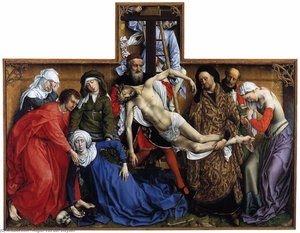
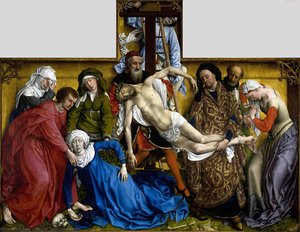
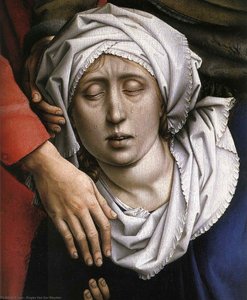
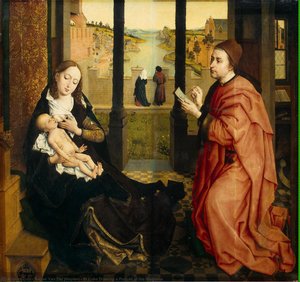
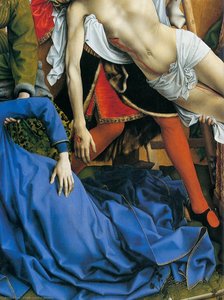
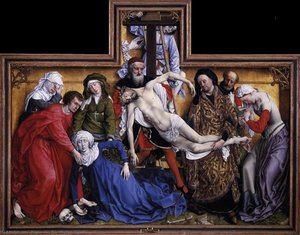
* St. Lukas zeichnet ein Porträt der Jungfrau Maria (Museum of Fine Arts, Boston): Dieses Gemälde zeigt Van der Weydens Meisterschaft in der Ölmalerei auf Holz mit einer beeindruckenden Darstellung von St. Lukas. * Lamentation (Musée des Beaux-Arts Tournai, Belgien): Dieses kleine, aber kraftvolle Gemälde demonstriert Van der Weydens Fähigkeit, durch Chiaroscuro emotionale Intensität auszudrücken.Museen und Sammlungen
* Musée des Beaux-Arts Tournai, Belgien: Bietet eine beeindruckende Sammlung von Werken van der Weydens, darunter das Porträtdiptychon von Jean de Gros. * Musées royaux des Beaux-Arts (Brüssel, Belgien): Beherbergt eine bedeutende Sammlung früher niederländischer Gemälde, darunter Werke von van der Weyden und anderen namhaften Künstlern.Vermächtnis
Van der Weydens Einfluss auf den nördlichen Renässanz ist unbestreitbar. Er stand zusammen mit Robert Campin und Jan van Eyck als einer der drei großen frühen flämischen Künstler, bekannt für seinen innovativen Stil und seine Technik. Obwohl sein Ruhm im 17. Jahrhundert nachließ, wurden seine Werke im 19. Jahrhundert wiederentdeckt, und er gilt heute als eine wichtige Figur in der Geschichte der frühen niederländischen Malerei.- Weitere Werke von Rogier van der Weyden auf ArtsDot.com ansehen
- Die Sammlung des Musée des Beaux-Arts Tournai entdecken unter Entdecken Sie die Meisterwerke des Musée des Beaux-Arts Tournai, Belgien
- Mehr über frühe niederländische Malerei auf Wikipedia erfahren
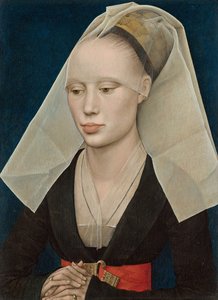
Rogier van der Weyden
1400 - 1464 , Belgien
Eckdaten zum Künstler
- Beeinflusste Künstler: ['Goswijn van der Weyden']
- Bemerkenswerte Werke:
- St. Lukas malt Maria
- Lamentation
- Deposition
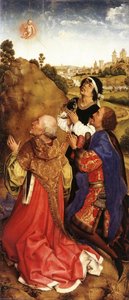
- Bladelin Triptychon
- Einfluss Auf Künstler: ['Italienische Renaissance']
- Geburtsdatum: ca. 1400
- Geburtsort: Tournai, Belgien
- Künstlerischer Stil: Frühflämische Malerei
- Nationalität: Belgisch
- Sterbedatum: 1464
- Vollständiger Name: Rogier van der Weyden
Verwandte Artikel

The Enduring Legacy of Oil on Canvas: Technique, History & Aesthetic Impact
Explore the rich history & techniques of oil painting – from Renaissance masters to Impressionism. Discover pigments, layering methods, and why this timeless medium endures. Expert insights for artists & art enthusiasts.
Öl auf Leinwand: Die 10 Meisterwerke, die Kunst für immer veränderten |
Entdecken Sie die 10 legendärsten Öl auf Leinwand Meisterwerke! Von Van Gogh bis Monet – erfahren Sie die Geschichten hinter ikonischen Gemälden und lassen Sie sich von Kunstgeschichte inspirieren. Hochwertige Reproduktionen für Ihr Zuhause finden Sie auf .

Öl auf Leinwand: Eine historische und technische Erkundung eines zeitlosen künstlerischen Mediums
Entdecken Sie die faszinierende Welt der Ölmalerei! Von historischen Techniken bis zur modernen Anwendung – wir bieten Expertenwissen, Restaurierungstipps und hochwertige Reproduktionen. Jetzt informieren!
Frühniederländische Renaissance: 10 Meisterwerke für Ihr Zuhause | ArtsDot
Entdecken Sie die 10 prägendsten Meisterwerke der Frühniederländischen Renaissance! Erfahren Sie mehr über Jan van Eyck, Rogier van der Weyden & Co. und ihre ikonischen Gemälde. Hochwertige Reproduktionen für Ihr Zuhause – jetzt auf ArtsDot.com!

Das bleibende Erbe der Ölmalerei: Technik, Geschichte und zeitgenössische Praxis
Entdecken Sie die faszinierende Geschichte der Ölmalerei – von den frühen Techniken bis zur modernen Kunst. Expertenwissen, detaillierte Analysen und Inspiration für Sammler & Kunstliebhaber.