 Vorschau anzeigen
 Versenden
 Teilen
 Details anzeigen

 Herunterladen
 Ähnliche Objekte
 Röntgenaufnahme
 Diashow
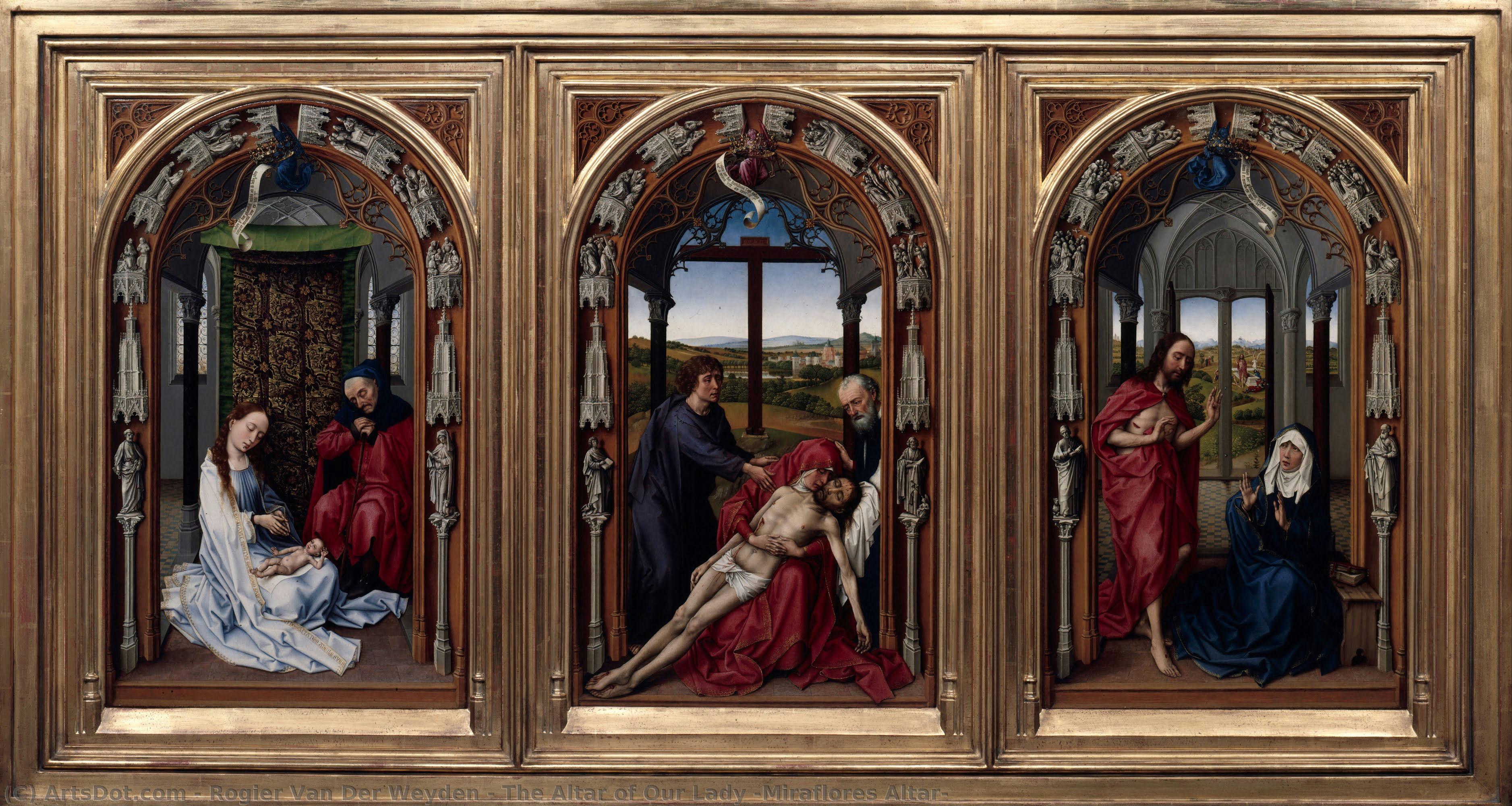
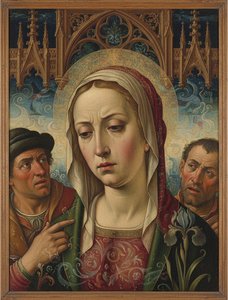
The Altar of Our Lady (Miraflores Altar)
 Öl auf Leinwand
- Wandkunst
- Early Netherlandish Painting
 1440
1440 213.0 x 43.0 cm
 Weiterlesen
Handgefertigte Ölreproduktion
Handgemaltes Ölgemälde auf Leinwand in Ihrer Wunschgröße und mit Rahmen, auf Bestellung von unseren Künstlern angefertigt. ( Druck bestellen Bild kaufen)




P118B $10

P118H $10

P118W $10

P438Z $10

P508JH $12

P508YH $12

P805H $10

P805Z $10

P919BZ $10

P919G $10

P919XJ $10

P959ZH $10

P968JZ $12

W106C $8

W218G $10

W218JH $8

W218Y $10

W307PJ $10

W316G $10

W316PJ $8

W316Y $10

W398PJ $8

W4111J $10

W500HY $15

W500JH $15

W692G $12

W849H $8

W940BG $15

W953PJ $8




Wählen Sie aus unseren vordefinierten Formaten, die den ursprünglichen Proportionen des Kunstwerks entsprechen.

Sie können Ihre eigenen Maße eingeben, um einen bestimmten Rahmen oder Platz auszufüllen. Wenn die gewählte Größe nicht den Proportionen des Originalbildes entspricht, werden wir das Kunstwerk entweder beschneiden oder das Gemälde durch zusätzliche, handgemalte Elemente erweitern. Ein digitales Mockup wird Ihnen zur Genehmigung zugesandt, bevor die Produktion beginnt.
Bitte beachten Sie, dass die Bildschirmvorschau nicht die tatsächliche Beschneidung oder Erweiterung widerspiegelt. Nur das Mockup zeigt die endgültige Komposition exakt an.
Obwohl Sondermaße verfügbar sind, empfehlen wir, eine Größe aus der vordefinierten Liste zu wählen, um die ursprünglichen Proportionen beizubehalten.
Nach der Bestellung wird das ArtsDot.com-Team dem Kunden Anweisungen per E-Mail zusenden und eine Mockup-Vorschau bereitstellen.
Weltweiter Versand () in nur 3 bis 4 Wochen statt der üblichen 5 Wochen. (27 August). Keine Kompromisse bei der Qualität.

Kostenloser weltweiter Expressversand

Hochwertige Leinenleinwand

Umfassender Versicherungsschutz beim Versand

Zollgebühren-Rückerstattungsgarantie

Garantie für exakte Farbtreue

60 Tage Rückgaberecht (nur bei Mängeln)

100% Geld-zurück-Garantie

Mengenrabatt verfügbar
 Die Glasoption ist nur für Größen unter 110 cm verfügbar.

The Altar of Our Lady (Miraflores Altar)
Art der Reproduktion
Format der Reproduktion
-


Gesamtpreis
$ 263
A Window Into Sacred Time: Rogier van der Weyden’s “The Altar of Our Lady”
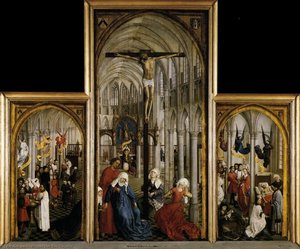
Rogier van der Weyden's "The Altar of Our Lady" (Miraflores Altarpiece), a masterpiece crafted around 1442-45, isn’t merely a painting; it’s an immersive theatrical experience. Commissioned for the Miraflores chapel in Brussels, this triptych transcends the traditional confines of religious art, inviting the viewer into a meticulously constructed world where biblical narratives unfold within imagined architectural spaces. Van der Weyden, a master of emotional realism and painstaking detail, elevates the familiar stories of Mary and Christ to an almost operatic scale, utilizing color, line, and symbolism with breathtaking sophistication.
The painting’s genesis lies in the burgeoning artistic trends of the early 15th century. Van der Weyden, trained initially as a goldsmith, brought his innate understanding of texture and craftsmanship to his art. This is immediately apparent in the remarkably realistic depiction of fabrics – the flowing robes, the folds of Mary's garments, the rough-hewn wood of the imagined architectural frames—all rendered with an astonishing level of detail. Furthermore, the influence of late Gothic architecture is palpable; the arches and spandrels that frame each panel aren’t simply decorative elements but integral components of a staged environment, blurring the line between painting and reality.
The Narrative Unfolds: Three Pivotal Moments
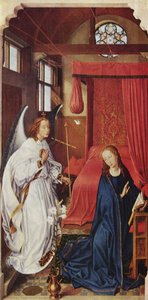
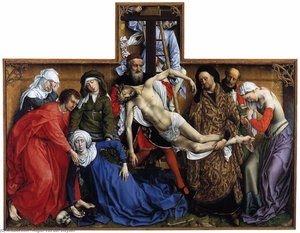
At first glance, “The Altar of Our Lady” presents three distinct scenes, yet they are inextricably linked by a chronological progression. The left panel depicts the Holy Family – Mary, Christ, and Saint Joseph – in a serene moment of return. Joseph, leaning on his staff, appears to be lost in sleep, while Mary gazes affectionately at her son. This isn’t a conventional Nativity scene; rather, it establishes a foundational narrative, setting the stage for the subsequent events. The central panel captures the poignant grief of the Lamentation – Christ's body cradled by Mary and John the Evangelist, with Peter standing vigil. The somber palette—primarily blues and blacks—underscores the tragedy, while Van der Weyden’s masterful rendering of Mary’s anguish is profoundly moving.
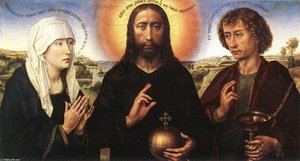
Finally, the right panel portrays a pivotal moment of divine reunion: Christ's appearance to his mother after the Resurrection. This scene, not explicitly detailed in the Gospels, serves as a powerful symbol of comfort and reassurance. The light emanating from Christ’s figure contrasts dramatically with the surrounding darkness, signifying hope amidst despair. The figures are rendered with an almost ethereal quality, suggesting a realm beyond earthly concerns.
Symbolism Woven into Every Detail
Beyond the narrative itself, “The Altar of Our Lady” is saturated with symbolism. Van der Weyden’s use of color is particularly significant; white represents Mary's purity and virginity, red signifies her sorrow and compassion, and blue embodies her faith. The intricate reliefs adorning the arches—depicting scenes from the lives of Christ and Mary—further enrich the narrative, providing a contextual framework for each central scene. The placement of these reliefs within imagined architectural portals creates an illusion of depth and space, drawing the viewer into the heart of the religious drama.
A Legacy of Emotion and Innovation
“The Altar of Our Lady” stands as a testament to Rogier van der Weyden’s artistic genius. It represents a pivotal moment in the development of Early Netherlandish painting, characterized by its emotional intensity, meticulous realism, and innovative use of perspective and symbolism. Influencing generations of artists, Van der Weyden's masterpiece continues to captivate viewers with its profound beauty and enduring message—a timeless exploration of faith, grief, and hope.
Ähnliche Kunstwerke
Über den Künstler
Leben und Karriere
Rogier van der Weyden, auch bekannt als Roger de la Pasture, war ein bedeutender niederländischer Maler des frühen 15. Jahrhunderts. Er wurde um 1400 in Belgien geboren und entwickelte sich zu einem der einflussreichsten Künstler seiner Zeit, wobei seine Werke in den Niederlanden, Italien und Spanien großen Anklang fanden.Künstlerischer Stil und Technik
Van der Weydens künstlerischer Stil war durch eine reiche Farbgebung, mitfühlende Ausdrucksweise und einen einzigartigen Ansatz für Pathos und Naturalismus geprägt. Seine Figuren wirkten oft statuarisch, insbesondere in seinen Altäfern, die detaillierte Ausarbeitungen und idealisierte Gesichtszüge aufwiesen. Er setzte ein vielfältiges Farbspektrum ein, um sicherzustellen, dass kein einzelner Ton wiederholt wurde, was Tiefe und Komplexität zu seinen Kompositionen hinzufügte.Bekannte Werke
* St. Lukas zeichnet ein Porträt der Jungfrau Maria (Museum of Fine Arts, Boston): Dieses Gemälde zeigt Van der Weydens Meisterschaft in der Ölmalerei auf Holz mit einer beeindruckenden Darstellung von St. Lukas. * Lamentation (Musée des Beaux-Arts Tournai, Belgien): Dieses kleine, aber kraftvolle Gemälde demonstriert Van der Weydens Fähigkeit, durch Chiaroscuro emotionale Intensität auszudrücken.Museen und Sammlungen
* Musée des Beaux-Arts Tournai, Belgien: Bietet eine beeindruckende Sammlung von Werken van der Weydens, darunter das Porträtdiptychon von Jean de Gros. * Musées royaux des Beaux-Arts (Brüssel, Belgien): Beherbergt eine bedeutende Sammlung früher niederländischer Gemälde, darunter Werke von van der Weyden und anderen namhaften Künstlern.Vermächtnis
Van der Weydens Einfluss auf den nördlichen Renässanz ist unbestreitbar. Er stand zusammen mit Robert Campin und Jan van Eyck als einer der drei großen frühen flämischen Künstler, bekannt für seinen innovativen Stil und seine Technik. Obwohl sein Ruhm im 17. Jahrhundert nachließ, wurden seine Werke im 19. Jahrhundert wiederentdeckt, und er gilt heute als eine wichtige Figur in der Geschichte der frühen niederländischen Malerei.- Weitere Werke von Rogier van der Weyden auf ArtsDot.com ansehen
- Die Sammlung des Musée des Beaux-Arts Tournai entdecken unter Entdecken Sie die Meisterwerke des Musée des Beaux-Arts Tournai, Belgien
- Mehr über frühe niederländische Malerei auf Wikipedia erfahren
Rogier van der Weyden
1400 - 1464 , Belgien
Kurzinfos
- Beeinflusste Künstler: ['Goswijn van der Weyden']
- Bemerkenswerte Werke:
- St. Lukas malt Maria
- Lamentation
- Deposition
- Bladelin Triptychon
- Einfluss Auf Künstler: ['Italienische Renaissance']
- Geburtsdatum: ca. 1400
- Geburtsort: Tournai, Belgien
- Künstlerischer Stil: Frühflämische Malerei
- Nationalität: Belgisch
- Sterbedatum: 1464
- Vollständiger Name: Rogier van der Weyden
Ähnliche Artikel
Frühniederländische Renaissance: 10 Meisterwerke für Ihr Zuhause | ArtsDot
Entdecken Sie die 10 prägendsten Meisterwerke der Frühniederländischen Renaissance! Erfahren Sie mehr über Jan van Eyck, Rogier van der Weyden & Co. und ihre ikonischen Gemälde. Hochwertige Reproduktionen für Ihr Zuhause – jetzt auf ArtsDot.com!
Rogier van der Weyden: Emotion, Innovation und die Frührenaissance der Niederlande
Entdecken Sie Rogier van der Weydens revolutionäre Kunst! Erfahren Sie mehr über seine Technik, ikonische Werke und den Einfluss der Frührenaissance auf die niederländische Malerei. Expertenanalyse & tiefe Einblicke.

Frühniederländische Meisterwerke: 10 Gemälde, die eine Epoche prägten | ArtsDot
Entdecken Sie die 10 prägendsten Meisterwerke der Frühniederländischen Malerei! Von Jan van Eyck bis Rogier van der Weyden – erleben Sie Kunstgeschichte hautnah. Hochwertige Reproduktionen & Inspiration für Ihr Interieur auf ArtsDot.com.
Hugo van der Goes: Andacht, Innovation und die psychologische Tiefe der frühen niederländischen Malerei
Entdecken Sie die revolutionäre Kunst von Hugo van der Goes! Tiefgründige Analyse seiner Werke, bahnbrechende Technik und bleibender Einfluss auf die frühe niederländische Malerei. Für Kunstexperten & Sammler.

Rembrandts Meisterwerke: Die Top 25 Kunstwerke für Ihr Zuhause | ArtsDot
Entdecken Sie Rembrandts 25 berühmteste Kunstwerke! Tauchen Sie ein in die Welt des Barock, Licht und Schatten & historischer Porträts. Hochwertige Reproduktionen für Ihr Zuhause – jetzt auf ArtsDot.com!