 Vorschau anzeigen
 Versenden
 Teilen
 Details anzeigen

 Herunterladen
 Ähnliche Objekte
 Röntgenaufnahme
 Diashow
Dante and Beatrice

 Weiterlesen
Handgefertigte Ölreproduktion
Handgemaltes Ölgemälde auf Leinwand in Ihrer Wunschgröße und mit Rahmen, auf Bestellung von unseren Künstlern angefertigt. ( Druck bestellen Bild kaufen)




P118B $10

P118H $10

P118W $10

P438Z $10

P508JH $12

P508YH $12

P805H $10

P805Z $10

P919BZ $10

P919G $10

P919XJ $10

P959ZH $10

P968JZ $12

W106C $8

W218G $10

W218JH $8

W218Y $10

W307PJ $10

W316G $10

W316PJ $8

W316Y $10

W398PJ $8

W4111J $10

W500HY $15

W500JH $15

W692G $12

W849H $8

W940BG $15

W953PJ $8




Wählen Sie aus unseren vordefinierten Formaten, die den ursprünglichen Proportionen des Kunstwerks entsprechen.

Sie können Ihre eigenen Maße eingeben, um einen bestimmten Rahmen oder Platz auszufüllen. Wenn die gewählte Größe nicht den Proportionen des Originalbildes entspricht, werden wir das Kunstwerk entweder beschneiden oder das Gemälde durch zusätzliche, handgemalte Elemente erweitern. Ein digitales Mockup wird Ihnen zur Genehmigung zugesandt, bevor die Produktion beginnt.
Bitte beachten Sie, dass die Bildschirmvorschau nicht die tatsächliche Beschneidung oder Erweiterung widerspiegelt. Nur das Mockup zeigt die endgültige Komposition exakt an.
Obwohl Sondermaße verfügbar sind, empfehlen wir, eine Größe aus der vordefinierten Liste zu wählen, um die ursprünglichen Proportionen beizubehalten.
Nach der Bestellung wird das ArtsDot.com-Team dem Kunden Anweisungen per E-Mail zusenden und eine Mockup-Vorschau bereitstellen.
Weltweiter Versand () in nur 3 bis 4 Wochen statt der üblichen 5 Wochen. (21 August). Keine Kompromisse bei der Qualität.

Kostenloser weltweiter Expressversand

Hochwertige Leinenleinwand

Umfassender Versicherungsschutz beim Versand

Zollgebühren-Rückerstattungsgarantie

Garantie für exakte Farbtreue

60 Tage Rückgaberecht (nur bei Mängeln)

100% Geld-zurück-Garantie

Mengenrabatt verfügbar
 Die Glasoption ist nur für Größen unter 110 cm verfügbar.

Dante and Beatrice
Art der Reproduktion
Format der Reproduktion
-


Gesamtpreis
$ 263
Beschreibung des Kunstwerks
Sandro Botticelli’s “Dante and Beatrice”: A Renaissance Vision of Divine Devotion
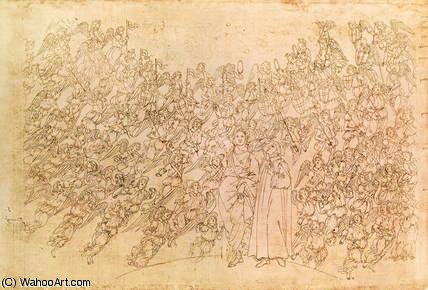
Sandro Botticelli's "Dante and Beatrice," painted around 1480, isn’t merely a depiction of two figures; it’s a vibrant portal into the heart of Florentine artistic and intellectual life during the Early Renaissance. This captivating drawing, now housed within the prestigious Kupferstichkabinett (Print Room) at the Staatliche Museen zu Berlin, offers a rare glimpse into Botticelli's masterful command of line and his profound engagement with Dante Alighieri’s “Divine Comedy.” More than just an illustration, it embodies a complex interplay of religious fervor, philosophical contemplation, and the burgeoning humanist spirit that defined the era. The work immediately draws the eye with its dynamic composition—a swirling mass of figures rendered in meticulously crafted black and white lines, creating a sense of both urgency and profound serenity.
Botticelli’s technique is instantly recognizable: a deliberate departure from the smooth, polished surfaces favored by many of his contemporaries. Here, he embraces a linear style reminiscent of late Gothic art, yet infused with a distinctly Renaissance sensibility. The artist employs intricate hatching and cross-hatching to build up tonal variations, suggesting depth and volume without relying on traditional shading. Notice how the varying line weights create texture—the dense layering of figures in the foreground contrasts sharply with the more fluid lines depicting the distant crowd, conveying a powerful sense of spatial recession. This masterful use of line isn’t simply decorative; it's integral to the work’s expressive power.
The Dantean Narrative and Symbolic Weight
At its core, “Dante and Beatrice” captures a pivotal moment from Dante’s “Paradiso,” the final canticle of his epic poem. The scene depicts Dante, guided by Virgil, ascending through the celestial spheres to encounter Beatrice, representing divine grace and ultimately, God himself. Botticelli doesn't offer a literal representation of this journey; instead, he translates the poem’s spiritual intensity into a visual drama. The sheer number of figures surrounding Dante—angels, saints, and other souls—underscores the overwhelming nature of divine presence and the magnitude of Dante’s ascent. Each figure is rendered with a distinct personality, contributing to the overall sense of bustling activity and profound reverence.
Symbolism permeates every aspect of the drawing. The central female figure, Beatrice, is depicted in a pose of serene beauty and ethereal grace—a testament to her role as an intercessor between humanity and the divine. The swirling crowd represents the collective yearning for salvation, while Virgil’s presence signifies human reason guiding Dante towards enlightenment. The composition itself echoes the structure of the “Divine Comedy” – a journey through different realms of existence, culminating in a transcendent experience. Botticelli's choice to depict this scene as a dynamic line drawing—rather than a more traditional fresco or panel painting—suggests a deliberate attempt to capture the *movement* and *energy* inherent in Dante’s vision.
Historical Context and Artistic Legacy
Botticelli’s “Dante and Beatrice” emerged during a period of intense intellectual ferment in Florence. The Renaissance was witnessing a renewed interest in classical antiquity, alongside a burgeoning humanist philosophy that emphasized human potential and earthly experience. This complex interplay of influences is reflected in Botticelli's work—his ability to seamlessly blend religious iconography with elegant, almost decorative forms. The drawing’s creation coincided with the rediscovery of Dante’s “Divine Comedy,” which quickly became a cultural phenomenon throughout Europe.
The acquisition of this drawing by Gustav von Waagen in 1854 from the Hamilton Collection is itself a fascinating story—a testament to the enduring appeal of Botticelli's work. The drawings were initially discovered in Scotland, and their subsequent journey to Berlin highlights the international significance of Renaissance art. “Dante and Beatrice” stands as a remarkable example of Botticelli’s artistic genius—a powerful synthesis of religious devotion, philosophical contemplation, and masterful technique that continues to captivate viewers centuries after its creation. It's a work that invites us to contemplate not only the beauty of the image itself but also the profound spiritual questions it raises.
A Timeless Masterpiece for Art Enthusiasts
Botticelli’s “Dante and Beatrice” is more than just an artwork; it’s a window into a pivotal moment in Western art history. Its intricate detail, dynamic composition, and rich symbolism make it a truly exceptional piece. Reproductions of this drawing offer a wonderful opportunity to bring this Renaissance masterpiece into your home or office, allowing you to appreciate its beauty and complexity on a daily basis. Whether you are an avid art collector, a design enthusiast seeking inspiration, or simply someone who appreciates the power of visual storytelling, “Dante and Beatrice” is sure to leave a lasting impression.
Ähnliche Kunstwerke
Über den Künstler
frühes Leben und Ausbildung
Sandro Botticelli, geboren Alessandro di Mariano di Vanni Filipepi um 1445, war eine zentrale Figur im frühen italienischen Frührenaissance der Malerei. Zunächst posthumig vernachlässigt, wurde Botticellis Werk im späten 19. Jahrhundert von den Präraffaeliten revitalisiert und führte zu einer Neubewertung seiner künstlerischen Beiträge. Botticelli wurde in Florenz, Italien, geboren und lebte sein ganzes Leben im selben Viertel. Seine Familie, darunter sein Vater Mariano di Vanni d’Amedeo Filipepi, war in verschiedene Berufe involviert, was sie mit Künstlern in Kontakt brachte. Giorgio Vasari berichtete, dass Botticelli zunächst als Goldschmied ausgebildet wurde.Künstlerischer Stil und bemerkenswerte Werke
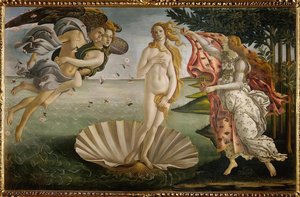
Botticellis Werk ist durch elegante Linearität gekennzeichnet, die die Lücke zwischen der späten italienischen Gotik und dem frühen Frührenaissance schließt. Seine berühmtesten Werke, die Geburt des Venus und Primavera, werden in der Uffizialleerie in Florenz ausgestellt, die eine bedeutende Sammlung seiner Kunst beherbergt. * die Geburt des Venus (ansicht auf ArtsDot) * Primavera (Sandro Botticellis Kunst erkunden auf ArtsDot) * Mystische Geburt (Nationalgalerie, London), datiert 1501, ist das einzige Werk von Botticelli mit einem klaren Datum.Vermächtnis und Einfluss
Botticellis Stil entwickelte sich in den 1490er Jahren zu einem persönlicheren Ansatz und unterschied sich von Zeitgenossen wie Leonardo da Vinci und dem aufkommenden Hochrenaissance-Stil. Sein Werk wurde als bedeutende Beiträge zur italienischen Renaissance Kunstbewegung anerkannt. * Die italienische Renaissance Kunstbewegung * Sandro Botticelli auf Wikipedia- Bekannte Künstler der italienischen Renaissance umfassen Sandro Botticelli, Leonardo da Vinci, Michelangelo und Tizian.
- Die Uffizialleerie in Florenz beherbergt eine bedeutende Sammlung von Botticellis Kunst.
- Botticellis Werk wurde als eine zentrale Figur im frühen italienischen Frührenaissance der Malerei anerkannt.
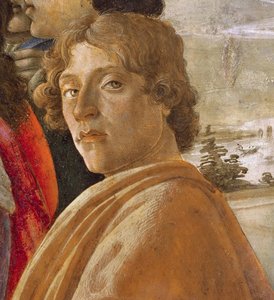
Sandro Botticelli
1445 - 1510 , Italien
Kurzinfos
- Beeinflusste Künstler: ['Präraffaeliten']
- Bemerkenswerte Werke:
- Die Geburt der Venus
- Primavera
- Mystische Geburt
- Einflussreiche Künstler:
- Fra Angelico
- Paolo Uccello
- Geburtsdatum: ca. 1445
- Geburtsort: Florenz, Italien
- Künstlerische Bewegung: Frührenaissance
- Nationalität: Italienisch
- Sterbedatum: 1510
- Vollständiger Name: Sandro Botticelli
Ähnliche Artikel
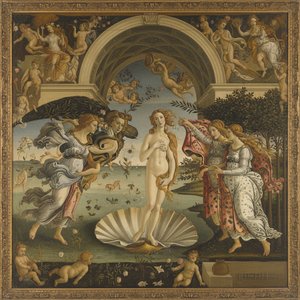
Sandro Botticelli: Die 25 Meisterwerke des Renaissance-Genies – Kunst für Ihr Zuhause
Entdecken Sie die 25 schönsten Meisterwerke von Sandro Botticelli! Erleben Sie die Renaissance-Kunst mit 'Geburt der Venus', 'Primavera' & mehr. Hochwertige Reproduktionen für Ihr Zuhause – jetzt auf ArtsDot.com!
Dante Gabriel Rossetti: Die 25 Meisterwerke des Präraffelitismus | ArtsDot
Entdecken Sie die 25 schönsten Gemälde von Dante Gabriel Rossetti! Tauchen Sie ein in die Welt der Präraffeliten, symbolistischer Kunst & viktorianischer Romantik. Hochwertige Reproduktionen für Ihr Zuhause – jetzt bei ArtsDot.com!
The Art of the Line: Discover Captivating Drawings to Transform Your Home with Sophisticated Minimalist Elegance
Elevate your home with the profound elegance of fine art drawings. From soulful charcoal sketches to minimalist line art, discover how captivating textures and masterful contours can transform your interior design. Explore expert curation for a sophisticated, meaningful living space.
The Nuances of Graphite: Exploring Emotional Depth & Technical Mastery in Pencil Drawing
Explore the captivating world of graphite drawing! Discover its rich history, master essential techniques like chiaroscuro, and learn how artists evoke emotion through this timeless medium. Expert insights for art enthusiasts.
Frührenaissance: Die 10 Meisterwerke, die eine Epoche prägten – Kunst für Ihr Zuhause
Entdecken Sie die 10 prägendsten Meisterwerke der Frührenaissance! Von Giotto bis Botticelli – erleben Sie Kunstgeschichte hautnah. Hochwertige Reproduktionen für Ihr Zuhause auf .