


 Vorschau anzeigen
 Versenden
 Teilen
 Details anzeigen

 Herunterladen
 Ähnliche Objekte
 Röntgenaufnahme
 Diashow
 Statistiken
Portrait of Toyotomi Hideyoshi,


 Weiterlesen
Erwerben Sie ein hochauflösendes, optimiertes digitales Bild, das der Online-Vorschau weit überlegen ist.
Jede Datei wird von unseren hauseigenen Spezialisten mit modernsten Werkzeugen und fachmännischer manueller Retusche sorgfältig vorbereitet. Wir stellen sicher, dass jedes Bild eine außergewöhnliche Klarheit, präzise Farbgenauigkeit und feinste Details aufweist.
Die endgültige Datei wird innerhalb von 72 Stunden per E-Mail zugestellt und ist für den sofortigen Einsatz in professionellen, redaktionellen und Druckumgebungen optimiert. Es handelt sich um dieselbe Qualität, der führende Designstudios, Verlage und Galerien vertrauen.
Digitales Bild
Laden Sie eine hochauflösende Datei für die persönliche Präsentation, den Druck und kreative Projekte herunter. ( Zu Druck wechseln Handgemalte Reproduktion bestellen)
In jeder Bestellung digitaler Bilder enthalten
Professionelle digitale Bereitstellung, garantiert
Wenn Sie sich für ArtsDot.com entscheiden, erhalten Sie nicht nur ein Bild – Sie erhalten ein professionell aufbereitetes digitales Kunstwerk, das mit höchster Präzision erstellt und durch eine Zufriedenheitsgarantie abgesichert wird. Hier ist alles, was automatisch mit Ihrer Bestellung geliefert wird:

Schnelle E-Mail-Zustellung
Ihre hochauflösende digitale Bilddatei wird Ihnen innerhalb von 72 Stunden nach der Bestellung per E-Mail zugestellt – bereit zur sofortigen Verwendung.

KI-optimierte digitale Datei
Ihre Kunstwerke werden professionell mithilfe fortschrittlicher KI-Tools und manueller Bearbeitung optimiert, um maximale Detailtreue, Klarheit und Farbgenauigkeit zu gewährleisten.

Lebenslanger kostenloser Neudruckservice
Datei versehentlich gelöscht oder verloren? Keine Sorge – wir senden sie Ihnen jederzeit kostenlos erneut zu.

Keine Einfuhrgebühren – jemals
Genießen Sie Ihr Kunstwerk sofort ohne Zollgebühren, Einfuhrabgaben oder Versandkosten – digitale Downloads sind immer steuerfrei.

Garantierte Farbtreue
Wir garantieren, dass Ihr digitales Bild mithilfe professioneller Werkzeuge und Farbmanagement die Originalfarben so präzise wie möglich wiedergibt.

100-Tage-Zufriedenheitsgarantie
Wenn Sie mit Ihrem digitalen Bild nicht zufrieden sind, werden wir es überarbeiten oder 100% innerhalb von 100 Tagen erstatten – ohne Wenn und Aber.

100% Geld-zurück-Garantie
Nicht zufrieden? Erhalten Sie innerhalb von 100 Tagen nach Erhalt Ihrer digitalen Datei eine vollständige Rückerstattung – ohne Wenn und Aber.

Rabatte bei Großbestellungen
3 Bilder kaufen, 10% sparen – 5 Bilder kaufen, 15% sparen – Ab 10 Bildern 20% sparen. Ideal für kreative Projekte, Galerien und Agenturen.
Ähnliche Kunstwerke
Biografie des Künstlers
Seisho Shotai (1548-1607): The Silent Chronicler of a Turbulent Era
The world of 16th-century Japan was one of immense upheaval – the waning days of the Sengoku period, marked by constant warfare and shifting alliances. Amidst this chaos emerged Seisho Shotai (c. 1548-1607), an artist whose legacy rests primarily on his exquisite inscriptions and, most notably, his masterful portraiture, particularly that of Toyotomi Hideyoshi, a figure who profoundly shaped the nation’s destiny. Shotai's name rarely graces the headlines of art history, yet his work offers a remarkably intimate glimpse into the political and cultural currents of his time, revealing a keen eye for detail and a subtle understanding of symbolism.
Born during this period of intense conflict, Shotai’s early life remains shrouded in relative obscurity. He emerged as a skilled calligrapher and painter, quickly gaining recognition for his elegant brushwork and ability to capture the essence of his subjects. His career coincided with the rise of Toyotomi Hideyoshi, a peasant-born warrior who, through sheer force of will and military brilliance, ascended to become one of Japan’s most powerful figures – a shogun in all but name. Shotai's connection to Hideyoshi was not merely professional; he became a trusted advisor and confidant, deeply involved in the warlord’s court.
The Art of Inscription and Portraiture
Shotai’s artistic output is remarkably focused. He is primarily known for his inscriptions – elegant calligraphy accompanying paintings, often providing context, commentary, or personal reflections. These inscriptions are not mere labels; they are integral to the artwork itself, adding layers of meaning and revealing Shotai's perspective on the subject depicted. However, it’s his portraits, particularly those of Toyotomi Hideyoshi, that have secured his place in art history. He produced a series of remarkably detailed and psychologically astute depictions of the warlord, capturing not just his physical appearance but also his character and authority.
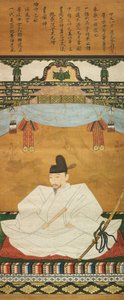
The “Portrait of Toyotomi Hideyoshi” (circa 1599), now housed at the Google Arts & Culture collection, exemplifies Shotai’s skill. The painting itself is a masterpiece of composition – Hideyoshi is seated with a ceremonial fan in his right hand and his left fist clenched, a gesture conveying both power and vigilance. He wears white silk socks and sits cross-legged on raised mats, mimicking the attire of an emperor, subtly asserting his elevated status as a regent (kanpaku). The backdrop features a stylized paulownia tree, a symbol deeply associated with imperial authority, further reinforcing Hideyoshi’s claim to legitimacy.
Symbolism and Context
Analyzing Shotai's work requires understanding the intricate symbolism of the era. The inclusion of the white silk socks, for instance, was not merely decorative; it represented a deliberate attempt to emulate imperial protocol, legitimizing Hideyoshi’s rule amidst a period of political instability. The paulownia tree, a sacred symbol in Japanese culture, served as a visual link between the warlord and the imperial lineage. Shotai's inscription, penned by Saisho Jotai, further illuminates these connections, highlighting the significance of the date – the 18th day of the fourth month—which coincided with the dedication of Hokoku Jinja, a shrine erected in honor of Hideyoshi.
The portrait’s creation was deeply intertwined with the political and religious landscape of the time. Commissioned by Yakuin Zenso, Hideyoshi's physician and a prominent Buddhist priest, it served as both a memorial to the deceased warlord and a means of solidifying his legacy. Shotai’s work, therefore, transcends mere portraiture; it becomes a historical document, capturing a pivotal moment in Japanese history.
Legacy and Influence
Despite his relatively quiet life, Seisho Shotai left an enduring mark on Japanese art. His meticulous attention to detail, combined with his profound understanding of symbolism, established him as one of the most accomplished portraitists of his era. His work offers a rare window into the world of Toyotomi Hideyoshi and the turbulent political climate in which he reigned. While few of his works survive, they remain highly prized by collectors and scholars alike, offering invaluable insights into the artistic and cultural traditions of 16th-century Japan.
Furthermore, Shotai’s legacy extends beyond individual artworks. His mastery of inscription influenced generations of calligraphers, while his portraiture set a standard for future artists seeking to capture the essence of their subjects. He stands as a testament to the power of quiet observation and skillful execution – a silent chronicler of a remarkable era.
seisho shotai (japanese, 1548-1607)
1548 - 1607 , Japan
Kurzinfos
- Artistic Movement Or Style: Inscriptions, Portraiture
- Artists Who Influenced This Artist: ['Saisho Jotai']
- Date Of Birth: 1548
- Date Of Death: 1607
- Full Name: Seisho Shotai
- Nationality: Japanese
- Notable Artworks: ['Portrait of Toyotomi Hideyoshi']
- Place Of Birth: Japan