

 Vorschau anzeigen
 Versenden
 Teilen
 Details anzeigen

 Herunterladen
 Ähnliche Objekte
 Röntgenaufnahme
 Diashow
 Statistiken
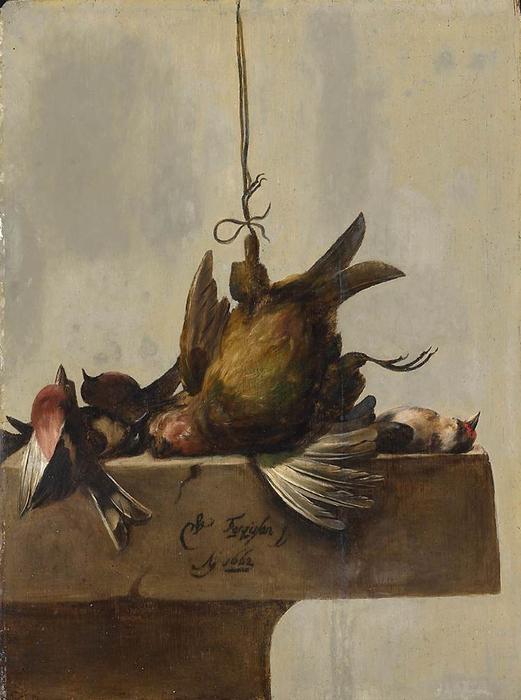
Still-Life with Birds
 Baroque
 1662
1662 32.0 x 28.0 cm
 Rijksmuseum
 Weiterlesen
Erwerben Sie ein hochauflösendes, optimiertes digitales Bild, das der Online-Vorschau weit überlegen ist.
Jede Datei wird von unseren hauseigenen Spezialisten mit modernsten Werkzeugen und fachmännischer manueller Retusche sorgfältig vorbereitet. Wir stellen sicher, dass jedes Bild eine außergewöhnliche Klarheit, präzise Farbgenauigkeit und feinste Details aufweist.
Die endgültige Datei wird innerhalb von 72 Stunden per E-Mail zugestellt und ist für den sofortigen Einsatz in professionellen, redaktionellen und Druckumgebungen optimiert. Es handelt sich um dieselbe Qualität, der führende Designstudios, Verlage und Galerien vertrauen.
Digitales Bild
Laden Sie eine hochauflösende Datei für die persönliche Präsentation, den Druck und kreative Projekte herunter. ( Zu Druck wechseln Handgemalte Reproduktion bestellen)
In jeder Bestellung digitaler Bilder enthalten
Professionelle digitale Bereitstellung, garantiert
Wenn Sie sich für ArtsDot.com entscheiden, erhalten Sie nicht nur ein Bild – Sie erhalten ein professionell aufbereitetes digitales Kunstwerk, das mit höchster Präzision erstellt und durch eine Zufriedenheitsgarantie abgesichert wird. Hier ist alles, was automatisch mit Ihrer Bestellung geliefert wird:

Schnelle E-Mail-Zustellung
Ihre hochauflösende digitale Bilddatei wird Ihnen innerhalb von 72 Stunden nach der Bestellung per E-Mail zugestellt – bereit zur sofortigen Verwendung.

KI-optimierte digitale Datei
Ihre Kunstwerke werden professionell mithilfe fortschrittlicher KI-Tools und manueller Bearbeitung optimiert, um maximale Detailtreue, Klarheit und Farbgenauigkeit zu gewährleisten.

Lebenslanger kostenloser Neudruckservice
Datei versehentlich gelöscht oder verloren? Keine Sorge – wir senden sie Ihnen jederzeit kostenlos erneut zu.

Keine Einfuhrgebühren – jemals
Genießen Sie Ihr Kunstwerk sofort ohne Zollgebühren, Einfuhrabgaben oder Versandkosten – digitale Downloads sind immer steuerfrei.

Garantierte Farbtreue
Wir garantieren, dass Ihr digitales Bild mithilfe professioneller Werkzeuge und Farbmanagement die Originalfarben so präzise wie möglich wiedergibt.

100-Tage-Zufriedenheitsgarantie
Wenn Sie mit Ihrem digitalen Bild nicht zufrieden sind, werden wir es überarbeiten oder 100% innerhalb von 100 Tagen erstatten – ohne Wenn und Aber.

100% Geld-zurück-Garantie
Nicht zufrieden? Erhalten Sie innerhalb von 100 Tagen nach Erhalt Ihrer digitalen Datei eine vollständige Rückerstattung – ohne Wenn und Aber.

Rabatte bei Großbestellungen
3 Bilder kaufen, 10% sparen – 5 Bilder kaufen, 15% sparen – Ab 10 Bildern 20% sparen. Ideal für kreative Projekte, Galerien und Agenturen.
Ähnliche Kunstwerke
Biografie des Künstlers
A Life Amongst Stillness: The World of William Gowe Ferguson
William Gouw (or Gow, or Gowe) Ferguson remains a somewhat enigmatic figure in the landscape of 17th-century art, yet his quiet mastery of still life painting secured him a respected place amongst his contemporaries. Born around 1632/3 in Scotland—a nation not particularly renowned for its artistic output at that time—Ferguson’s journey took him far from his homeland and into the heart of European artistic innovation. His early training is believed to have occurred within Scotland itself, but an ambition for greater refinement led him towards France and Italy, formative experiences that would profoundly shape his aesthetic vision. By 1660, Ferguson had established a residence in The Hague, a bustling center of trade and culture, where he entered into an unusual agreement with a house proprietor: the annual creation of a painting as part of his tenancy. This arrangement speaks to both the demand for his work and the practical realities of an artist’s life during this period. He continued to reside there until at least 1668, steadily building a reputation for his evocative depictions of the natural world.The Dutch Influence and Artistic Development
Ferguson's artistic development was deeply intertwined with his time in the Netherlands, particularly within the circles of Utrecht, The Hague, and Amsterdam. It’s here that he absorbed the meticulous detail and realism characteristic of the Dutch Golden Age still life tradition. Artists like Jan Vonck and Willem van Aelst served as significant influences, inspiring Ferguson's precise rendering of textures, light, and form. However, Ferguson wasn’t merely an imitator; he infused his work with a distinctly personal sensibility. While specializing in *dead game*—still lifes featuring meticulously arranged birds, animals, and hunting implements—he also ventured into compositions incorporating classical ruins and sculptural fragments, often bathed in dramatic chiaroscuro lighting. This blending of genres reveals a sophisticated artistic intellect, capable of harmonizing the naturalistic precision of Dutch painting with the more theatrical elements favored by Italianate artists. In 1681, he was betrothed to Sara van Someren of Stockholm while living in Amsterdam’s Batavier Graat, suggesting a degree of social standing and integration within the city's artistic community. Horace Walpole noted his extended sojourn in Italy and France, further emphasizing the breadth of his European experience.Themes of Vanitas and Evocative Realism
Ferguson’s still lifes are not simply exercises in technical skill; they resonate with deeper symbolic meaning. The *dead game* genre, popular throughout the 17th century, often served as a visual meditation on mortality—a reminder of the fleeting nature of life and the inevitability of decay. The meticulously rendered feathers, fur, and flesh, while beautiful in their detail, simultaneously hint at transience. This subtle interplay between beauty and decay aligns with the broader *Vanitas* tradition prevalent during this era. Beyond the symbolic weight, Ferguson’s paintings are remarkable for their evocative realism. He possessed an exceptional ability to capture the textures and colors of his subjects, creating a sense of tangible presence that draws the viewer into the scene. His skillful use of light and shadow further enhances this effect, imbuing his compositions with a dramatic intensity. Examples of his work can be found in prestigious institutions like the Rijksmuseum in Amsterdam and the Berlin State Museums, testaments to his enduring artistic quality.Later Life and Legacy
The details surrounding Ferguson’s later life remain somewhat obscure. His last known dated painting appears in 1689, after which records become scarce. It is believed he returned to London, though some accounts suggest a possible return to Scotland. Intriguingly, twelve of his paintings were sold in Edinburgh between 1692 and 1693, indicating continued artistic activity or the dispersal of earlier works. Despite the lack of definitive biographical information, Ferguson’s legacy as a skilled still life painter is secure. His work has often been favorably compared to that of more celebrated artists, and instances have even occurred where his paintings were mistakenly attributed to Cornelis van Lelienbergh or Jan Weenix—a testament to the quality and stylistic similarities of their respective oeuvres. He occupies a unique position as one of Scotland’s most accomplished 17th-century painters, bridging the gap between native artistic traditions and the innovations of the Dutch Golden Age. His paintings continue to captivate viewers with their exquisite detail, evocative realism, and subtle exploration of themes surrounding life, death, and the beauty of the natural world.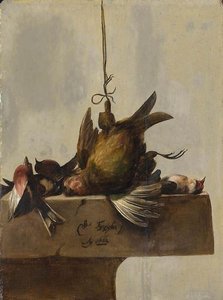
William Gowe Ferguson
1632 - 1689