
The Post-Napoleonic Pivot: Political Restraint and the Rise of the Private Sphere
The Dawn of Biedermeier: Post-Napoleonic Europe and the Rise of the Middle Class To understand the soul of the Biedermeier era, one must look to the shifting tides of 19th-century Europe following the tumultuous conclusion of the Napoleonic Wars. As ...
To understand the soul of the Biedermeier era, one must look to the shifting tides of 19th-century Europe following the tumultuous conclusion of the Napoleonic Wars. As the dust settled over the German Confederation in 1815, a profound social transformation began to take root. The grand, sweeping gestures of imperial conquest and the intimidating opulence of the preceding Empire style gave way to a more introspective period. This was an era where the political sphere was often restricted by conservative systems, such as that established by Klemens von Metternich, leading the citizenry to turn their gaze inward. In a world where public expression was frequently met with censorship and surveillance, the home became a sanctuary—a private stage for emotional warmth and quiet stability.
This cultural pivot created a unique vacuum that the Biedermier movement moved to fill. As the growing middle class sought solace from the turbulent political landscape, they found beauty in the familiar and the local. The era was characterized by a retreat into the domestic sphere, where the joys of everyday existence were elevated to the status of high art. It was not merely a decorative trend but a psychological response to a changing world, fostering an environment where family intimacy and modest prosperity could flourish away from the watchful eyes of the state.
Defining Biedermeier: From Satirical Origins to a Cultural Movement
 Biedermeier
The Biedermeier period was an era in the art and culture of the German Confederation between 1815 and 1848 during which the middle classes grew in number and artists began producing works appealing to their sensibilities. The period began with the en...
The term Biedermeier carries with it a fascinating, somewhat ironic history. It did not begin as a self-conscious artistic manifesto but rather emerged organically from the social shifts of Central Europe. The name itself finds its roots in popular literature, specifically derived from a fictional, mediocre poet named Gottlieb Biedermaier, featured in the Munich satirical magazine Fliegende Blätter. Initially, the term was used somewhat derisively to characterize the bourgeois tendency toward complacency and unchallenging, even "boring," artistic tastes. It poked fun at the Biedermann—the honest, capable, yet perhaps overly simple man of the middle class.
However, what began as a caricature of bourgeois simplicity soon became the definitive label for an entire era of culture spanning from 1815 to 1848. What was once intended as satire was reclaimed as a celebration of unpretentious beauty. This period saw artists, writers, and musicians producing works that appealed directly to the sensibilities of this new urban audience. Whether in literature, music, or the visual arts, Biedermeier became shorthand for an aesthetic that valued the attainable over the grandiose, and the intimate over the monumental.
Aesthetic Principles: The Harmony of Geometric Purity and Functional Elegance
The aesthetic language of Biedermeier is characterized by a remarkable tension between restraint and refinement. At its core, the movement rejected the heavy, gilded ornamentation that had long defined European luxury. Instead, it embraced a philosophy of clarity and geometric purity. This was an era of refined functionalism, where the beauty of an object was found in its proportions and the inherent quality of its materials rather than in superficial embellishment. The design language favored clean lines and a sense of harmonious balance that anticipated many principles of modern design.
This pursuit of simplicity did not imply a lack of sophistication. Beneath the apparent restraint lay a highly sensitive aesthetic language and remarkable technical mastery. Designers utilized light-colored woods, such as cherry or birch, to create furniture that felt airy and bright, reflecting the era's desire for an atmosphere of cheerfulness and order. By focusing on the natural grain of the wood and the elegance of the silhouette, Biedermeier achieved a democratization of luxury—offtaining high-quality craftsmanship that was accessible to the burgeoning middle class, bridging the gap between the heavy Neoclassical traditions and a more modern, streamlined sensibility.
The Art of Domesticity: Furniture, Interior Design, and the Bourgeois Ideal
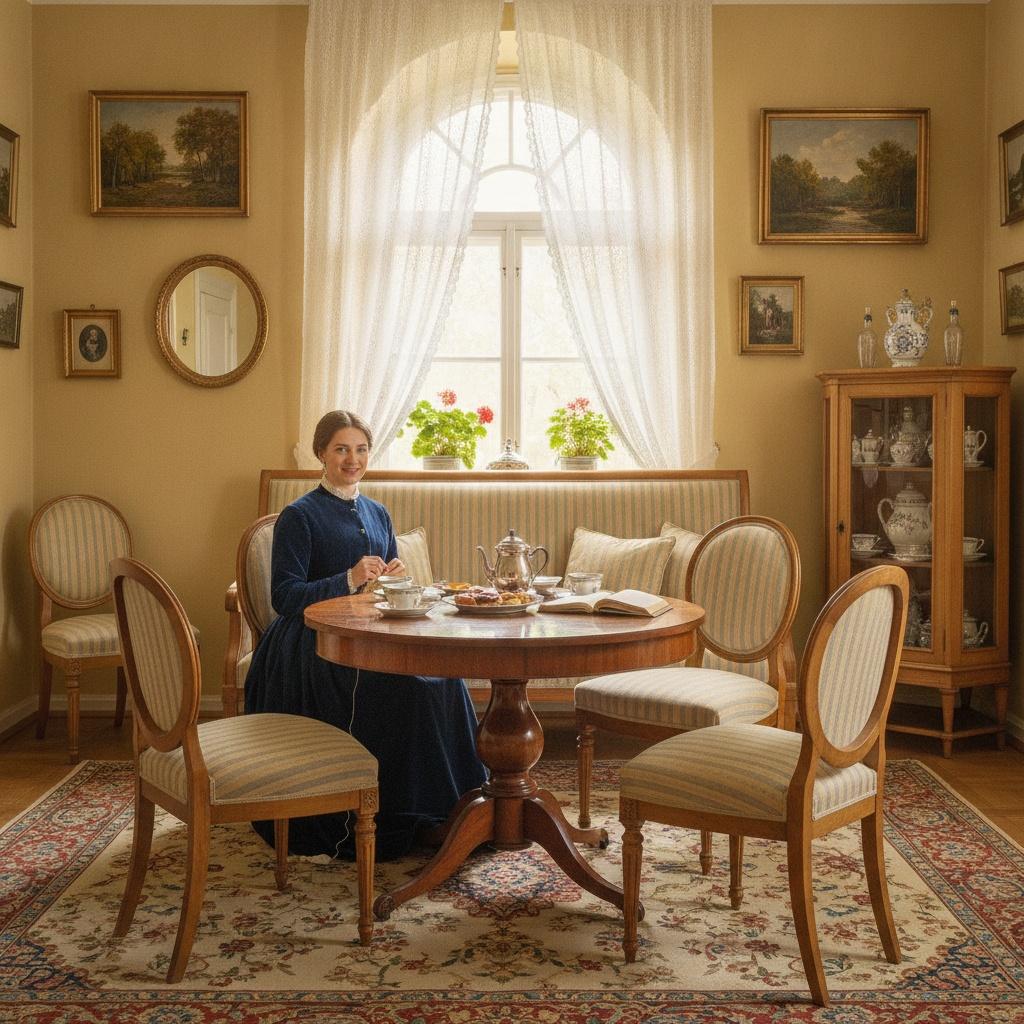
As the middle class grew more prosperous and secure, the demand for comfortable and affordable furnishings transformed the interior landscape of Central Europe. Biedermeier furniture became the centerpiece of this new domestic culture. Unlike the intimidating, throne-like pieces of the aristocratic era, Biedermer furniture emphasized comfort and usability. The style often combined simple, outdoor-inspired concepts with sophisticated indoor design, creating pieces that were as much about the experience of living as they were about the display of wealth.
The interior of a Biedermeier home was a carefully curated environment designed to foster family intimacy. Seating became more ergonomic and inviting, and surfaces like the secretaire or writing desk became essential for the intellectual pursuits of the household. This era saw a blossoming of interior decorating where every element—from the arrangement of light-drenched windows to the selection of charming, graceful textiles—served to reinforce the values of stability and emotional warmth. It was an art of living that celebrated the quiet, beautiful moments of the domestic routine.
Biedermeier’s Lasting Legacy: Bridging Neoclassicism and Modern Minimalism
Though the Biedermeier period reached its conclusion with the onset of the Revolutions of 1848, its influence on the trajectory of design remains profound. It served as a vital aesthetic bridge, connecting the rigid, straight lines of the Neoclassical style with the more rounded, voluptuous forms of the Romantic movement. By stripping away the excess of the past, Biedermer paved the way for the functionalist movements of the 20th century, proving that elegance does not require opulence.
Today, we see the echoes of Biedermeier in contemporary interiors that prize minimalism, light, and organic textures. The movement’s ability to reconcile high-quality craftsmanship with a sense of approachable beauty continues to inspire collectors and designers alike. For those who seek to bring this sense of historical grace into their own homes, the era offers a timeless blueprint for creating spaces that are both sophisticated and profoundly comforting.
At ArtsDot.com, we celebrate this enduring legacy of art history. We specialize in providing museum-quality reproductions of the world's most canonical masterpieces, allowing you to bring the profound beauty of historical eras into your modern living space. Whether you are drawn to the delicate intimacy of a Biedermeier-era portrait or the grand scale of an Old Master landscape, our hand-painted oil reproductions are crafted with academic excellence. Our artists use traditional techniques on 100% cotton canvas to ensure that every brushstroke captures the true soul of the original work, offering you a lasting connection to the triumphs of human creativity.