
The Essence of Ink: Understanding the Four Treasures of the Study
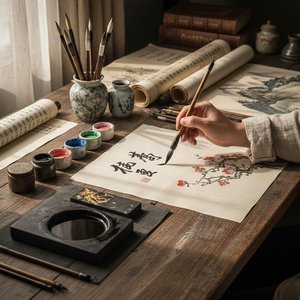
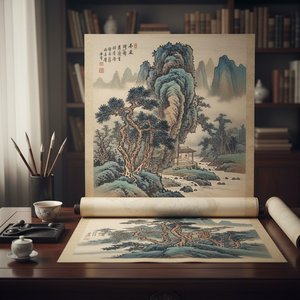
To enter the world of Chinese calligraphy is to step into a realm where materiality and spirituality converge. At the heart of this meditative practice lie the Four Treasures of the Study: the brush, the inkstick, the paper, and the inkstone. These are not merely tools of a trade; they are the conduits through which the artist’s life force, or qi, is transferred onto the absorbent surface of the paper. The brush, crafted from fine animal hair, possesses a structural intelligence that allows for both the most delicate whisper of a line and the bold, commanding weight of a heavy stroke. When paired with the deep, lustrous black of hand-ground ink, the medium transcends simple writing to become an act of creation.
The preparation of the ink is a ritual in itself, a slow descent into focus. As the artist rubs the inkstick against the stone, the rhythmic friction serves to quiet the mind, preparing the soul for the movement to come. The quality of the inkstone determines the smoothness of the grind, while the texture of the paper—often delicate Xuan paper—dictates how the moisture will bloom and spread. In this delicate balance of water, soot, and fiber, there is no room for error; once the ink touches the page, the decision is eternal. This permanence demands a profound level of presence, making every stroke a testament to the artist's immediate state of being.
The Dance of the Brush: Exploring Calligraphic Scripts from Zhuanshu to Cursive
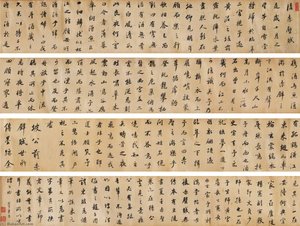
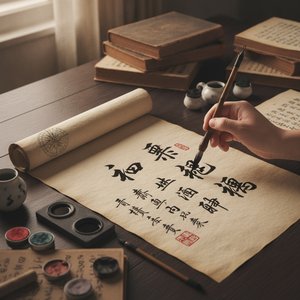
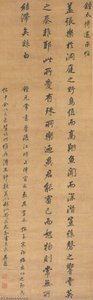
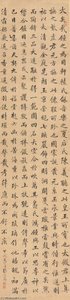
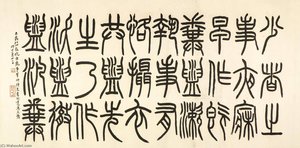
The history of calligraphy is written in the evolution of its scripts, each representing a different tempo of human emotion and historical era. We begin our journey with Zhuanshu, or Seal Script, an ancient and architectural form characterized by its uniform line weight and balanced, almost primordial elegance. As seen in the works of masters like Zhao Shuru, this script carries a sense of monumental stability, reminiscent of bronze inscriptions from antiquity. It is a slow, deliberate dance, where every curve is measured and every proportion is sacred, evoking a time when the written word was as much a symbol of power as it was a vessel for meaning.
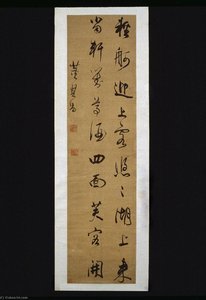
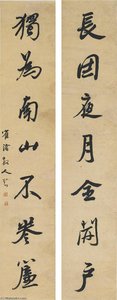
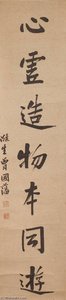
As civilization progressed, so too did the fluidity of the brush. The transition to Xingshu, or Running Script, introduced a rhythmic vitality to the page. In this semi-cursive style, the characters begin to breathe, their strokes connected by invisible threads of energy. One can observe this breathtaking motion in the works of Ni Yuanlu, where the calligraphy flows with an organic grace that mimics the movement of wind through bamboo. Finally, we reach the zenith of expressive freedom in Caoshu, or Cursive Script. Here, the boundaries of legibility are often surrendered to the pure expression of motion. The brush moves with a frantic yet controlled passion, creating abstract landscapes of ink that prioritize the emotional resonance of the gesture over the literal reading of the text.
Beyond Words: The Symbiosis of Poetry, Painting, and Calligraphy
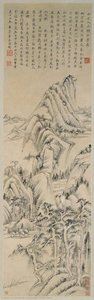
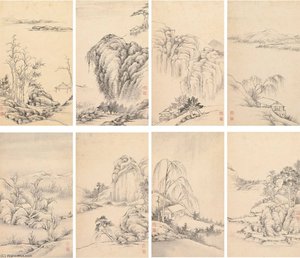
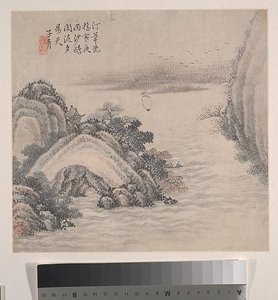
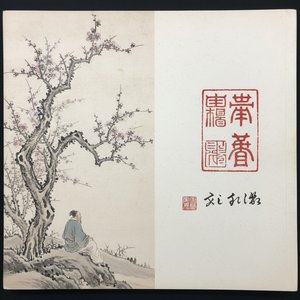
In the classical Chinese tradition, the distinction between the literati painter and the calligrapher is often non-existent. There exists a profound symbiosis between poetry, painting, and calligraphy, forming a trinity of aesthetic expression. A landscape painting is rarely just a depiction of mountains and mist; it is a poetic composition where the brushwork used to render a pine tree is the same brushwork used to write a verse of Tang Dynasty poetry. This unity creates a multi-layered experience for the viewer, where the visual rhythm of the ink mirrors the lyrical cadence of the written word.
This integration allows the artwork to function as a complete philosophical statement. The negative space in a painting—the ma or emptiness—is just as vital as the inked strokes, providing a stage for the calligraphy to resonate. When an artist like Zhou Sicong captures a scene of daily life or a sweeping landscape, the accompanying calligraphy provides the intellectual and emotional context, anchoring the visual imagery in a specific literary tradition. To view such a work is to engage in a dialogue between sight and thought, where the ink serves as the common language for both the eye and the intellect.
The Scholar's Spirit: Calligraphy as a Reflection of Character and Philosophy
For the ancient scholar, calligraphy was far more than an aesthetic pursuit; it was a mirror held up to the soul. It was believed that one’s handwriting revealed their moral integrity, their discipline, and their temperament. A shaky or hesitant line suggested a lack of resolve, while a bold, unswerving stroke spoke of a person of great character and strength. This connection between calligraphy and Confucian ethics transformed the act of writing into a form of self-cultivation. The mastery of the brush required the mastery of the self—the ability to regulate breath, balance emotion, and maintain focus amidst the distractions of the world.
Furthermore, the influence of Taoist philosophy is deeply embedded in the movement of the ink. The concept of wu wei, or effortless action, finds its ultimate expression in a calligraphic stroke that appears spontaneous yet is underpinned by years of rigorous training. The artist seeks to align themselves with the natural flow of the universe, allowing the brush to move with the spontaneity of water or the strength of stone. In this way, every piece of calligraphy becomes a meditative exercise, an attempt to capture the ephemeral essence of nature and the eternal truths of the cosmos within the confines of a single sheet of paper.
Legacy in Motion: The Evolution of Calligraphic Mastery through the Ages
The legacy of Chinese calligraphy is not a static relic of the past, but a living, breathing tradition that has continuously adapted to the changing tides of history. From the monumental stability of the early dynasties to the expressive innovations of the 20th century, the art form has maintained its core essence while embracing new modes of expression. Artists such as Yang Tianji played a crucial role in this evolution, blending traditional ink wash techniques with a modern sensibility that allowed the ancient spirit of calligraphy to resonate within the context of a changing world.
Today, this legacy continues to inspire collectors and enthusiasts globally. The profound depth of meaning found in these ink-drenched compositions offers a sanctuary of stillness in an increasingly frenetic age. Whether through the study of historical masterpieces or the appreciation of contemporary works that honor the classical lineage, the dance of the brush remains an enduring testament to human creativity. As we continue to explore the interplay of ink and soul, we find that the beauty of calligraphy lies not just in what is written, but in the eternal, rhythmic pulse of the artist's spirit captured forever in black and white.