Alexej von Jawlensky’s ‘Variation: Summer Blessing’ – A Raw Expression of Spiritual Yearning
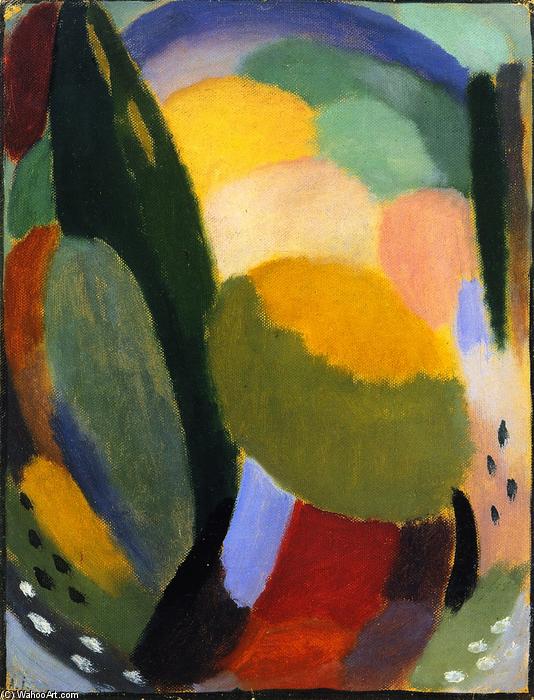
“Variation: Summer Blessing,” painted in 1916 by the profoundly influential Alexej von Jawlensky, is not merely a depiction of trees and color; it's a visceral outpouring of emotion, a testament to the artist’s deeply held spiritual beliefs rendered through a uniquely expressive style. This work, characterized by its bold simplification and intensely saturated hues, exemplifies Jawlensky’s pivotal role in the development of early Expressionism – a movement driven not by objective representation but by the subjective experience of the world.
The painting immediately confronts the viewer with a dynamic composition dominated by a central tree, rendered with thick, impasto strokes of green. This isn't a meticulous botanical study; it’s an embodiment of life and vitality, a symbol often associated with strength, resilience, and connection to the divine. Scattered around this focal point are other trees, fragmented and abstracted, contributing to a sense of layered depth and suggesting a multitude of perspectives – mirroring perhaps Jawlensky’s own complex inner landscape. The inclusion of geometric shapes – a vibrant yellow circle, an orange triangle, and a cool blue square – introduces an element of controlled chaos, disrupting the natural forms and forcing the eye to engage with the painting on multiple levels.
The Language of Emotion: Jawlensky's Technique
Jawlensky’s technique is immediately recognizable. He employed a restricted palette—primarily greens, yellows, oranges, blues, and browns – applying paint in thick, almost sculptural layers. This impasto method isn’t about creating a realistic surface; it’s about building up texture and intensity of color to convey raw emotion. The brushstrokes are often abrupt and forceful, reflecting the artist's inner turmoil and his desire to bypass intellectual analysis and speak directly to the viewer’s soul. Notice how the edges of forms are deliberately blurred and undefined – a characteristic feature of Jawlensky’s work that further emphasizes the emotional impact over precise detail.
Historical Context & Spiritual Roots
Created in 1916, during a period of immense social and political upheaval—the First World War raging across Europe—‘Variation: Summer Blessing’ reflects the anxieties and spiritual searching of the time. Jawlensky was deeply influenced by Christian mysticism, believing that art should serve as a conduit for divine revelation. His work often eschewed traditional religious iconography, instead focusing on symbolic representations of faith and redemption. The simplified forms and intense colors can be interpreted as an attempt to strip away the superficial layers of society and reveal a more fundamental truth – a belief deeply rooted in his personal spirituality.
Symbolism & Emotional Resonance
The overall effect of ‘Variation: Summer Blessing’ is profoundly moving. It evokes a sense of both serenity and unease, beauty and struggle. The tree itself represents life, growth, and spiritual connection, while the fragmented shapes suggest the brokenness of the world and the challenges of faith. Jawlensky's deliberate avoidance of narrative or representational clarity invites viewers to project their own emotions and experiences onto the canvas, creating a deeply personal encounter with this powerful work. This reproduction offers an opportunity to experience firsthand the raw emotional intensity that defined Jawlensky’s artistic vision – a vision that continues to resonate with audiences today.