 Preview
 Send
Send Share
Share
 Details

 Download
 Similars
 X-Ray
X-Ray Diaporama
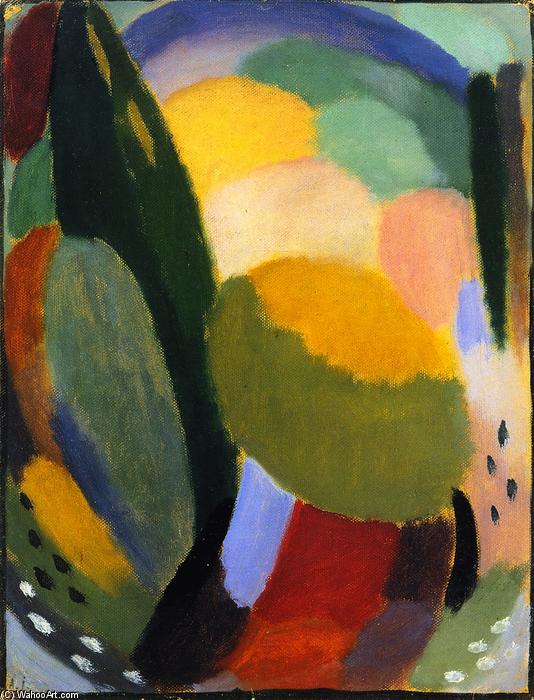
Variation: Summer Blessing


 Read More
Hand Made Oil Reproduction
Hand-painted oil on canvas in your size and frame, made to order by our artists. ( Buy Print Buy Image)




P118B $10

P118H $10

P118W $10

P438Z $10

P508JH $12

P508YH $12

P805H $10

P805Z $10

P919BZ $10

P919G $10

P919XJ $10

P959ZH $10

P968JZ $12

W106C $8

W218G $10

W218JH $8

W218Y $10

W307PJ $10

W316G $10

W316PJ $8

W316Y $10

W398PJ $8

W4111J $10

W500HY $15

W500JH $15

W692G $12

W849H $8

W940BG $15

W953PJ $8




Pick from our preset sizes that match the artwork's original proportions.

You may enter your own dimensions to fit a specific frame or space. If your selected size does not match the original image's proportions, we will either crop the artwork or extend the painting with additional hand-painted elements. A digital mockup will be sent for your approval before production begins.
Please note that the on-screen preview does not reflect the actual cropping or extension. Only the mockup will accurately show the final composition.
While custom sizes are available, we recommend selecting a dimension from the predefined list to preserve the original proportions.
After order, ArtsDot.com team will email client for instructions and provide a mockup preview
Worldwide Delivery () in 3/4 weeks instead of standard 5 weeks. (17 August). No compromise on quality.

Free Worldwide Express Shipping

High-Quality Linen Canvas

Full Shipping Insurance

Customs Tax Refund Guarantee

True Color Matching Guarantee

60-Day Return Policy (Defects Only)

100% Money-Back Guarantee

Bulk Discount Offer
 Glass option is only available in size under 110 CM

Variation: Summer Blessing
Reproduction Medium
Reproduction Size
-


Total Price
$ 263
Artwork Description
Alexej von Jawlensky’s ‘Variation: Summer Blessing’ – A Raw Expression of Spiritual Yearning
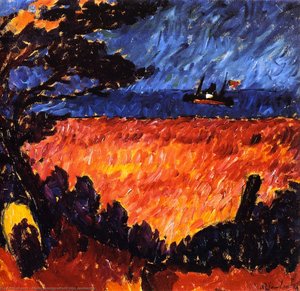
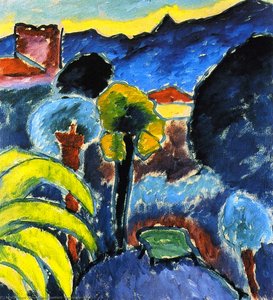
“Variation: Summer Blessing,” painted in 1916 by the profoundly influential Alexej von Jawlensky, is not merely a depiction of trees and color; it's a visceral outpouring of emotion, a testament to the artist’s deeply held spiritual beliefs rendered through a uniquely expressive style. This work, characterized by its bold simplification and intensely saturated hues, exemplifies Jawlensky’s pivotal role in the development of early Expressionism – a movement driven not by objective representation but by the subjective experience of the world.
The painting immediately confronts the viewer with a dynamic composition dominated by a central tree, rendered with thick, impasto strokes of green. This isn't a meticulous botanical study; it’s an embodiment of life and vitality, a symbol often associated with strength, resilience, and connection to the divine. Scattered around this focal point are other trees, fragmented and abstracted, contributing to a sense of layered depth and suggesting a multitude of perspectives – mirroring perhaps Jawlensky’s own complex inner landscape. The inclusion of geometric shapes – a vibrant yellow circle, an orange triangle, and a cool blue square – introduces an element of controlled chaos, disrupting the natural forms and forcing the eye to engage with the painting on multiple levels.
The Language of Emotion: Jawlensky's Technique
Jawlensky’s technique is immediately recognizable. He employed a restricted palette—primarily greens, yellows, oranges, blues, and browns – applying paint in thick, almost sculptural layers. This impasto method isn’t about creating a realistic surface; it’s about building up texture and intensity of color to convey raw emotion. The brushstrokes are often abrupt and forceful, reflecting the artist's inner turmoil and his desire to bypass intellectual analysis and speak directly to the viewer’s soul. Notice how the edges of forms are deliberately blurred and undefined – a characteristic feature of Jawlensky’s work that further emphasizes the emotional impact over precise detail.
Historical Context & Spiritual Roots
Created in 1916, during a period of immense social and political upheaval—the First World War raging across Europe—‘Variation: Summer Blessing’ reflects the anxieties and spiritual searching of the time. Jawlensky was deeply influenced by Christian mysticism, believing that art should serve as a conduit for divine revelation. His work often eschewed traditional religious iconography, instead focusing on symbolic representations of faith and redemption. The simplified forms and intense colors can be interpreted as an attempt to strip away the superficial layers of society and reveal a more fundamental truth – a belief deeply rooted in his personal spirituality.
Symbolism & Emotional Resonance
The overall effect of ‘Variation: Summer Blessing’ is profoundly moving. It evokes a sense of both serenity and unease, beauty and struggle. The tree itself represents life, growth, and spiritual connection, while the fragmented shapes suggest the brokenness of the world and the challenges of faith. Jawlensky's deliberate avoidance of narrative or representational clarity invites viewers to project their own emotions and experiences onto the canvas, creating a deeply personal encounter with this powerful work. This reproduction offers an opportunity to experience firsthand the raw emotional intensity that defined Jawlensky’s artistic vision – a vision that continues to resonate with audiences today.
Related Artworks
Artist Biography
A Life Painted in Emotion: The Journey of Alexej von Jawlensky
Alexej von Jawlensky, born Alexej Georgewitsch von Jawlensky on March 13, 1864, in the Russian town of Torzhok, embarked on a path that would firmly establish him as a pivotal figure within early twentieth-century Expressionism. His formative years were characterized by frequent relocations, culminating in a settling within Moscow at the age of ten—an experience that likely instilled a sense of displacement and perhaps, a yearning for deeper connection, themes subtly woven into the emotional core of his later artistic explorations. Initially drawn to a military career, Jawlensky’s encounter with the vibrant world of art during the 1880 Moscow World Exposition proved transformative. This exposure ignited within him a passion that would ultimately supersede any sense of duty, leading him down a path dedicated to visual expression. Securing a posting in St. Petersburg through his social connections allowed Jawlensky to formally study at the Art Academy from 1889 to 1896, balancing artistic pursuits with military obligations. It was during this period that he crossed paths with Ilya Repin, a prominent Russian realist painter, and more importantly, met Marianne von Werefkin. Werefkin, herself an accomplished artist of considerable means, became not only his mentor but also a crucial benefactor, providing him the financial stability to fully dedicate himself to his craft. Their relationship was complex, deeply intertwined with artistic ambition and mutual support, shaping the trajectory of both their careers.
Munich and the Seeds of Expressionist Innovation
The move to Munich in 1894 marked a turning point for Jawlensky. He enrolled at Anton Ažbe’s private school, immersing himself in an environment that encouraged experimentation and challenged conventional academic approaches. This period witnessed his growing engagement with avant-garde ideas circulating within the European art world. The influence of artists like Ferdinand Hodler, Jan Verkade, and Paul Sérusier proved particularly significant, exposing him to principles of symbolism and synthetism—movements that prioritized subjective experience and emotional resonance over strict representational accuracy. Jawlensky’s artistic style began to evolve, moving away from the realism he had initially studied. He became increasingly interested in exploring the expressive potential of color and form, simplifying compositions and intensifying hues to convey inner states rather than merely depicting external appearances. This exploration led him towards abstraction, a path that would define much of his later work. His involvement with groups like the Neue Künstlervereinigung München (NKvM) further solidified his commitment to artistic innovation, placing him at the heart of a burgeoning Expressionist movement. The NKvM, though short-lived, was a crucible for radical ideas, and Jawlensky’s participation demonstrated his willingness to challenge established norms and embrace new modes of visual language.
The Mystical Heads: A Descent into Spiritual Essence
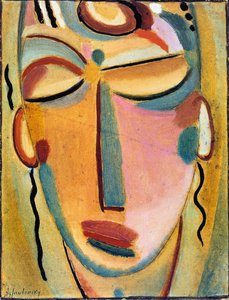
Around 1909, Jawlensky embarked on what would become his most iconic series—the “Mystical Heads.” These intensely colored portraits, often depicting faces reduced to essential forms, are not merely representations of individuals but rather explorations of spiritual essence and inner life. The heads possess a haunting quality, their simplified features and vibrant palettes conveying a sense of profound emotion and psychological depth. Works like Schokko with Red Hat (1909) and Portrait of Alexander Sakharoff (1909) exemplify this period, showcasing his mastery of color and composition. These weren’t portraits in the traditional sense; they were attempts to capture something beyond physical likeness—the soul, the inner landscape of the sitter. He distilled faces into geometric shapes, emphasizing the power of color to evoke emotion and spiritual resonance. Throughout the 1910s, Jawlensky continued to refine his style, moving towards an even greater degree of abstraction. His compositions became increasingly geometric, with forms distilled to their most fundamental elements. He developed a formulaic approach, often employing a limited range of colors arranged in carefully balanced configurations. Violet Turban (1911) demonstrates this stylistic evolution, showcasing his ability to create powerful visual statements through the interplay of color and shape.
Exile, Resilience, and Lasting Legacy
The outbreak of World War I brought upheaval to Jawlensky’s life. Expelled from Germany in 1914 due to his Russian origins, he sought refuge in Switzerland, where he encountered Emmy Scheyer. Scheyer became a devoted champion of his work, tirelessly promoting it in the United States and securing him recognition on an international stage. Despite facing increasing health challenges—including severe arthritis that progressively limited his ability to paint—Jawlensky continued to create until his death in Wiesbaden, Germany, on March 15, 1941. His later works, created under immense physical hardship, are a testament to his unwavering dedication to artistic expression. Today, Alexej von Jawlensky is celebrated as a key figure in the development of Expressionism. His paintings are held in prominent museum collections worldwide, including the Museum Ostwall in Dortmund and the Städtische Galerie im Lenbachhaus in Munich. His exploration of color, form, and spiritual themes continues to resonate with audiences, solidifying his place as one of the most important artists of the early twentieth century. He left behind a body of work that is both visually striking and emotionally profound, offering a glimpse into the inner world of an artist who dared to challenge conventions and embrace the power of subjective expression.
Influences and Artistic Associations
Jawlensky’s artistic journey was shaped by a network of influential figures and movements:
- Ilya Repin: Early mentor providing foundational training in realist techniques.
- Marianne von Werefkin: Crucial benefactor, mentor, and artistic partner who supported his development.
- Ferdinand Hodler: Influenced Jawlensky’s use of simplified forms and symbolic imagery.
- Jan Verkade & Paul Sérusier: Introduced him to the principles of symbolism and synthetism, shaping his approach to color and composition.
- Wassily Kandinsky & Franz Marc: Collaborators within Der Blaue Reiter, fostering a shared commitment to artistic innovation.
These relationships were not merely passive influences; they were dynamic exchanges that fueled Jawlensky’s creative evolution and contributed to the rich tapestry of early Expressionist art. His legacy continues to inspire artists today, reminding us of the power of art to transcend boundaries and explore the depths of human emotion and spirituality.
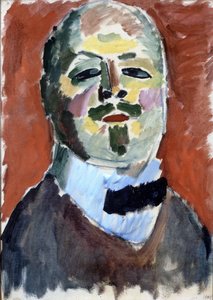
Alexej von Jawlensky
1864 - 1941 , Russia
Quick Facts
- Artistic Movement Or Style: Expressionism
- Artists Or Movements Influenced By This Artist:
- Der Blaue Reiter
- Die Blaue Vier
- Artists Who Influenced This Artist:
- Ilya Repin
- Marianne von Werefkin
- Ferdinand Hodler
- Date Of Birth: March 13, 1864
- Date Of Death: March 15, 1941
- Full Name: Alexej von Jawlensky
- Nationality: Russian
- Notable Artworks:
- Schokko with Red Hat
- Violet Turban
- Self-Portrait
- Place Of Birth: Torzhok, Russia