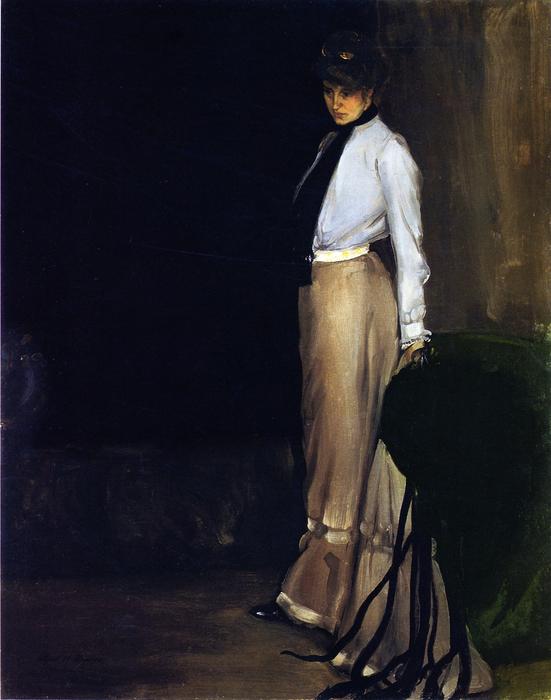
A Portrait of a Moment – The Model by Alfred Henry Maurer
Alfred Henry Maurer’s “The Model,” painted in 1902, isn't merely a depiction of a woman; it’s a carefully constructed tableau that encapsulates the burgeoning anxieties and aspirations of early 20th-century American modernism. This oil on canvas, now residing within the Hirshhorn Museum’s collection, immediately draws the viewer in with its quiet intensity – a deliberate departure from the grand narratives of history painting and a bold step toward capturing the fleeting moments of everyday life. The painting presents a full-length portrait of a woman standing confidently with her hands on her hips, positioned slightly off-center against a backdrop that suggests an urban interior or perhaps even a dimly lit street corner. It’s a scene both familiar and subtly unsettling, inviting contemplation rather than immediate judgment.
Maurer's choice to render the background in such muted tones – browns, creams, blacks, and subtle greens – is crucial to the painting’s effect. It serves not as a detailed setting but as an atmospheric void, amplifying the figure’s presence and directing our attention entirely onto her. The composition itself utilizes a vertical format, emphasizing the woman's height and commanding stance. A strong diagonal line created by her pose draws the eye across the canvas, injecting a dynamic energy into what could otherwise be a static portrait. This deliberate arrangement speaks to a desire to capture not just likeness but also character – a sense of self-assuredness and perhaps even a hint of guarded vulnerability.
The Fauvist Echoes and American Roots
“The Model” is deeply rooted in the artistic currents of its time, particularly the influence of European modernism. The muted color palette, reminiscent of the work of Paul Gauguin and Vincent van Gogh (Fauvism), creates a sense of emotional resonance rather than strict realism. However, Maurer skillfully infuses this European sensibility with distinctly American characteristics. The painting’s focus on an individual within a contemporary setting—a woman in fashionable attire—reflects a growing interest in depicting the lives of ordinary people and capturing the spirit of the modern urban experience. It's a shift away from traditional subjects and towards a more relatable, psychologically-driven approach to portraiture.
Maurer’s technique is equally noteworthy. The visible brushstrokes, characteristic of an impasto style, lend texture and depth to the canvas. The edges of the figure are deliberately soft and blurred, contributing to a sense of fluidity and movement. This loose handling of paint—a departure from the sharp lines and meticulous detail favored by earlier portraitists—underscores the painting’s modern aesthetic. The use of oil on canvas allows for rich, vibrant colors that subtly shift with the changing light, adding another layer of complexity to the composition.
Symbolism and a Portrait of an Era
Beyond its formal qualities, “The Model” is laden with symbolic meaning. The woman’s confident posture—hands on her hips, gaze direct—suggests independence and self-assurance, yet there's also a subtle air of melancholy in her expression. Some art historians interpret the painting as a commentary on the changing roles of women in society during this period of rapid social and economic change. The dark background could be seen as representing the uncertainties and anxieties of the modern world, while the woman’s presence embodies a quiet resilience.
Furthermore, “The Model” offers a poignant glimpse into the life of Alfred Henry Maurer himself. A man struggling with his father's disapproval and battling against the constraints of artistic convention, Maurer poured his personal struggles into this work. The painting is not simply a portrait; it’s an intimate self-portrait—a reflection on identity, ambition, and the challenges of navigating the complexities of modern life. It stands as a testament to the artist's unique vision and enduring legacy within American art history.