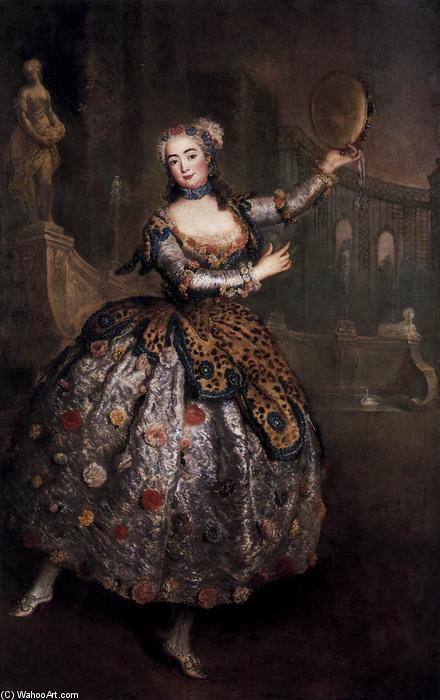
Explore this stunning oil on canvas painting by Antoine Pesne (1745), capturing Barbara Campanini's grace and artistry. Located in Potsdam’s Neues Palais, it exemplifies Rococo style with intricate detail and masterful composition.
The Dancer Barbara Campanini: A Rococo Masterpiece
- Subject: Antoine Pesne’s “The Dancer Barbara Campanini” is an exquisite portrayal of the celebrated Italian ballerina, Barbara Campanini herself. The painting captures a moment of dynamic movement and theatrical grace, frozen in time with remarkable realism and elegance. It's not merely a portrait; it’s a window into the opulent world of 18th-century court entertainment.
- Style & Technique: Executed in oil on canvas around 1745, the work exemplifies the Rococo style – characterized by its emphasis on grace, elegance, and playful asymmetry. Pesne's meticulous brushwork is immediately apparent, particularly in the rendering of Campanini’s costume and the intricate details of her headpiece. The artist skillfully employs *sfumato*, a technique perfected during his time in Italy, to create soft transitions between light and shadow, adding depth and volume to the subject’s form. Notice the delicate modeling of her face, conveying both poise and a hint of playful confidence.
- Historical Context: Created during a pivotal transition in European art history, “The Dancer” reflects the shift from the grand, dramatic style of the Baroque period to the lighter, more intimate aesthetic of the Rococo. Pesne’s work was commissioned at a time when ballet was gaining immense popularity within royal courts across Europe, and artists were increasingly tasked with capturing these performances for posterity. The painting's setting – a classical architectural structure reminiscent of a bridge or archway – further reinforces this connection to the grandeur and sophistication of the era.
A Portrait of an Era: Pesne’s Prussian Patronage
Antoine Pesne’s journey is as fascinating as the artwork itself. Born in Paris in 1683, he benefited from a family legacy of artistic talent, learning directly from his father and uncle. His early training at the Académie Royale, coupled with extended stays in Venice – where he honed his skills under Italian masters – shaped him into a leading figure of the Rococo movement. The commission to paint King Frederick I of Prussia’s self-portrait in 1710 marked a significant turning point, relocating Pesne from Paris to Berlin and establishing him as a court painter. This move reflects the burgeoning artistic patronage within the Prussian monarchy, eager to embrace European trends and elevate its own cultural standing.
Symbolism & Composition
- Costume: Campanini’s costume is more than just clothing; it's a symbol of her profession and status. The intricate patterns and what appears to be leopard print (a fashionable detail at the time) speak to the extravagance and theatricality of ballet performance.
- Architectural Background: The classical architectural setting – a bridge or archway – symbolizes stability, order, and connection between realms. It elevates the subject, reinforcing her importance within the scene.
- Lighting & Composition: Pesne’s masterful use of lighting draws the viewer's eye directly to Campanini, emphasizing her beauty and grace while creating a sense of depth and dimensionality within the composition. The balanced arrangement of elements contributes to the painting’s overall harmony and visual impact.
Owning a Piece of History
Handmade oil paintings reproductions of “The Dancer Barbara Campanini” are now available at ArtsDot.com, allowing art lovers to own a tangible connection to this remarkable artwork and the artistic legacy of Antoine Pesne. Each reproduction is created with meticulous attention to detail, faithfully capturing the original’s beauty and historical significance. This piece offers an exceptional opportunity to bring a touch of Rococo elegance into your home or office – a timeless investment in art history.