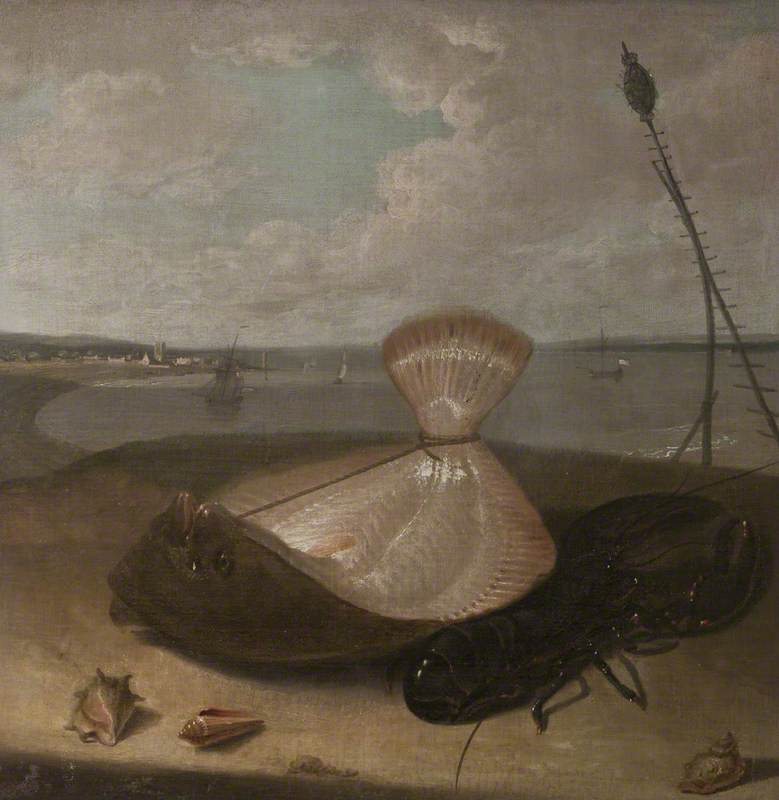
A captivating Thames Estuary painting by Arthur Devis (1772) featuring turbot, lobster & shells – a beautiful glimpse into 18th-century maritime life and artistry.
Arthur William Devis (1762-1822) was an English portrait & history painter known for intimate 'conversation piece' portraits, depictions of naval life including the Death of Nelson, and family portraits. Discover his legacy at ArtsDot!
Experience the Palladian grandeur of Kedleston Hall and the poignant colonial history of Sudbury Hall in Derby, where breathtaking architecture and exquisite art await your discovery within these National Trust treasures.
A Thames Estuary Reverie: Devis’s “Turbot, Lobster and Sea Shells”
Arthur William Devis's "Turbot, Lobster and Sea Shells, in the Thames Estuary" is more than a simple depiction of a coastal scene; it’s a meticulously crafted tableau brimming with quiet observation and subtle symbolism. Painted in 1772, during a period of burgeoning artistic interest in capturing everyday life – a trend known as the conversation piece – this work offers a serene glimpse into the heart of London's maritime world. The painting transports us to the Thames Estuary, not with dramatic storms or bustling activity, but with a contemplative stillness that invites the viewer to linger and contemplate the scene’s quiet beauty. Devis masterfully employs a muted palette of greys, browns, and blues, reflecting the atmospheric conditions of a cloudy day over the water. The brushstrokes are delicate yet confident, creating a sense of texture in the ripples of the water and the rough surfaces of the shells scattered across the foreground. It’s a testament to Devis's skill that he manages to evoke such a strong sense of place with such understated elegance.
The Artist and His Context
Arthur William Devis (1762–1787) was a pivotal figure in the development of English portraiture, though his career often felt somewhat overshadowed by more flamboyant contemporaries. Born into an artistic lineage – his father, Anthony Devis, was a respected topographical painter – Arthur inherited a deep appreciation for observation and detail. His early training under Flemish artists instilled in him a rigorous approach to technique, while his later years were marked by a growing interest in capturing the nuances of English life. The painting’s creation coincided with a period of significant social and political change in Britain, as the nation grappled with the aftermath of the American Revolution and the rise of industrialization. Devis's work reflects this shifting landscape, offering a nostalgic glimpse into a world on the cusp of transformation. His decision to focus on a relatively commonplace subject – a coastal scene teeming with marine life – speaks to a desire to find beauty in the ordinary, a theme that resonated deeply with his artistic sensibilities.
A Symphony of Symbolism
Beyond its aesthetic appeal, “Turbot, Lobster and Sea Shells” is rich in symbolic meaning. The prominent turbot itself, a prized fish known for its delicate flavor, represents abundance and prosperity – a reflection of the Thames Estuary’s importance as a source of sustenance for Londoners. The lobster, often associated with luxury and exoticism, adds an element of intrigue to the composition, suggesting a connection between the local and the distant. Scattered amongst these marine treasures are various seashells, each carrying its own unique history and evoking memories of voyages and exploration. These shells aren’t merely decorative elements; they represent the enduring legacy of the sea, connecting the present moment with centuries of maritime tradition. The inclusion of boats in the water further emphasizes this connection to trade and commerce, highlighting the vital role that the Thames Estuary played in shaping London's identity.
Technique and Legacy
Devis’s masterful use of light and shadow is particularly noteworthy. He employs a technique known as chiaroscuro – the dramatic contrast between light and dark – to create a sense of depth and atmosphere, drawing the viewer’s eye into the heart of the scene. The subtle gradations of tone suggest the play of sunlight on the water's surface, while the darker areas hint at the mysteries hidden beneath the waves. This careful attention to detail is further evident in his rendering of the marine life – the turbot’s scales shimmer with an almost iridescent quality, and the shells are depicted with remarkable precision. “Turbot, Lobster and Sea Shells” ultimately stands as a testament to Devis's artistic skill and his ability to capture the essence of a particular moment in time. It is a painting that rewards careful observation and invites repeated viewing, revealing new layers of meaning with each encounter. Its quiet beauty continues to resonate today, offering a poignant reminder of the enduring connection between humanity and the natural world.