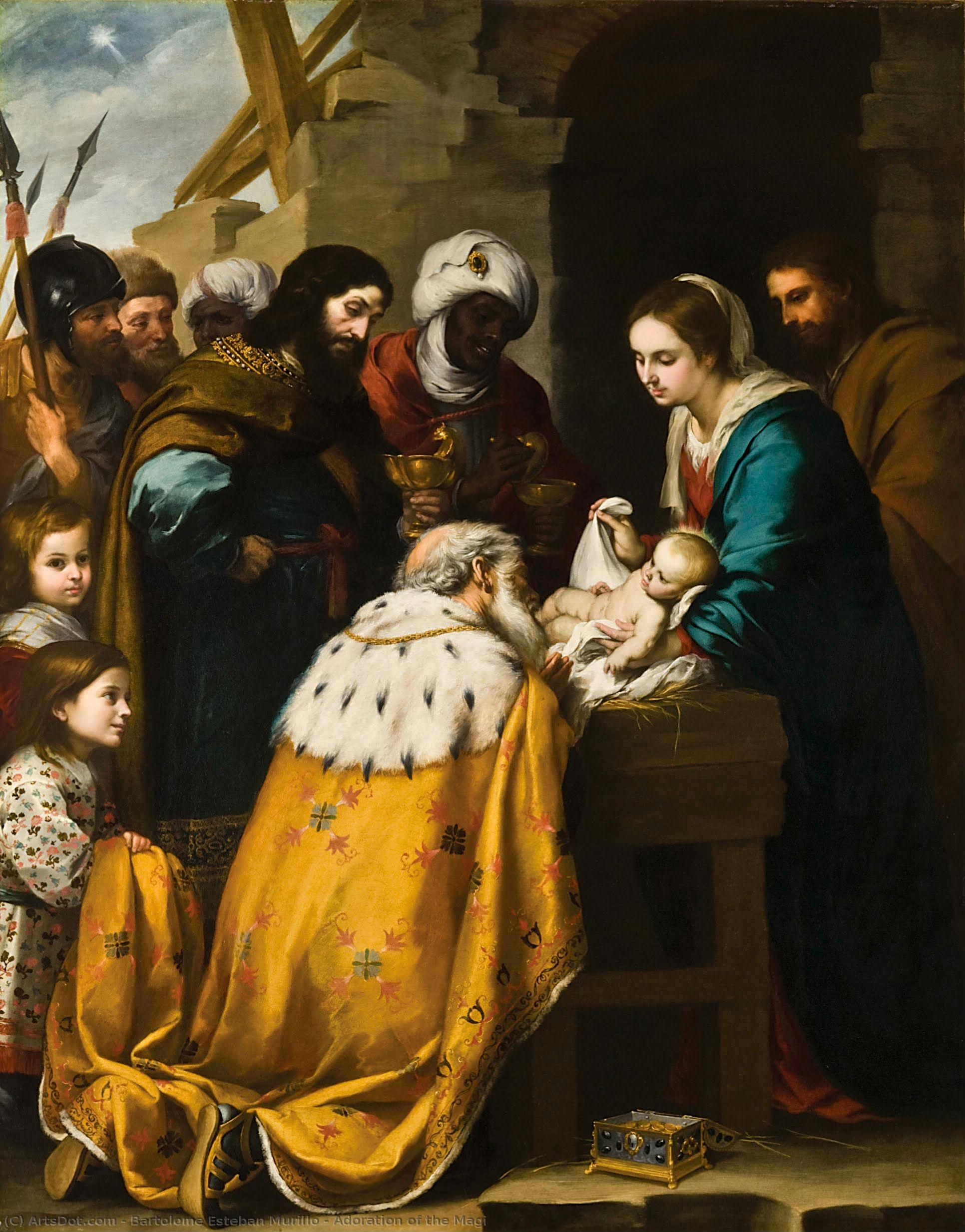
The Majesty of Faith: Unveiling Bartolomé Esteban Murillo’s “Adoration of the Magi”
Bartolomé Esteban Murillo's "Adoration of the Magi," painted around 1650 in Seville, Spain, isn’t merely a religious scene; it’s a vibrant tableau of faith, social commentary, and artistic mastery. This monumental work, measuring an impressive 1461 x 1908 cm, immediately captivates with its rich palette, dynamic composition, and the palpable sense of reverence that permeates the scene. Murillo, a leading figure in Seville’s Golden Age of Spanish Baroque painting, skillfully blends elements of realism with idealized figures, creating an image both deeply spiritual and remarkably human.
The heart of the composition is undoubtedly Mary holding the infant Jesus – a tender depiction of divine infancy that draws the eye immediately. Surrounding her are the Magi, identified as Gaspar, Melchior, and Balthazar, each identifiable by their distinctive attire and gifts: gold, frankincense, and myrrh. Murillo’s genius lies not just in rendering these figures with meticulous detail – note the luxurious fabrics, the intricate jewelry, and the varied expressions of awe and devotion – but also in imbuing them with a sense of earthly presence. The scene unfolds within a modest brick chamber, a deliberate choice that grounds the divine narrative in the everyday realities of 17th-century life. The inclusion of servants, shepherds, and other onlookers further emphasizes this connection to the human experience.
A Seville Story: Murillo’s Artistic Roots and Influences
Born in Seville in 1618, Bartolomé Esteban Murillo's artistic journey was shaped by a confluence of influences. His early training under Juan del Castillo instilled in him a foundation of realism and a focus on capturing the essence of his subjects. However, Murillo’s style evolved significantly, absorbing elements from the Flemish masters – particularly their use of light and shadow – as well as the dramatic compositions favored by Alonso Cano. Crucially, he was deeply influenced by the works of Francisco de Zurbarán, whose stark realism and religious intensity resonated profoundly with Murillo's own artistic vision.
Interestingly, despite prevailing narratives suggesting extensive travels to Italy or Madrid, art historians now largely agree that Murillo’s remarkable skill developed almost entirely within the confines of Seville. His success stemmed from his ability to cater to the tastes of a discerning clientele – wealthy patrons and religious institutions – who appreciated his capacity to translate complex theological concepts into visually compelling narratives. The painting's popularity reflects not only Murillo’s talent but also the thriving artistic environment of Seville during this period.
Symbolism Woven Within: Decoding the Layers of Meaning
Beyond its immediate depiction of the Magi presenting gifts to the infant Jesus, “Adoration of the Magi” is rich in symbolic meaning. The brick chamber itself represents the earthly realm, a space where the divine and human worlds intersect. The presence of the shepherds underscores the humility of God’s plan – that salvation comes not through power or prestige but through humble service. The inclusion of various figures—servants, onlookers, and even a self-portrait of Murillo himself—highlights the universality of faith and invites viewers to contemplate their own place within this sacred narrative.
The palm tree in the background is particularly significant, referencing the biblical prophecy that the Messiah would be born under a palm tree. Furthermore, the carob tree, with its seeds used as units of measurement for precious stones, subtly alludes to the value and significance of Christ’s birth. The overall composition creates a harmonious balance between earthly realism and divine symbolism, making “Adoration of the Magi” a profound meditation on faith, humility, and the enduring power of belief.
A Legacy in Reproduction: Bringing Murillo's Vision Home
Today, reproductions of Bartolomé Esteban Murillo’s "Adoration of the Magi" continue to captivate audiences worldwide. The painting’s vibrant colors, dynamic composition, and profound symbolism make it a timeless masterpiece that resonates with viewers across generations. When commissioning a hand-painted reproduction, consider the meticulous detail and authentic materials used by skilled artisans – ensuring that you capture the essence of Murillo's original vision and bring this extraordinary work of art into your home or space.