A Divine Encounter in Flemish Gold
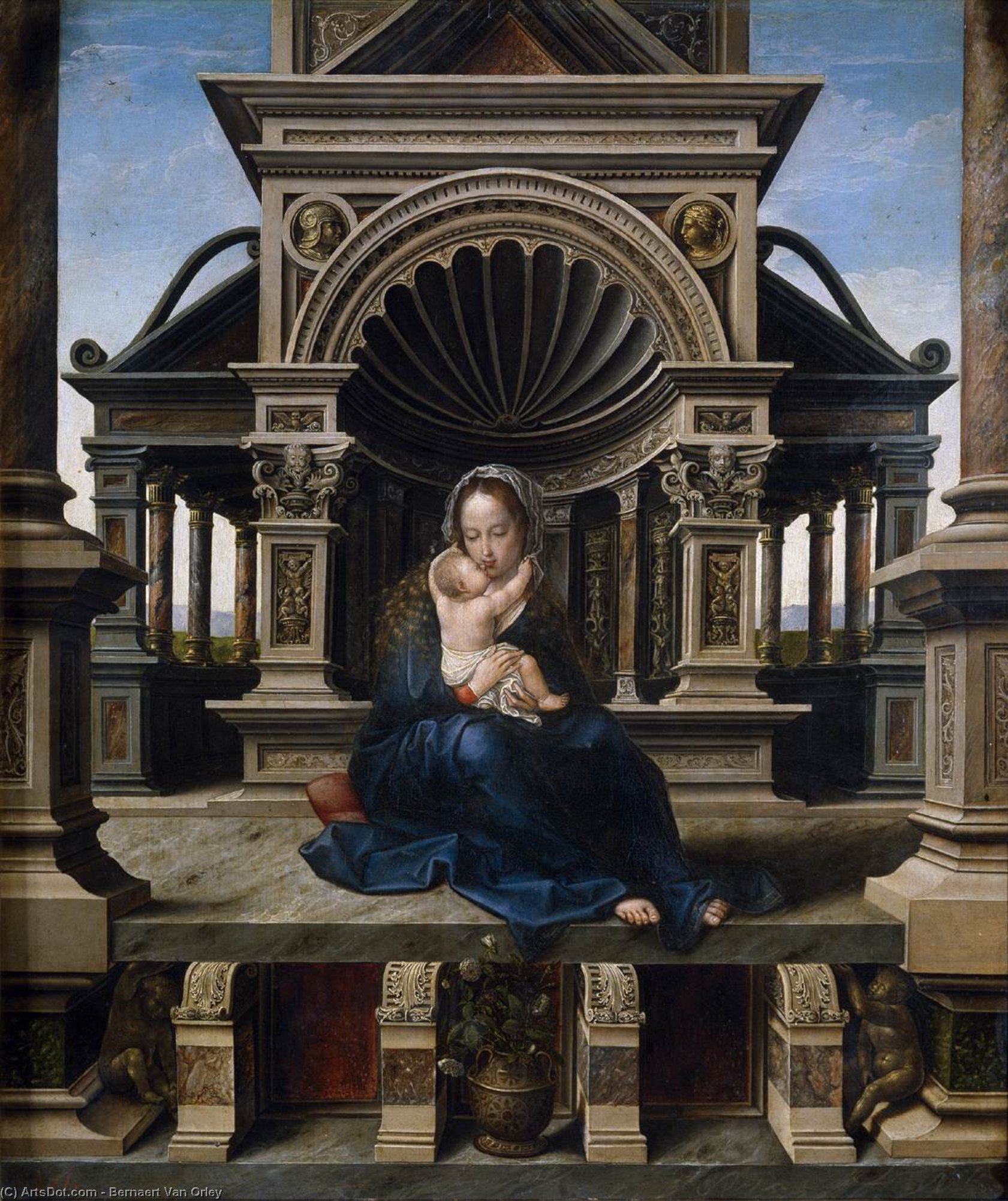
In the quietude of the Early Renaissance, few works capture the intersection of earthly tenderness and celestial majesty as profoundly as the Virgin of Louvain. Attributed to the masterful hand of Bernaert van Orley around 1520, this oil painting is far more than a religious icon; it is a window into a period of profound spiritual and artistic transformation. As the viewer approaches, they are immediately enveloped by a sense of serene dignity. The central figures—the Virgin Mary and the infant Jesus—are presented not merely as subjects of devotion, but as embodiments of a divine grace that feels both intimately human and cosmically significant. The composition, anchored by a stable pyramidal structure, draws the eye upward, mirroring the soul's own ascent toward the divine.
The atmosphere of the piece is one of hushed reverence, achieved through a masterful command of light and shadow. A soft, diffused glow emanates from an unseen source, casting gentle highlights upon the porcelain skin of the Christ child and the contemplative features of Mary. This luminosity is not accidental but is the result of Van Orley’s sophisticated use of glazing—the meticulous layering of thin, translucent washes of pigment. This technique allows light to penetrate the upper layers of paint and reflect back from the primer, imbuing the blues of Mary's robes and the rich golds of the architectural accents with an inner radiance that seems to pulse with life.
The Synthesis of Northern Detail and Italian Grandeur
What makes the Virgin of Louvain a true masterpiece for the discerning collector is its unique position at the crossroads of two great artistic traditions. While Van Orley was a titan of the Flemish tradition, known for the meticulous detail and textural richness characteristic of the Low Countries, he was also a pioneer of "Romanism." This movement sought to infuse Northern painting with the classical elegance and structural clarity of the Italian High Renaissance, specifically the influence of Raphael. In this work, we see the architectural setting—reminiscent of a Roman basilica—providing a sense of monumental stability that balances the delicate, organic folds of the drapery.
The interplay between the geometric precision of the stone dais and the soft, flowing lines of the figures creates a visual tension that is both intellectually stimulating and aesthetically pleasing. For an interior designer, this painting offers a rare versatility; its palette of deep blues, earthy browns, and regal golds provides a sophisticated anchor for a room, capable of complementing both classical period settings and contemporary minimalist spaces. The heavy, tactile quality of the painted stonework contrasts beautifully with the ethereal smoothness of the faces, offering a sensory experience that rewards prolonged contemplation.
A Legacy of Faith and Beauty
Beyond its technical brilliance, the painting serves as a profound symbolic narrative. Every element, from the architectural arches to the specific arrangement of the figures, is designed to evoke themes of motherhood, protection, and the sanctity of life. The way Mary cradles Jesus is a testament to the humanist ideals of the era—a focus on the emotional reality of the human experience within a divine framework. To possess a reproduction of such a work is to bring more than just decoration into a home; it is to invite a sense of historical continuity and spiritual peace.
For those seeking to curate a collection that speaks to the heights of human achievement, the Virgin of Louvain stands as an essential inspiration. It remains a timeless testament to the era when the craftsmanship of Flanders met the classical soul of Italy, creating a visual language that continues to captivate, move, and inspire the modern eye.