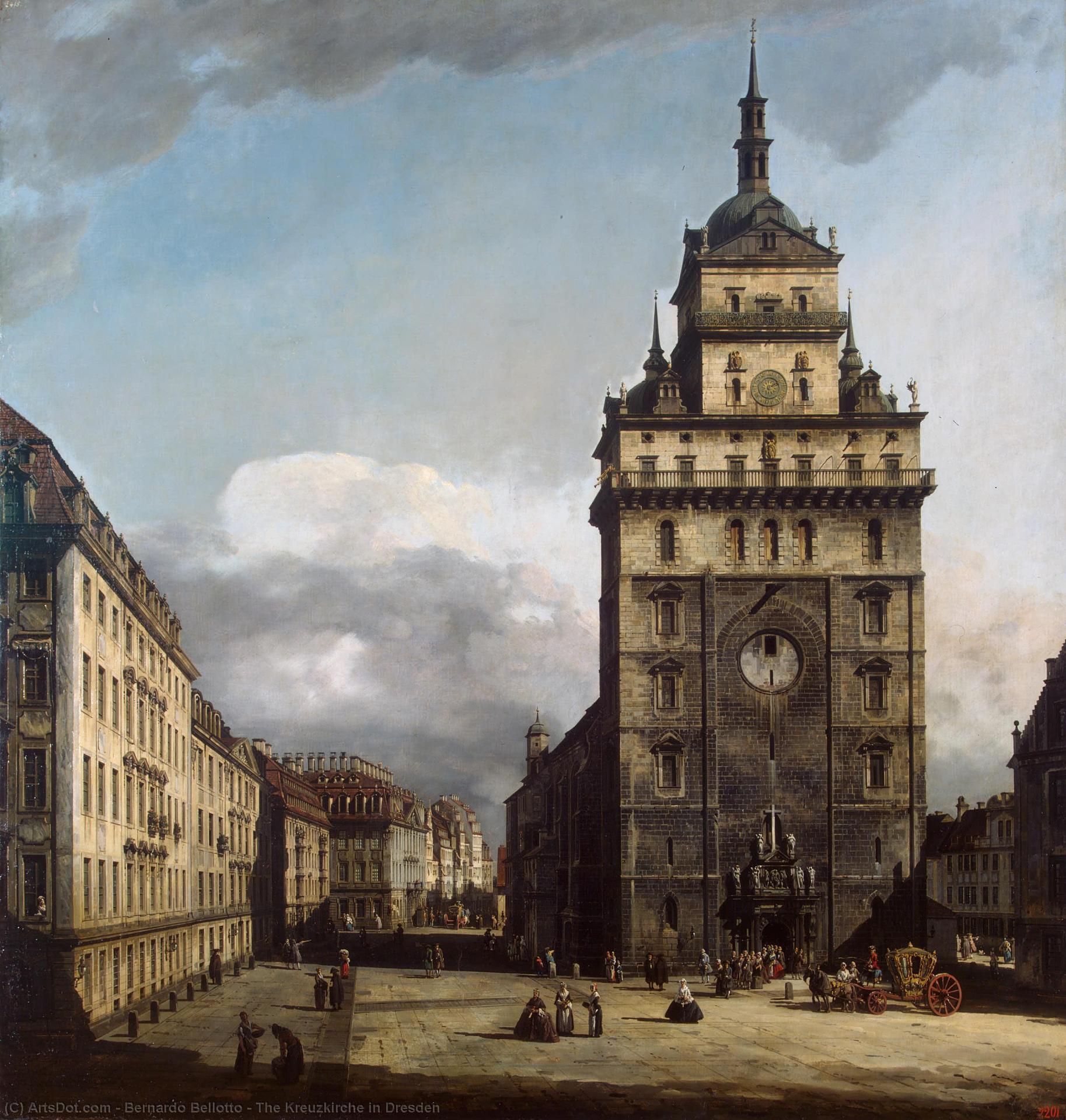
Bernardo Bellotto’s ‘The Kreuzkirche in Dresden’: A Window into a Lost City
Bernardo Bellotto's 1747 depiction of the Kreuzkirche in Dresden is more than just a cityscape; it’s a meticulously rendered testament to a vanished world and a poignant reflection on the fragility of beauty. Executed during a pivotal moment in European history – a period marked by shifting alliances, burgeoning empires, and devastating conflicts – this large-scale drawing offers an intimate glimpse into the heart of Saxony's capital, just years before the catastrophic destruction wrought by Allied bombing during the final stages of World War II. Bellotto, apprenticed to the celebrated Canaletto, inherited his mentor’s extraordinary ability to capture not merely the appearance of a place, but its very soul. This work exemplifies that skill, showcasing a profound understanding of urban space and a masterful command of perspective and light.
A Venetian Legacy: Bellotto's Artistic Training
- Canaletto’s Influence: Bellotto’s artistic journey began under the tutelage of Giovanni Antonio Canal, better known as Canaletto. This formative period instilled in him a deep appreciation for detailed observation and a distinctive approach to architectural drawing – one characterized by a precise rendering of buildings, streets, and public spaces.
- Technical Mastery: Like his mentor, Bellotto employed the techniques of linear perspective with remarkable accuracy, creating an illusion of depth that draws the viewer into the scene. His use of hatching and cross-hatching adds subtle variations in tone, enhancing the realism and atmospheric quality of the drawing.
- Venetian Perspective: Bellotto’s early works demonstrate a Venetian sensibility – a focus on capturing the light and shadow effects unique to the city's canals and architecture. This influence is subtly present in ‘The Kreuzkirche,’ contributing to its overall sense of authenticity.
Dresden at a Crossroads: Historical Context and Artistic Purpose
Commissioned by King August III of Poland, Bellotto arrived in Dresden in 1747, tasked with documenting the city’s architectural landscape. This was not merely an act of artistic patronage; it served a strategic purpose – to create a visual record of Dresden's grandeur and stability, intended for diplomatic use and as a testament to the king’s power. The drawing captures the Kreuzkirche, one of Dresden’s most prominent landmarks, during a period of significant urban development and political maneuvering. The impending Seven Years' War casts a subtle shadow over the scene, hinting at the turbulent times ahead. Bellotto’s work is thus inextricably linked to the historical events unfolding around him, offering a valuable primary source for understanding the city’s appearance and social dynamics in the mid-18th century.
Symbolism and Emotional Impact: A Frozen Moment
Beyond its technical brilliance, ‘The Kreuzkirche’ possesses a powerful emotional resonance. The scene is alive with activity – figures strolling along the streets, horses pulling carriages, and merchants engaged in trade. This bustling atmosphere conveys a sense of vitality and prosperity, yet it's also tinged with melancholy, particularly considering the eventual destruction of Dresden. Bellotto’s meticulous attention to detail allows us to almost feel the texture of the stone buildings, smell the aromas of the city, and hear the sounds of its inhabitants. The drawing serves as a poignant reminder of what was lost – a beautiful city reduced to rubble by war. The inclusion of the clock tower, a symbol of time’s relentless passage, adds another layer of significance to this enduring masterpiece.