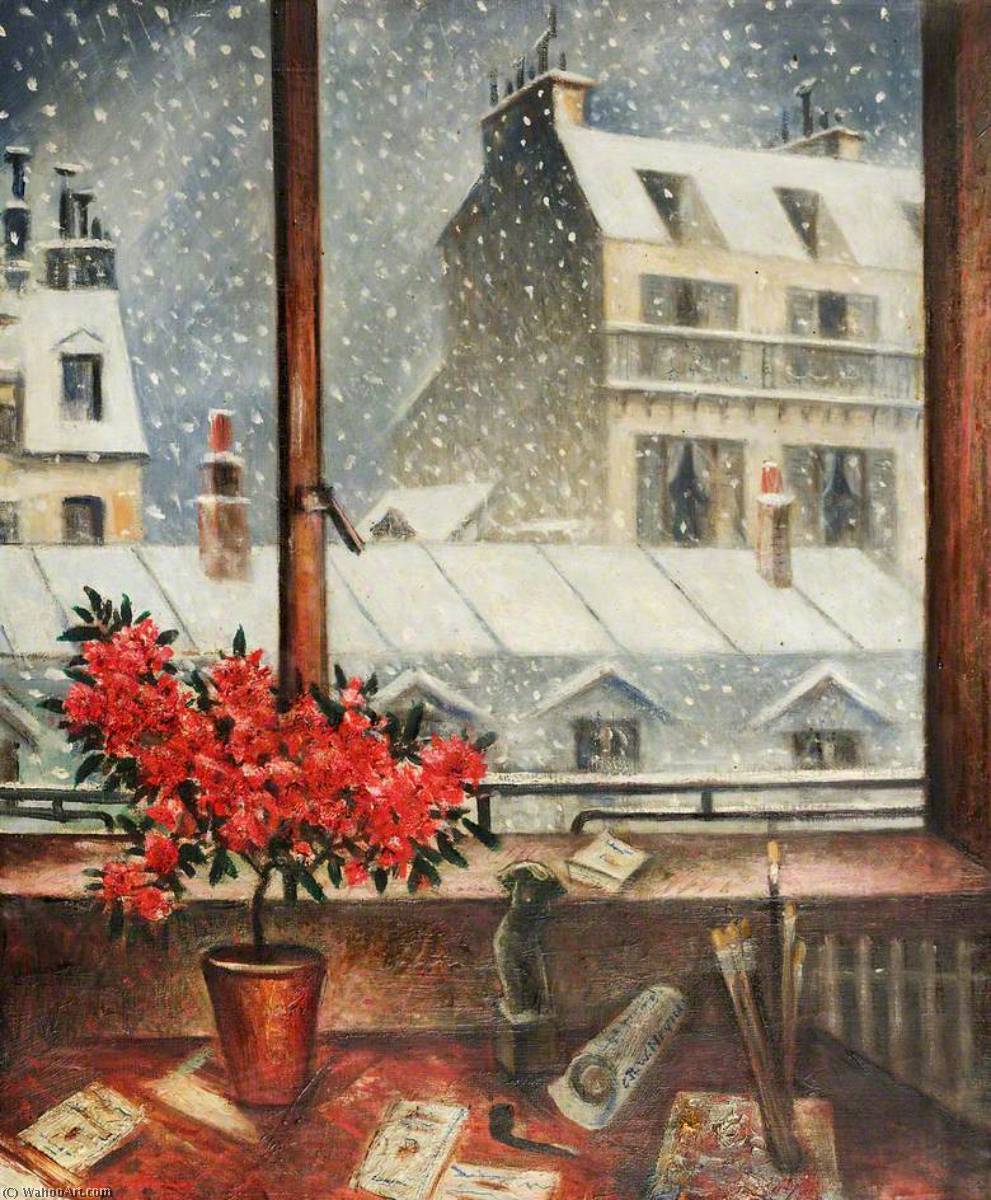
A Frozen Reverie: Christopher Richard Wynne Nevinson’s “Winter Time”
Christopher Richard Wynne Nevinson's "Winter Time," painted circa 1915-1916, isn’t merely a depiction of snow; it’s a carefully constructed meditation on the anxieties and transformations simmering beneath the surface of early 20th-century Europe. This evocative oil painting, currently housed at the Royal Academy of Music in London, captures a European town shrouded in a thick blanket of winter, yet within that stillness lies a palpable sense of unease—a feeling amplified by Nevinson’s masterful deployment of Futurist and Cubist techniques.
The scene unfolds from a window, offering a carefully framed view of a cityscape dominated by the muted tones of grey stone buildings and slate roofs. The snow itself isn't rendered as a pristine white; instead, it’s layered with shades of blue, violet, and even hints of ochre, suggesting a world both beautiful and subtly unsettling. The artist deliberately avoids romanticizing winter – there are no cheerful figures or festive decorations to be found. Instead, the focus is on the architecture itself, rendered in sharp, angular forms that echo the geometric principles of Cubism. These fractured shapes create a sense of dynamism and instability, mirroring the turbulent times.
The Seeds of Modernity: Nevinson’s Artistic Influences
Nevinson's artistic journey was deeply intertwined with the radical currents sweeping through Europe at the time. His early exposure to Augustus John’s expressive brushwork ignited a passion for capturing raw emotion, while his time in Paris introduced him to the revolutionary ideas of Futurism and Cubism. He became particularly close to Filippo Marinetti, embracing the movement's fascination with speed, technology, and the dynamism of modern life. This influence is strikingly evident in "Winter Time," where the rigid geometry of the buildings contrasts sharply with the fluid, almost chaotic, application of paint.
However, Nevinson’s relationship with the Futurists was ultimately fraught with tension. His tendency towards self-promotion and his association with the controversial Wyndham Lewis led to a falling out, resulting in his exclusion from the core group. Despite this estrangement, he remained a key figure in British avant-garde art, pushing boundaries and challenging conventional artistic norms.
Symbolism Within the Snowfall
Beyond its formal elements, "Winter Time" is rich with symbolic meaning. The snow itself can be interpreted as a metaphor for oblivion—a blank slate upon which the past is erased and the future remains uncertain. The darkened windows suggest introspection and isolation, reflecting the anxieties of a continent bracing itself for war. Even the red flowers in the foreground – a deliberate splash of color against the muted palette – carry symbolic weight, perhaps representing fleeting beauty amidst a landscape of decay or a reminder of life’s vitality persisting through hardship.
The inclusion of books scattered throughout the scene adds another layer of interpretation. They could represent knowledge, memory, and the enduring power of human thought—a quiet resistance against the encroaching darkness. The overall composition feels like a contained world, a snapshot of a moment suspended in time, inviting contemplation on themes of loss, resilience, and the passage of history.
A Legacy of Intensity
“Winter Time” is not simply a pretty winter scene; it’s a powerfully emotive work that captures the spirit of a pivotal era. Nevinson's bold use of color, fractured forms, and unsettling atmosphere created a lasting impact on British art, influencing generations of artists to come. Despite his later controversies and struggles with self-image, his contribution to the development of modernism remains undeniable. Today, "Winter Time" stands as a testament to Nevinson’s artistic vision—a frozen reverie that continues to resonate with viewers seeking beauty, complexity, and a glimpse into the heart of a turbulent time.