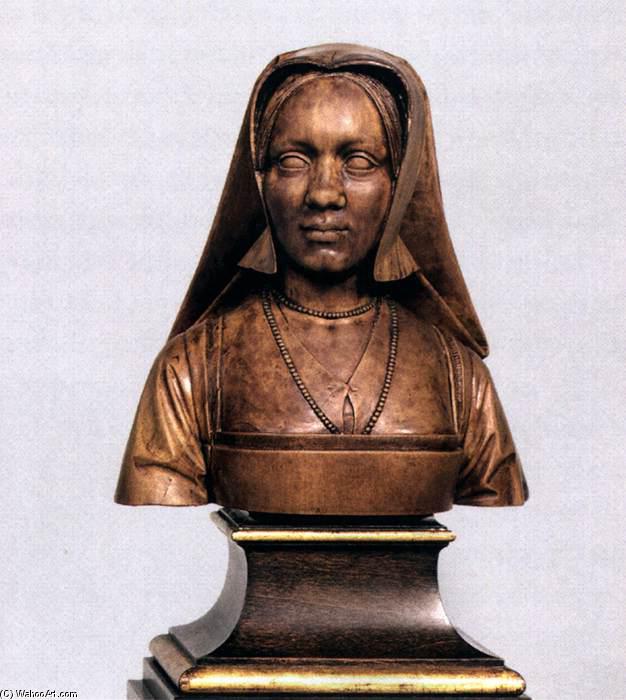
The Silent Strength: Conrad Meit’s Bust of Margaret of Austria
Conrad Meit's bronze bust of Margaret of Austria, created around 1515, is more than a mere likeness; it’s a carefully constructed embodiment of power, piety, and the weighty responsibilities borne by one of Europe’s most influential women. The image, recently reproduced with remarkable fidelity, immediately draws the eye to the subject's serene expression – a quiet dignity that belies the turbulent political landscape she navigated for decades. The subtle lines etched around her eyes and mouth speak not of age, but of contemplation, suggesting a mind constantly engaged in strategic thought and diplomatic maneuvering. The meticulous detail in the rendering of her hair, styled with an elegant updo characteristic of the period, and the careful sculpting of her garments hint at both wealth and authority – a visual declaration of her position as Regent of the Netherlands.
- Material & Technique: The bust is crafted from what appears to be bronze or a similar metal, exhibiting a rich, dark patina that speaks to its age and the passage of time. Meit’s mastery lies in his ability to capture texture – the subtle creases of her clothing, the delicate folds of her hair, and the weathered quality of her face—all achieved through painstaking hand-modeling and polishing.
- Historical Context: Margaret's life was one of extraordinary circumstance. Born into the powerful Habsburg dynasty, she inherited a vast empire at a young age, thrusting her into the role of regent for both her father, Emperor Maximilian I, and later her nephew, Charles V. This period saw the Netherlands embroiled in conflict with France and Spain, demanding shrewd leadership and unwavering resolve.
A Royal Portrait: Symbolism and Habsburg Identity
Beyond its technical brilliance, the bust is laden with symbolic meaning deeply rooted in the iconography of the era. The head covering, reminiscent of a veil or cap, alludes to her role as a pious ruler, emphasizing her commitment to religious authority – a crucial element in maintaining stability during a time of political upheaval. The posture itself—a slight forward lean, suggesting attentiveness and engagement—conveys a sense of command and responsibility. The Habsburgs, known for their meticulous attention to detail and their embrace of classical ideals, sought to project an image of strength, wisdom, and divine right through portraiture. Meit’s bust perfectly embodies this ambition, presenting Margaret not merely as a queen, but as the embodiment of her dynasty's legacy.
The subtle inclusion of elements referencing both Byzantine and Italian Renaissance art reflects the complex cultural influences shaping Habsburg courtly culture at the time.
The Workshop of Meit: A Legacy in Flanders
Conrad Meit’s career flourished during a period of immense artistic innovation in the Low Countries, particularly in the workshops of Brussels and Antwerp. He was employed by Margaret of Austria from 1514 until her death in 1530, producing numerous works that served to decorate her court and showcase her power. His style is characterized by a remarkable blend of late Gothic and early Renaissance techniques—a testament to his versatility and his ability to adapt to the evolving artistic trends of the time. The royal tombs at Brou Monastery, where he created monumental figures alongside other sculptors, stand as enduring evidence of his skill and influence. Research reveals that Meit’s work was unfortunately largely destroyed during the Reformation and French Revolution, leaving only a handful of surviving examples—a poignant reminder of the fragility of artistic heritage.
Further research into Meit's life reveals he was also a prolific woodcarver, creating numerous small statuettes for Margaret's court.
A Timeless Image: Recreating Majesty
Reproductions of this remarkable bust offer an unparalleled opportunity to bring the spirit of Margaret of Austria into any setting. The meticulous detail and evocative expression capture the essence of a woman who navigated treacherous political waters with grace, intelligence, and unwavering determination. Whether displayed in a private collection or incorporated into a grand interior design scheme, Meit’s portrait serves as a powerful reminder of the enduring legacy of one of Europe's most remarkable female rulers—a silent testament to her strength, wisdom, and lasting influence.