A Glimpse into Parisian Bohemia
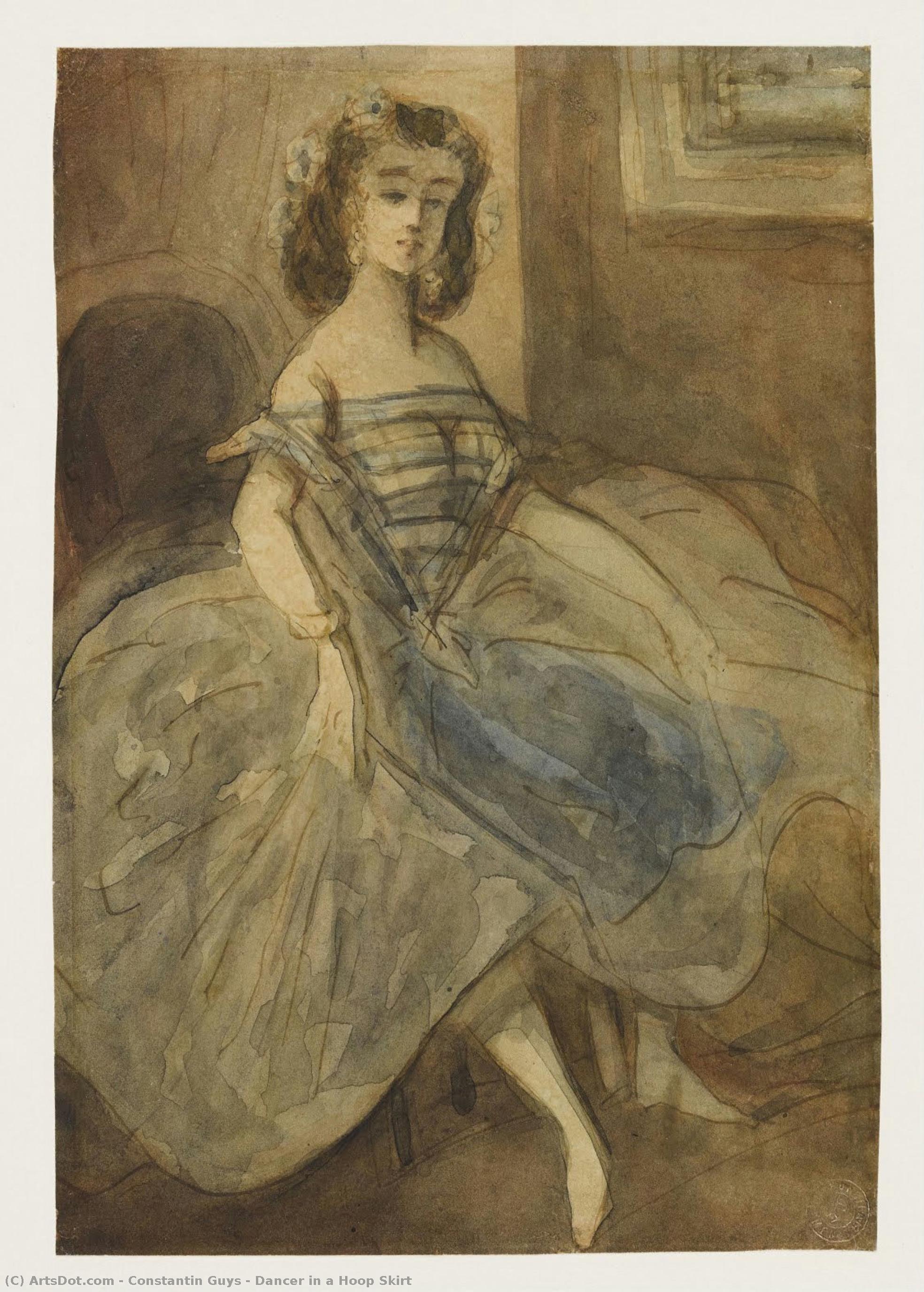
In the delicate, translucent strokes of Constantin Guys’ Dancer in a Hoop Skirt, we are transported back to the vibrant, pulsing heart of mid-19th-century Paris. This exquisite watercolor, dating from 1860, serves as more than just a portrait; it is a window into the "modernité" that the poet Charles Baudelaire so famously celebrated. The subject, a charming and slightly cheeky figure from the Parisian bohemian circles, sits poised in her voluminous hoop skirt, embodying the fleeting elegance of an era defined by rapid social change. Through Guys’ eyes, we do not merely see a woman posing; we witness a captured moment of urban life, where the boundaries between the private individual and the public spectacle begin to blur.
The composition is masterfully intimate, centering on the subject's graceful posture as she rests upon a wooden chair. The interplay of light and shadow, filtered perhaps through a nearby window, illuminates the intricate textures of her attire. There is a profound sense of presence in her gaze, a quiet confidence that suggests she is well aware of the artist's observant eye. For the collector or interior designer, this piece offers a sophisticated focal point, bringing a touch of historical romance and French elegance to any curated space.
Mastery of Light and Fluidity
Technically, Dancer in a Hoop Skirt is a triumph of watercolor realism. Constantin Guys employs a light, transparent brush technique that allows the paper to breathe, creating an ethereal quality in the tulle and fabric of the dancer's dress. This luminosity is essential to the work's emotional impact; it lends the clothing a weightless, almost shimmering appearance that mimics the movement of dance itself. The artist’s ability to render the structural complexity of the hoop skirt while maintaining a sense of airy lightness demonstrates his unparalleled skill in capturing the ephemeral nature of fashion and life.
The color palette is subtle yet evocative, utilizing soft tones that emphasize the delicate blue ribbon at the woman's neck and the warm, organic hues of the wooden furniture. This restraint ensures that the viewer's attention remains fixed on the interplay of texture and light. Such a masterful use of medium makes this reproduction an ideal choice for those seeking to introduce a sense of airy sophistication and classical beauty into a modern interior, providing a soft, luminous contrast to more structured or contemporary decor.
The Legacy of the Modern Flâneur
To understand this artwork is to understand the concept of the flâneur—the detached observer of the city. As a chronicler of the Crimean War and the social strata of Paris, Guys possessed a unique ability to deindividualize his subjects just enough to turn them into archetypes of modern life. In this painting, the dancer becomes a symbol of the transient beauty found in the everyday. She represents the "minor cocottes" and the spirited characters that populated the cafes and salons of the era, making the work deeply rooted in the sociological fabric of 1860s France.
For the discerning art lover, owning a reproduction of such a piece is an invitation to engage with history. It is an opportunity to possess a fragment of the Belle Époque, a period of unparalleled artistic and cultural flourishing. Whether placed in a sunlit reading nook or as part of a larger gallery wall, Dancer in a Hoop Skirt radiates a timeless charm that continues to captivate the imagination, offering a nostalgic yet vital connection to the birth of modern visual culture.