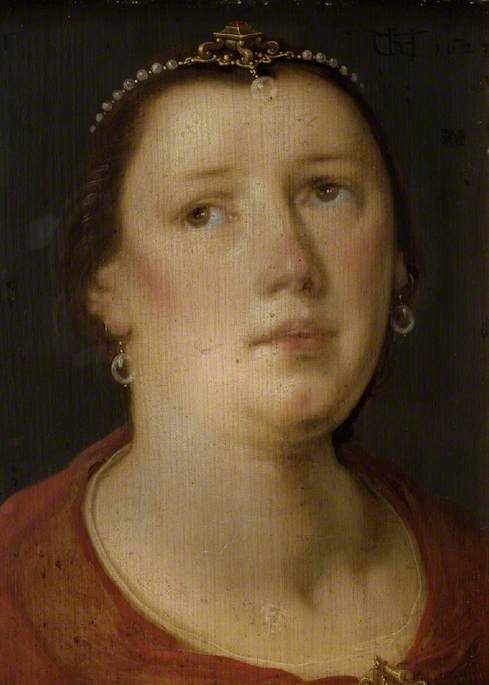
Admire Cornelis van Haarlem's "Female Head," a masterful portrait capturing grace and dignity—a pivotal piece from the Dutch Golden Age, showcasing intricate detail and reflecting the artist’s influence on Frans Hals.
Cornelis Cornelisz van Haarlem’s Female Head: A Window Into Renaissance Portraiture
The painting “Female Head,” attributed to Cornelis Cornelisz van Haarlem (1562–1638), stands as a testament to the burgeoning artistic spirit of the Dutch Golden Age and offers a fascinating glimpse into the stylistic conventions prevalent during its formative years. Executed around 1590, this portrait exemplifies the Mannerist style—a reaction against the idealized beauty championed by earlier Renaissance artists—characterized by heightened realism, dramatic lighting, and an exploration of psychological complexity. It’s housed in The Fitzwilliam Museum in Cambridge, England, where it continues to captivate viewers with its subtle nuances and masterful execution.
- Subject Matter & Style: Van Haarlem's depiction focuses on a woman’s face—a motif common in portraiture during the period—but eschews the smooth, polished surfaces favored by Raphael or Leonardo da Vinci. Instead, he employs a textured brushstroke technique that lends an immediacy and palpable presence to his subject. The woman’s gaze is direct, conveying confidence and introspection; this deliberate choice reflects the Mannerist preoccupation with capturing inner emotion rather than merely presenting an outward appearance.
- Technique & Materials: Painted on panel—a favored medium for portraitists of the time—the artwork utilizes oil paint mixed with resin to achieve a luminous sheen and remarkable detail. Van Haarlem’s meticulous layering of glazes creates depth and dimension, capturing subtle variations in skin tone and highlighting the contours of the face with precision. The artist skillfully manipulates light and shadow to sculpt the woman's features, emphasizing her gaze and creating an atmosphere of contemplative serenity.
- Historical Context: Van Haarlem’s work emerged during a period of significant political upheaval—the Eighty Years’ War against Spain—which profoundly impacted artistic patronage and intellectual discourse. The artist was deeply influenced by the humanist ideals championed by figures like Erasmus and Pico della Mirandola, who emphasized human dignity and potential for spiritual enlightenment. This influence is evident in Van Haarlem's portrayal of the woman as a symbol of feminine virtue and intellect—a reflection of prevailing societal attitudes toward women during the Renaissance.
- Symbolism & Emotion: Beyond its technical brilliance, “Female Head” resonates with symbolic significance. The crown adorning the woman’s head represents authority and nobility, yet it is positioned slightly askew, hinting at vulnerability and perhaps a subtle critique of patriarchal structures. The artist's masterful use of chiaroscuro—the dramatic interplay between light and dark—amplifies the emotional impact of the portrait, conveying a sense of quiet contemplation and inner strength.
- Legacy & Influence: Cornelis van Haarlem’s “Female Head” served as an important precursor to Frans Hals' groundbreaking portraits of Dutch citizens during the Golden Age. Hals adopted Van Haarlem’s expressive brushwork and psychological realism—techniques that would become hallmarks of his distinctive style—solidifying Van Haarlem’s position as a pivotal figure in the artistic canon. Its enduring appeal testifies to the power of art to capture not only likeness but also the essence of human experience.
Explore this captivating artwork at The Fitzwilliam Museum and immerse yourself in the splendor of Renaissance portraiture.
Discover more about Cornelis van Haarlem’s artistic journey on Wikipedia.