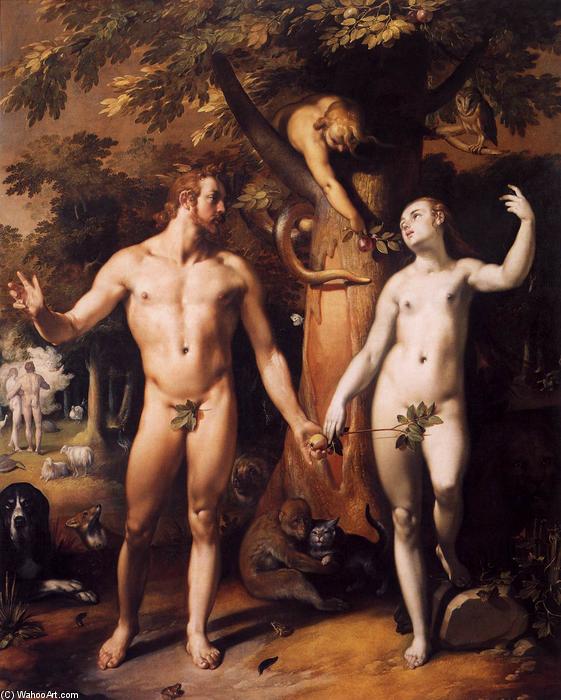
A Dramatic Echo of Paradise Lost: Cornelis van Haarlem’s “The Fall of Man”
Cornelis Cornelisz van Haarlem's "The Fall of Man," painted in 1592, isn’t merely a depiction of a biblical story; it’s a profound meditation on human nature, temptation, and the irrevocable loss of innocence. Housed within the Rijksmuseum in Amsterdam, this monumental oil painting transcends its religious subject matter to become a timeless exploration of morality and consequence. Van Haarlem, a pivotal figure bridging the late Mannerist period with the burgeoning Dutch Golden Age, masterfully captures the moment when Adam and Eve succumb to the serpent’s allure, forever altering their relationship with God and the world around them.
The scene unfolds with arresting theatricality. Adam and Eve, rendered in a strikingly realistic style for the time – yet retaining a subtle Mannerist elegance – stand close, their nakedness not presented as shame but rather as a poignant reminder of their original state of grace. The woman’s hand, holding the forbidden fruit, is a gesture both vulnerable and defiant. The serpent, a creature of unsettling realism with a human torso, coils towards them, its gaze laden with persuasive malice. Beyond this central drama, the landscape—a lush, almost idyllic vista dotted with sheep and hinting at a distant village – serves as a stark counterpoint to the impending doom, emphasizing the paradise they’ve forfeited.
The Language of Symbolism: Decoding Van Haarlem's Vision
Van Haarlem’s genius lies not just in his technical skill but also in his deliberate use of symbolism. The apple itself is a potent emblem of temptation and transgression, its crimson hue drawing the eye and representing the forbidden knowledge that leads to humanity’s downfall. The serpent, traditionally associated with evil and deceit, embodies the seductive power of sin. Crucially, the background—featuring God as a veiled figure in the left panel – serves as a visual reminder of divine authority and the consequences of disobedience. The inclusion of animals, particularly the sheep, can be interpreted as representing innocence lost, while the distant village symbolizes the earthly realm now tainted by sin.
The artist’s choice to depict Adam and Eve in such detail—the texture of their skin, the folds of their garments, the intricate branches of the tree – underscores the tangible reality of their fall. This realism, combined with a Baroque sensibility evident in the dramatic lighting and dynamic composition, elevates the painting beyond a simple narrative illustration. The use of nudity, a bold choice for its time, isn’t intended to be overtly erotic but rather to convey the vulnerability and innocence stripped away from humanity by sin.
Technique and Artistic Flourishes: A Window into Van Haarlem's Studio
“The Fall of Man” is a testament to Van Haarlem’s mastery of oil painting. The rich, vibrant color palette—dominated by earthy browns, ochres, and greens—is punctuated by the striking red of the forbidden fruit. The artist employs impasto techniques, building up thick layers of paint on the figures' skin and the tree bark, creating a tactile surface that invites close inspection. This textural richness adds depth and volume to the scene, drawing the viewer into its emotional core.
Furthermore, Van Haarlem’s skillful use of perspective—creating a sense of space and distance—enhances the drama of the composition. The distant village and landscape recede into the background, emphasizing the immediate confrontation between Adam and Eve and the serpent. The visible brushstrokes, characteristic of the period, contribute to the painting's dynamism and immediacy, reminding us that we are witnessing a pivotal moment in art history unfold before our eyes.
A Timeless Masterpiece: Reproduction Possibilities
ArtsDot offers meticulously crafted hand-painted reproductions of “The Fall of Man,” allowing you to bring this iconic artwork into your home or office. Our skilled artisans replicate Van Haarlem’s techniques and color palette with exceptional accuracy, ensuring that your reproduction captures the painting's original power and beauty. Whether you are an art enthusiast, a collector, or simply seeking a stunning piece of décor, our reproductions provide an authentic and affordable way to experience the enduring legacy of this masterpiece.