 Preview
 Send
Send Share
Share
 Details

 Download
 Similars
 X-Ray
X-Ray Diaporama
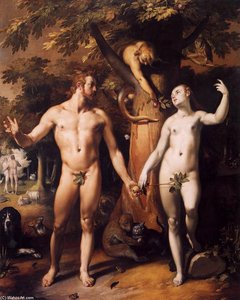
The Fall of Man
 Oil On Canvas
- WallArt
- Baroque
 1592
1592 273.0 x 220.0 cm
 Rijksmuseum
 Read More
Hand Made Oil Reproduction
Hand-painted oil on canvas in your size and frame, made to order by our artists. ( Buy Print Buy Image)




P118B $10

P118H $10

P118W $10

P438Z $10

P508JH $12

P508YH $12

P805H $10

P805Z $10

P919BZ $10

P919G $10

P919XJ $10

P959ZH $10

P968JZ $12

W106C $8

W218G $10

W218JH $8

W218Y $10

W307PJ $10

W316G $10

W316PJ $8

W316Y $10

W398PJ $8

W4111J $10

W500HY $15

W500JH $15

W692G $12

W849H $8

W940BG $15

W953PJ $8




Pick from our preset sizes that match the artwork's original proportions.

You may enter your own dimensions to fit a specific frame or space. If your selected size does not match the original image's proportions, we will either crop the artwork or extend the painting with additional hand-painted elements. A digital mockup will be sent for your approval before production begins.
Please note that the on-screen preview does not reflect the actual cropping or extension. Only the mockup will accurately show the final composition.
While custom sizes are available, we recommend selecting a dimension from the predefined list to preserve the original proportions.
After order, ArtsDot.com team will email client for instructions and provide a mockup preview
Worldwide Delivery () in 3/4 weeks instead of standard 5 weeks. (16 August). No compromise on quality.

Free Worldwide Express Shipping

High-Quality Linen Canvas

Full Shipping Insurance

Customs Tax Refund Guarantee

True Color Matching Guarantee

60-Day Return Policy (Defects Only)

100% Money-Back Guarantee

Bulk Discount Offer
 Glass option is only available in size under 110 CM

The Fall of Man
Reproduction Medium
Reproduction Size
-


Total Price
$ 313
Artwork Description
A Dramatic Echo of Paradise Lost: Cornelis van Haarlem’s “The Fall of Man”
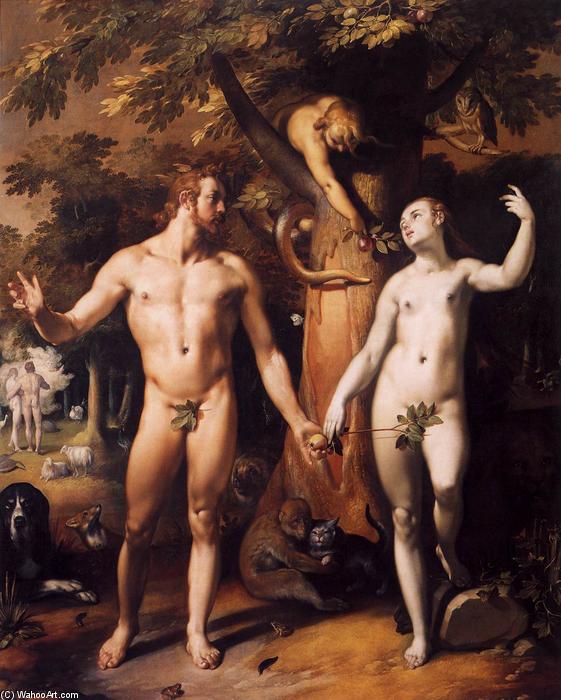
Cornelis Cornelisz van Haarlem's "The Fall of Man," painted in 1592, isn’t merely a depiction of a biblical story; it’s a profound meditation on human nature, temptation, and the irrevocable loss of innocence. Housed within the Rijksmuseum in Amsterdam, this monumental oil painting transcends its religious subject matter to become a timeless exploration of morality and consequence. Van Haarlem, a pivotal figure bridging the late Mannerist period with the burgeoning Dutch Golden Age, masterfully captures the moment when Adam and Eve succumb to the serpent’s allure, forever altering their relationship with God and the world around them.
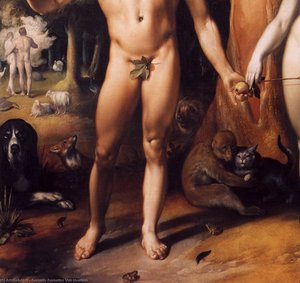
The scene unfolds with arresting theatricality. Adam and Eve, rendered in a strikingly realistic style for the time – yet retaining a subtle Mannerist elegance – stand close, their nakedness not presented as shame but rather as a poignant reminder of their original state of grace. The woman’s hand, holding the forbidden fruit, is a gesture both vulnerable and defiant. The serpent, a creature of unsettling realism with a human torso, coils towards them, its gaze laden with persuasive malice. Beyond this central drama, the landscape—a lush, almost idyllic vista dotted with sheep and hinting at a distant village – serves as a stark counterpoint to the impending doom, emphasizing the paradise they’ve forfeited.
The Language of Symbolism: Decoding Van Haarlem's Vision
Van Haarlem’s genius lies not just in his technical skill but also in his deliberate use of symbolism. The apple itself is a potent emblem of temptation and transgression, its crimson hue drawing the eye and representing the forbidden knowledge that leads to humanity’s downfall. The serpent, traditionally associated with evil and deceit, embodies the seductive power of sin. Crucially, the background—featuring God as a veiled figure in the left panel – serves as a visual reminder of divine authority and the consequences of disobedience. The inclusion of animals, particularly the sheep, can be interpreted as representing innocence lost, while the distant village symbolizes the earthly realm now tainted by sin.
The artist’s choice to depict Adam and Eve in such detail—the texture of their skin, the folds of their garments, the intricate branches of the tree – underscores the tangible reality of their fall. This realism, combined with a Baroque sensibility evident in the dramatic lighting and dynamic composition, elevates the painting beyond a simple narrative illustration. The use of nudity, a bold choice for its time, isn’t intended to be overtly erotic but rather to convey the vulnerability and innocence stripped away from humanity by sin.
Technique and Artistic Flourishes: A Window into Van Haarlem's Studio
“The Fall of Man” is a testament to Van Haarlem’s mastery of oil painting. The rich, vibrant color palette—dominated by earthy browns, ochres, and greens—is punctuated by the striking red of the forbidden fruit. The artist employs impasto techniques, building up thick layers of paint on the figures' skin and the tree bark, creating a tactile surface that invites close inspection. This textural richness adds depth and volume to the scene, drawing the viewer into its emotional core.
Furthermore, Van Haarlem’s skillful use of perspective—creating a sense of space and distance—enhances the drama of the composition. The distant village and landscape recede into the background, emphasizing the immediate confrontation between Adam and Eve and the serpent. The visible brushstrokes, characteristic of the period, contribute to the painting's dynamism and immediacy, reminding us that we are witnessing a pivotal moment in art history unfold before our eyes.
A Timeless Masterpiece: Reproduction Possibilities
ArtsDot offers meticulously crafted hand-painted reproductions of “The Fall of Man,” allowing you to bring this iconic artwork into your home or office. Our skilled artisans replicate Van Haarlem’s techniques and color palette with exceptional accuracy, ensuring that your reproduction captures the painting's original power and beauty. Whether you are an art enthusiast, a collector, or simply seeking a stunning piece of décor, our reproductions provide an authentic and affordable way to experience the enduring legacy of this masterpiece.
Related Artworks
Artist Biography
A Forerunner of the Dutch Golden Age: The Life and Art of Cornelis Cornelisz van Haarlem
Cornelis Cornelisz van Haarlem, born in 1562 within the burgeoning artistic hub of Haarlem, Netherlands, stands as a pivotal figure bridging the late Mannerist period with the dawn of the Dutch Golden Age. His journey was one of stylistic evolution and significant influence, particularly on the celebrated portraitist Frans Hals. Initially steeped in the highly stylized conventions prevalent at the time, van Haarlem’s early training under Pieter Pietersz in his native city and later Gillis Coignet in Antwerp laid a foundation for a career marked by both technical prowess and an eventual embrace of more naturalistic representation. The political turmoil of the Eighty Years' War cast a long shadow over his youth; when Spanish forces besieged Haarlem in 1573, his parents fled, leaving young Cornelis to be raised by Pieter Pietersz, solidifying his artistic path. This early experience likely instilled within him a sense of resilience and a deep connection to the cultural identity of his hometown, themes that would subtly permeate his later work.From Mannerist Grandeur to Netherlandish Realism
Van Haarlem’s initial artistic output was characterized by large-scale compositions featuring dramatically posed figures—often Italianate nudes—with an emphasis on artifice and exaggerated anatomy. These works, while demonstrating considerable skill, reflected the prevailing Northern Mannerist aesthetic heavily influenced by artists like Bartholomeus Spranger whose drawings were introduced to Haarlem by Carel van Mander in 1585. However, a distinct shift began to emerge as van Haarlem matured. He gradually moved away from these highly stylized forms towards a more grounded and realistic approach rooted in the Netherlandish tradition. This transformation wasn’t abrupt but rather a considered evolution, reflecting not only his artistic growth but also a broader cultural movement within the Netherlands toward greater naturalism and emotional depth. His evolving style mirrored a changing society—one increasingly focused on individual expression and observable reality.Key Works and Civic Recognition
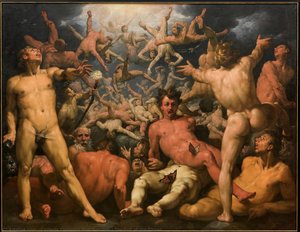
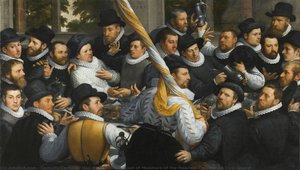
Throughout his career, van Haarlem secured numerous commissions that attest to his growing reputation and skill. One of his earliest significant works, The Banquet of the Haarlem Civic Guard (1583), showcased his emerging talent as a portraitist and ability to capture group dynamics with impressive detail. This piece, along with subsequent civic commissions, cemented his position within the community and established him as a reliable and capable artist. The Fall of the Titans (1588-1590), a monumental mythological scene, demonstrates his mastery of complex compositions and narrative storytelling. These large-scale paintings weren’t merely displays of technical skill; they were statements of civic pride and artistic ambition. He became deeply involved in the Haarlem art community, participating in informal drawing groups with Hendrick Goltzius and Carel van Mander—a collective often referred to as the “Haarlem Mannerists” or the "Haarlem Academy"—where ideas were exchanged and new artistic directions explored.A Lasting Legacy: Influence on Frans Hals and Beyond
Cornelis van Haarlem’s influence extended far beyond his own prolific output. He is particularly remembered for his profound impact on Frans Hals, one of the most celebrated portrait painters of the Dutch Golden Age. While the exact nature of their relationship remains a subject of scholarly debate, it's clear that van Haarlem served as an important mentor and source of inspiration for the younger artist. His emphasis on capturing individual character and psychological depth in his portraits likely paved the way for Hals’s groundbreaking approach to portraiture—an approach characterized by spontaneity, vitality, and a remarkable ability to convey personality. Van Haarlem's role as city painter of Haarlem further solidified his legacy, ensuring that his artistic vision continued to shape the cultural landscape of the region. His students included Salomon de Bray, Cornelis Jacobsz Delff, and Gerrit Pietersz Sweelink, continuing his influence into subsequent generations. His work can be found in prominent museum collections today, including the Rijksmuseum in Amsterdam and the Frans Hals Museum in Haarlem, ensuring that his artistic contributions continue to inspire and captivate audiences worldwide.Exploring Van Haarlem’s World Today
The enduring appeal of Cornelis van Haarlem's art is readily accessible through various online resources. Platforms like ArtsDot.com offer a comprehensive collection of his paintings, allowing enthusiasts to delve into the breadth and depth of his oeuvre. Detailed biographical information and critical analyses can be found on Wikipedia, providing valuable context for understanding his artistic development and historical significance. The Getty Museum and National Gallery websites also provide insights into specific works within their collections. Through these digital avenues, van Haarlem’s legacy is preserved and shared with a global audience, ensuring that this important forerunner of the Dutch Golden Age continues to receive the recognition he deserves. His paintings remain powerful testaments to an era of artistic innovation and cultural transformation.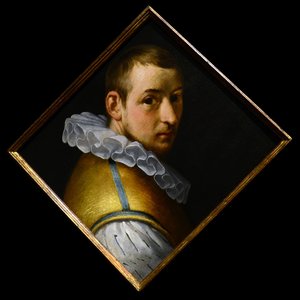
Cornelis Cornelisz van Haarlem
1562 - 1638 , Netherlands
Quick Facts
- Artistic Movement Or Style: Northern Mannerism
- Artists Or Movements Influenced By This Artist: ['Frans Hals']
- Artists Who Influenced This Artist:
- Pieter Pietersz
- Gillis Coignet
- Date Of Birth: 1562
- Date Of Death: 1638
- Full Name: Cornelis Cornelisz van Haarlem
- Nationality: Dutch
- Notable Artworks:
- Banquet of the Haarlem Civic Guard
- The Fall of the Titans
- Place Of Birth: Haarlem, Netherlands
Related Articles

Van Gogh's Masterpieces: Explore 25 Iconic Paintings & Art for Your Home
Journey through Vincent van Gogh's 25 most iconic paintings! Explore 'Starry Night', 'Sunflowers,' and more—discover the stories, techniques & emotions behind these Post-Impressionist masterpieces. Find museum-quality art reproductions for your home at ArtsDot.com.

Rembrandt's Masterpieces: Explore 25 Iconic Paintings & Prints | ArtsDot
Journey through Rembrandt van Rijn's 25 most iconic paintings & etchings. Explore Dutch Golden Age masterpieces, dramatic chiaroscuro, and timeless portraits. Find museum-quality art reproductions to elevate your home decor on ArtsDot.com.
Cornelis van Poelenburch: Bridging Mannerism & the Dutch Baroque Landscape
Discover Cornelis van Poelenburch, a pivotal Dutch Baroque landscape painter bridging Mannerism & Italianate styles. Explore his life, key works, and lasting influence on 17th-century art with ArtsDot.
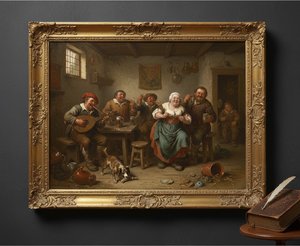
Adriaen van Ostade: A Master of Dutch Genre Painting & Social Commentary
Explore the life & work of Adriaen van Ostade, a leading Dutch Golden Age painter. Discover his realistic genre scenes, social commentary, and lasting influence on art history. Learn more at ArtsDot.
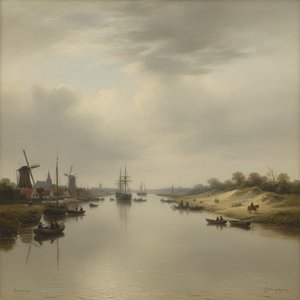
Jan van Goyen: Master of Dutch Landscape & Atmospheric Perspective
Discover Jan van Goyen, the master of Dutch landscape painting. Explore his subtle technique, atmospheric realism & lasting influence on art history. Learn about this 17th-century pioneer at ArtsDot.