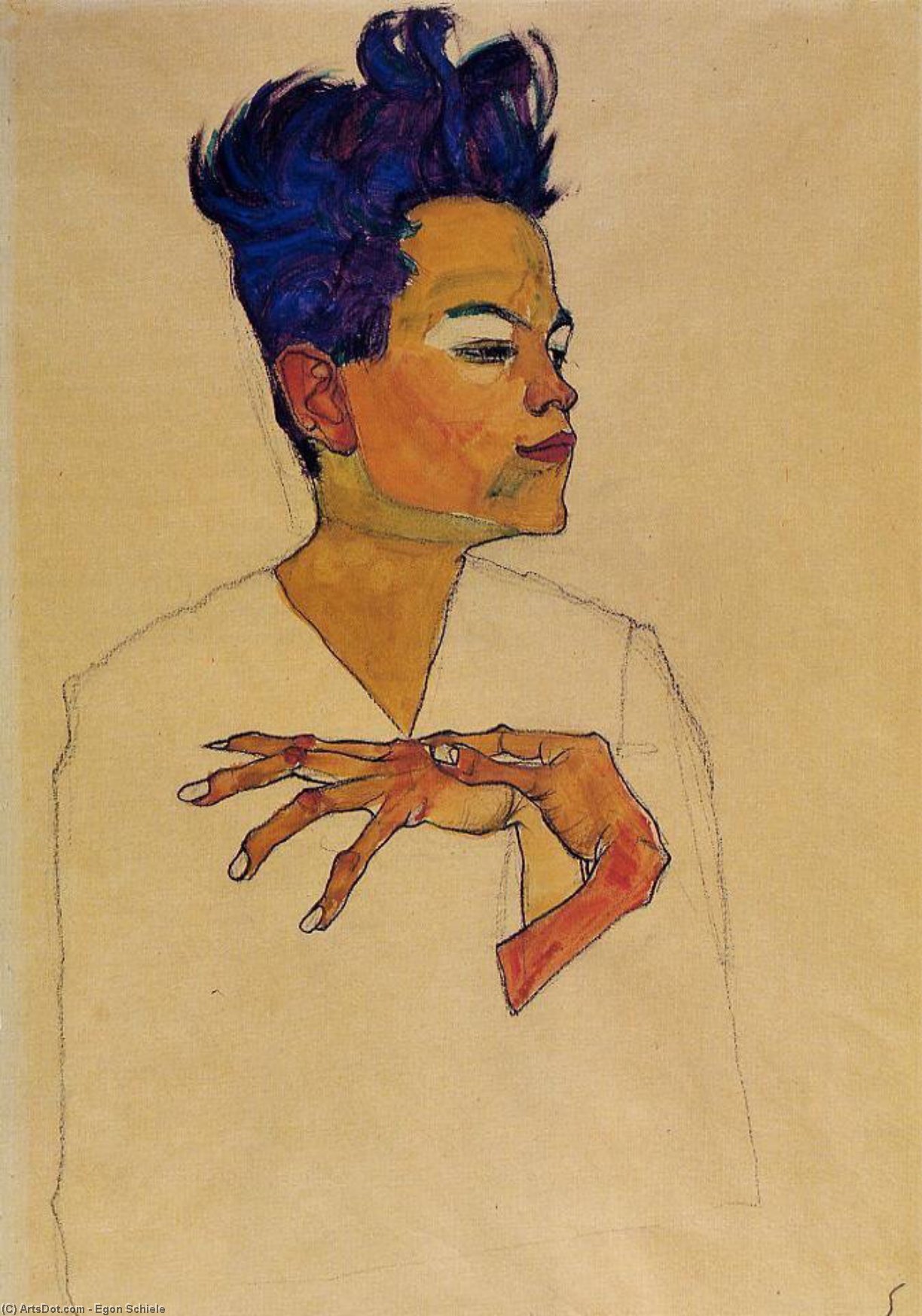
A Window into the Soul: Egon Schiele’s ‘Self Portrait with Hands on Chest’ (1910)
This striking self-portrait by Austrian Expressionist master Egon Schiele is more than just a likeness; it's a raw and unflinching exploration of inner turmoil, vulnerability, and the search for identity. Created in 1910, at a pivotal moment in both his artistic development and personal life, this work embodies the core tenets of Expressionism while establishing Schiele’s uniquely haunting style.
Artistic Style & Technique: Watercolor's Fragile Power
Schiele deliberately chose watercolor – a medium often associated with delicacy and transience – to depict such intense emotional weight. This choice is profoundly effective. The fluid washes of color, combined with bold, angular lines, create a sense of both fragility *and* nervous energy. Notice how the artist doesn’t blend colors seamlessly; instead, he allows them to bleed and interact, mirroring the complexities of human emotion. The visible brushstrokes contribute to an immediacy that draws the viewer directly into Schiele's psychological space.
Expressionism & Influences: A Generation in Revolt
As a leading figure within the Expressionist movement, Schiele reacted against the prevailing artistic conventions of his time. While influenced by artists like Vincent van Gogh and Edvard Munch – particularly their use of distorted forms and emotionally charged color palettes – he forged his own distinct path. Unlike the Impressionists’ focus on capturing fleeting moments of light, Expressionists sought to convey subjective experience and inner states. Schiele's work is characterized by elongated figures, often contorted into uncomfortable poses, reflecting a sense of alienation and existential angst common in early 20th-century Europe.
Symbolism & Interpretation: A Gesture of Self-Protection
The central gesture – Schiele’s hands clasped over his chest – is laden with symbolism. It can be interpreted as an act of self-protection, a physical barrier against the harsh realities of the world. However, it also suggests vulnerability and introspection; the hands seem to simultaneously shield *and* expose the heart. The pose subtly echoes traditional depictions of Christian martyrs or saints, imbuing the portrait with a spiritual dimension and hinting at Schiele’s own sense of suffering and isolation. The intense gaze further amplifies this feeling of exposed emotion.
Historical Context: Vienna on the Brink
Vienna in 1910 was a city brimming with intellectual and artistic ferment, but also rife with social and political tensions. The Austro-Hungarian Empire was crumbling, and traditional values were being challenged. Schiele’s work reflected this sense of upheaval and uncertainty. His unflinching depictions of the human body – often nude or in psychologically charged poses – scandalized conservative audiences and led to legal troubles for the artist.
Emotional Impact & Enduring Legacy
‘Self Portrait with Hands on Chest’ is a profoundly moving work that continues to resonate with viewers today. It's a testament to Schiele’s ability to capture the complexities of the human psyche and translate them into a visually arresting image.
The painting invites us to confront our own vulnerabilities, anxieties, and search for meaning in a chaotic world. His influence on subsequent generations of artists is undeniable, and his work remains a powerful example of Expressionist art’s enduring relevance.
Considering a Reproduction?
- This piece works beautifully in minimalist interiors, adding a touch of dramatic intensity.
- Its muted color palette complements both modern and traditional décor schemes.
- The intimate scale makes it ideal for smaller spaces like studies or bedrooms.
- A high-quality reproduction captures the nuances of Schiele’s watercolor technique, bringing the artist's vision to life in your home.