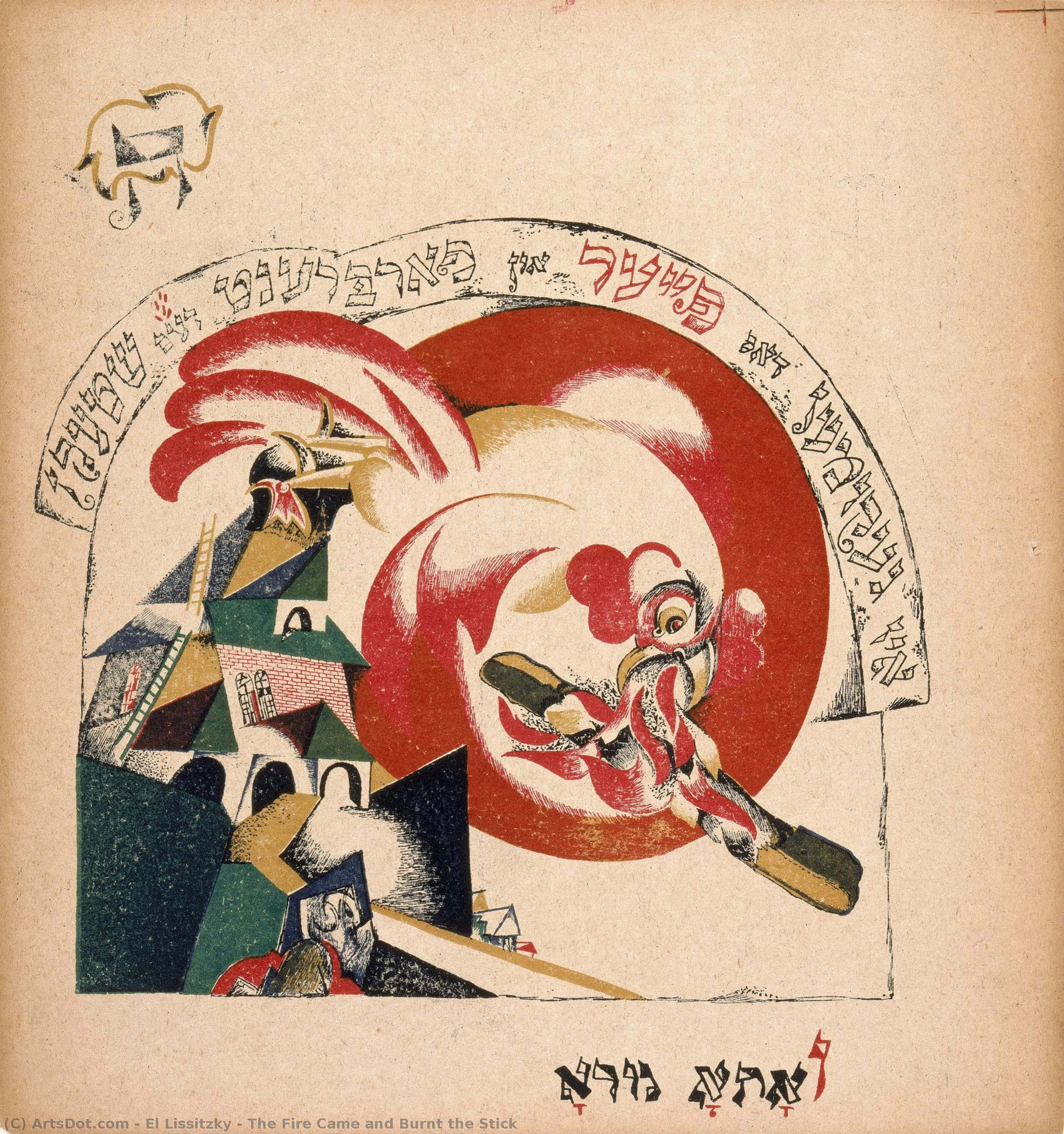
A Fiery Finale: Decoding El Lissitzky’s “The Fire Came and Burnt the Stick”
El Lissitzky's "The Fire Came and Burnt the Stick" (1919) is a pivotal work within his series interpreting the traditional Jewish song, *Had Gadya*. More than mere illustration, it’s a dynamic visual poem born from a period of immense social and artistic upheaval. This painting encapsulates Lissitzky's revolutionary approach to art, blending abstract forms with deeply rooted cultural narratives.
The Song and Its Significance
*Had Gadya*, an Aramaic folk song traditionally sung at the end of the Passover Seder, tells a cumulative tale of escalating destruction. Each verse introduces a new agent that overcomes the previous one – a goat is eaten by a cat, the cat by a dog, and so on, culminating in fire consuming the stick that beat the dog. The song’s allegorical nature has been interpreted in numerous ways, often representing historical oppressions faced by the Jewish people or the cyclical nature of power and violence. Lissitzky's series sought to visually represent these layers of meaning during a turbulent time in Russian history following the revolution.
A Style Forged in Revolution: Suprematism & Constructivism
Lissitzky’s style is instantly recognizable for its bold geometry, vibrant color palette (though this piece leans heavily into reds and beiges), and dynamic compositions. Heavily influenced by his mentor Kazimir Malevich's *Suprematism*, Lissitzky moved beyond pure abstraction to develop his own unique visual language called *Proun*. *Proun* sought to bridge the gap between painting and architecture, exploring spatial relationships and geometric forms in a way that felt both abstract and structurally sound. “The Fire Came and Burnt the Stick” exemplifies this – flattened planes intersect, creating a sense of depth while simultaneously rejecting traditional perspective. Elements of *Constructivism*, with its emphasis on art serving social purposes, are also present in the painting’s bold graphic quality.
Decoding the Imagery: Symbolism & Interpretation
The artwork presents a chaotic yet carefully constructed scene. A dominant flame-like form commands attention, representing the final act of destruction from the song. A building with multiple towers is partially obscured by this fiery element, perhaps symbolizing societal structures vulnerable to collapse. The figure resembling a man holding a stick in the lower right corner could represent humanity’s role in perpetuating cycles of violence or simply the literal character from the song. The chicken, rendered with a striking red circle around its head – almost like a comical grimace – adds an unsettling and ambiguous element. The inclusion of script-like elements within the composition hints at the textual origins of the work and reinforces the narrative foundation.
Emotional Resonance & Lasting Impact
“The Fire Came and Burnt the Stick” evokes a sense of unease, anxiety, and perhaps even apocalyptic foreboding. The intense color scheme and fragmented forms contribute to this emotional impact. However, it’s not simply a depiction of destruction; it's an exploration of consequence and the inevitable cycle of renewal that follows devastation. Lissitzky’s work remains profoundly relevant today, resonating with contemporary concerns about conflict, power dynamics, and the fragility of civilization.
Collecting & Reproductions
Original Location: The Jewish Museum, New York, United States.
For those seeking to bring this powerful artwork into their space, high-quality reproductions are available. ArtsDot.com offers meticulously crafted oil painting reproductions of El Lissitzky’s works, allowing you to experience the energy and complexity of “The Fire Came and Burnt the Stick” firsthand.