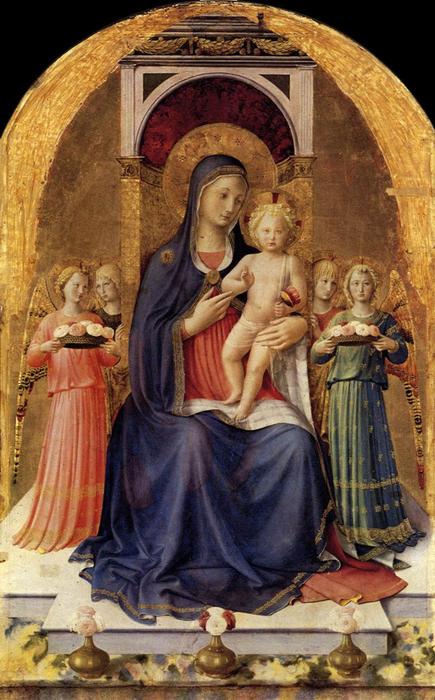
Explore Fra Angelico’s "Perugia Altarpiece" – a stunning Renaissance masterpiece! Admire its pyramidal composition, dramatic lighting & rich symbolism of 1447. #FraAngelico #RenaissanceArt
Explore Fra Angelico's (c. 1395-1455) serene Renaissance art: devout frescoes, vibrant colors & spiritual depth. Discover the 'Angelic Painter' & his legacy!
The museum offers wheelchair access, audio guides, Braille models, and a Baby Pit Stop for breastfeeding mothers.
A Vision of Divine Motherhood: Fra Angelico’s Perugia Altarpiece
This exquisite panel painting by Fra Angelico, created in 1447, offers a serene and deeply moving depiction of the Virgin Mary cradling the infant Jesus. Measuring 130 x 77 cm, the *Perugia Altarpiece* exemplifies the blossoming artistry of the Early Renaissance, seamlessly blending spiritual devotion with innovative artistic techniques.
Subject & Composition
The central panel presents a pyramidal composition, a hallmark of Renaissance design, drawing the viewer’s eye upwards towards Mary as its apex. She is portrayed with gentle grace and regal dignity, holding the Christ Child who gazes outward with an expression of quiet knowing. Flanking them are angels, their delicate features and flowing robes adding to the scene's ethereal quality. The figures are set against a dark, undefined background which serves to heighten their luminosity and emphasize the ornate golden frame – a typical feature of altarpieces designed for devotional settings.
Style & Technique
Fra Angelico’s style is instantly recognizable for its *purity of line*, delicate modeling, and harmonious color palette. He masterfully employs tempera on panel, building up layers of pigment bound in egg yolk to achieve a luminous finish with subtle tonal variations. The surfaces appear remarkably smooth, achieved through the glazing technique characteristic of the period. Notice how light dramatically illuminates Mary and Christ, suggesting a divine source emanating from above. While perspective is still developing in Early Renaissance art, Angelico skillfully uses foreshortening and layering to create a sense of depth within the composition. Geometric shapes – rectangles, circles, and triangles – are subtly integrated into the architecture and drapery, contributing to the painting’s overall harmony and balance.
Historical Context & Artistic Lineage
Fra Angelico (born Giovanni da Fiesole, c. 1395-1455) was a Dominican friar whose devout faith profoundly influenced his art. He worked during a pivotal period in Renaissance history, bridging the gap between the Gothic traditions of the past and the emerging humanist ideals of the new era. His work reflects influences from artists like Masaccio, particularly in the use of volume and form, but Angelico infuses these elements with a uniquely spiritual quality. He was contemporaries with Piero della Francesca, another master of perspective and serene composition, whose influence can be seen in the clarity and stillness of this piece.
Symbolism & Meaning
The *Perugia Altarpiece* is rich in symbolic meaning. The lilies held by the angels represent purity and Mary’s virginity. The luxurious fabrics adorning her robes signify her status as Queen of Heaven. The very act of presenting the Christ Child alludes to his role as savior, a pivotal moment in Christian theology. This altarpiece was intended not merely as decoration but as an object of contemplation and devotion, meant to inspire faith and reverence in those who beheld it.
Emotional Impact & Interior Design
This painting evokes a sense of peace, serenity, and profound spiritual connection. The soft colors, gentle expressions, and harmonious composition create a calming atmosphere. A high-quality reproduction of the *Perugia Altarpiece* would be a stunning addition to any interior, lending an air of timeless elegance and contemplative beauty. It is particularly well-suited for bedrooms, libraries, or meditation spaces where its tranquil presence can be fully appreciated. The gold leaf detailing will complement warm color palettes and add a touch of Renaissance grandeur to both traditional and contemporary settings. It’s a piece that invites quiet reflection and offers a visual reminder of faith, hope, and the enduring power of art.