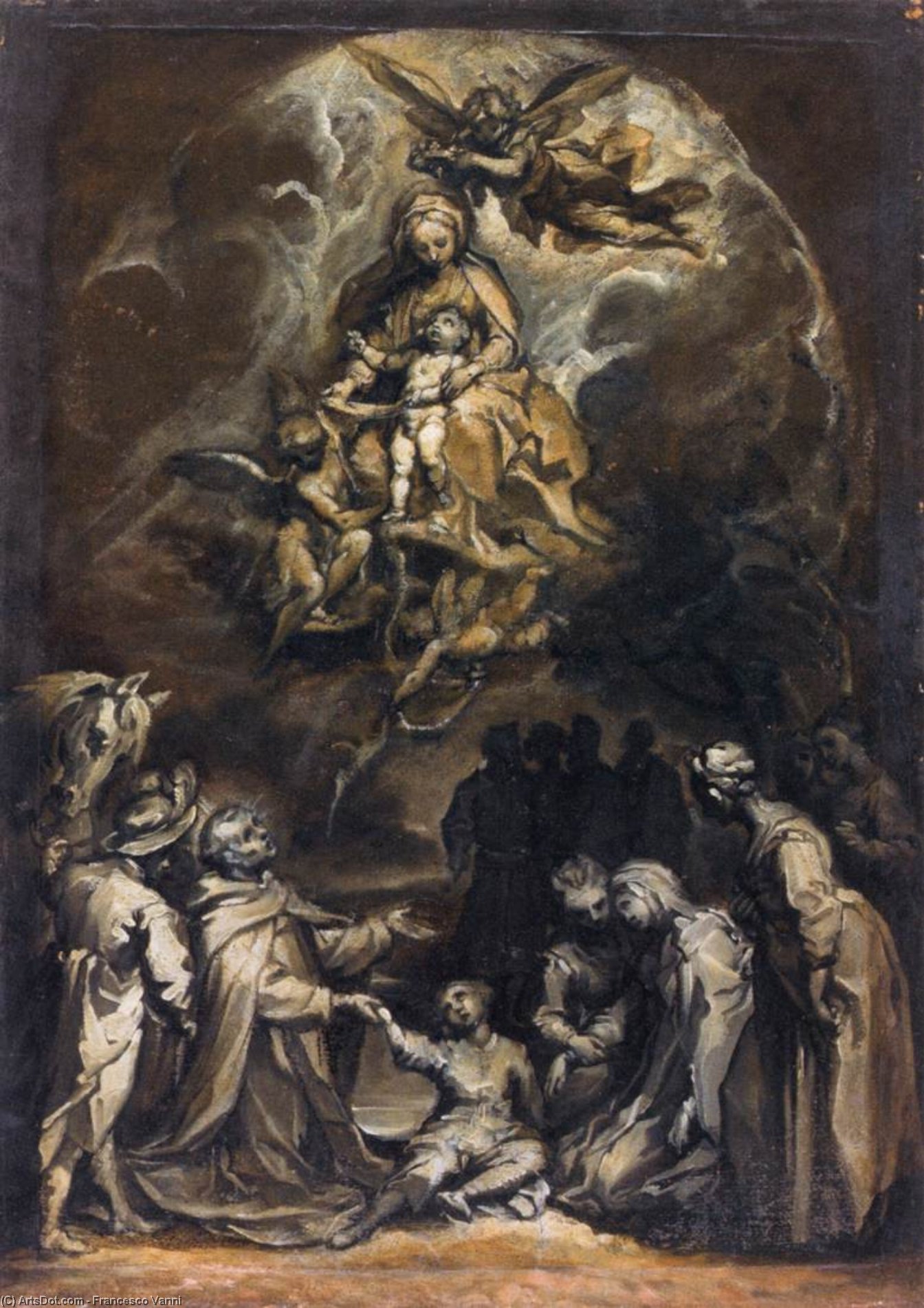
St Hyacinthus Raising a Drowned Child by Francesco Vanni
Francesco Vanni’s “St Hyacinthus Raising a Drowned Child,” painted circa 1605, stands as a poignant testament to Renaissance piety and artistic mastery—a masterpiece housed within the Musée du Louvre in Paris. This monumental altarpiece transcends mere depiction; it embodies a profound meditation on compassion, divine intervention, and the enduring struggle between earthly suffering and spiritual salvation.
The painting’s stylistic lineage firmly anchors itself within the Flemish Baroque tradition, mirroring the influence of Pieter Bruegel the Elder—a kindred spirit who similarly captured the complexities of human experience against a backdrop of solemn grandeur. Vanni meticulously employs chiaroscuro – dramatic contrasts between light and dark – to sculpt the figures into emotionally resonant forms. The muted palette predominately utilizes earthy tones: ochre, umber, and Sienna – colors deliberately chosen to convey humility and reverence. These hues are punctuated by subtle glimmers of gold leaf adorning the halos of St Hyacinthus and St John the Baptist, symbolizing divine grace and illuminating the scene’s spiritual core.
Technically, Vanni demonstrates exceptional skill in oil paint application, layering thin glazes upon thicker undercoats to achieve remarkable luminosity and textural depth. The artist's attention to detail is evident in every brushstroke—from the folds of St Hyacinthus’ robe to the delicate rendering of the drowned child’s limp limbs. This painstaking craftsmanship underscores Vanni’s commitment to conveying not just visual accuracy but also palpable emotion.
Historically, “St Hyacinthus Raising a Drowned Child” emerged during a period marked by fervent religious fervor—the Counter-Reformation—when Catholic churches across Europe sought to reaffirm faith and combat the spread of Protestantism. The iconography itself speaks volumes about this era’s anxieties and aspirations. St Hyacinthus, revered as protector of drowning men, embodies selfless devotion and unwavering faith in God's providence. His outstretched hand cradles the lifeless body of a young boy—a symbolic representation of humanity’s vulnerability before divine mercy. Above him, angels hover with compassionate gazes, signifying God’s benevolent intervention in alleviating human suffering. The inclusion of St John the Baptist, traditionally depicted as baptizing Jesus, reinforces the narrative's central theme: redemption through faith and repentance.
Beyond its religious symbolism, the painting possesses a powerful emotional impact—a visceral portrayal of grief mingled with hope. The woman’s anguished expression captures the agony of maternal despair, while her unwavering gaze conveys an earnest plea for divine compassion. Vanni skillfully communicates this emotional intensity through subtle gestures and facial expressions, inviting viewers to contemplate the profound mysteries of faith and mortality. “St Hyacinthus Raising a Drowned Child” remains a timeless masterpiece—a captivating exploration of human emotion and spiritual aspiration that continues to inspire awe and contemplation centuries after its creation.
- Artist: Francesco Vanni
- Date: Circa 1605
- Medium: Oil on Canvas
- Location: Musée du Louvre, Paris