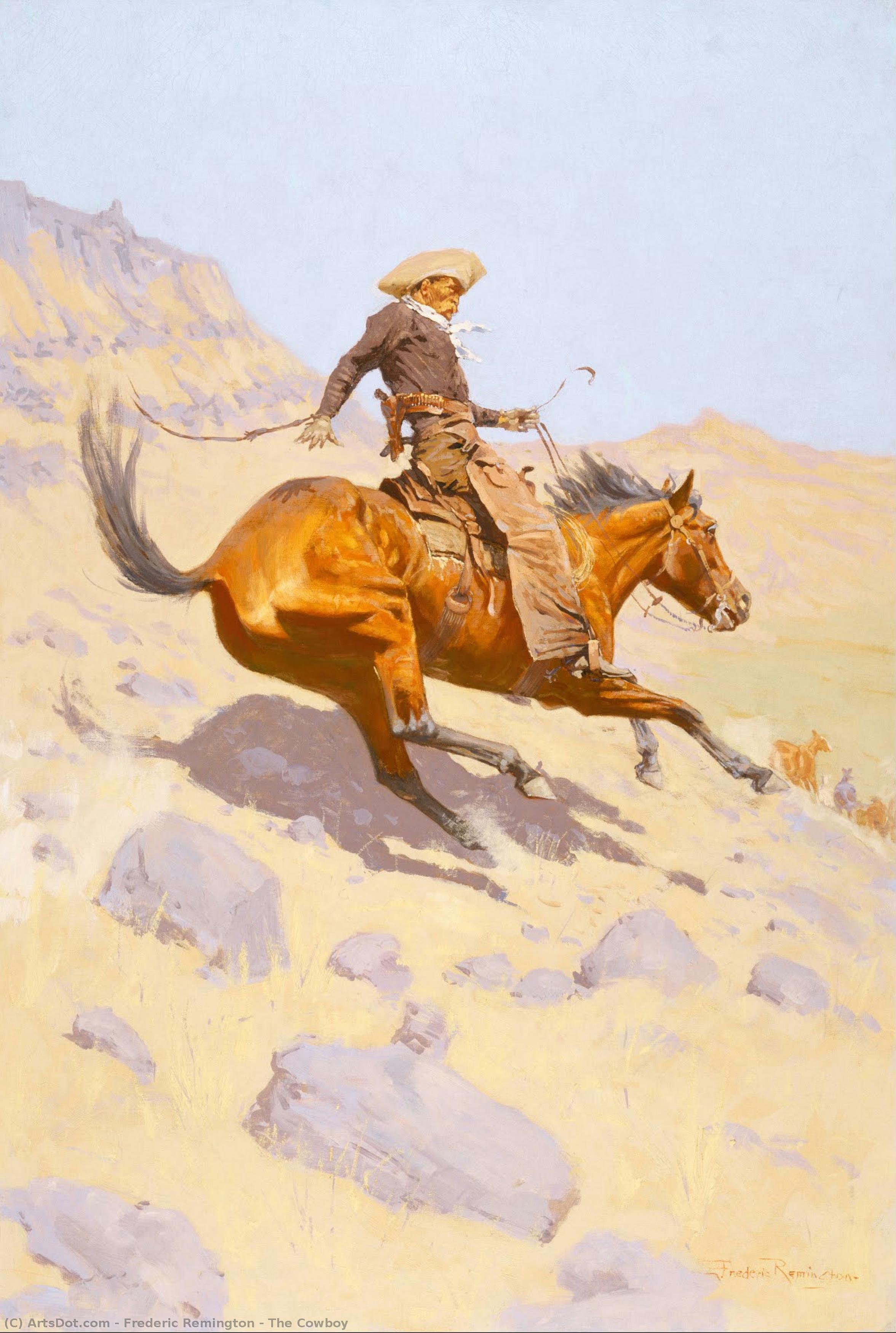
This monumental painting by Frederic Remington portrays a cowboy skillfully riding a horse atop a hill, embodying the adventurous essence of frontier life. Explore Remington’s legacy at Ogdensburg Art Museum and Buffalo Bill Center of The West.
Explore the captivating world of Frederic Remington (1861-1909), master of Western American art! Discover iconic paintings of cowboys, Native Americans & frontier life – a true American legend.
Discover American art at the Amon Carter Museum of American Art! Explore masterpieces by Remington & Russell, plus photography & 19th/20th-century works. Free admission!
A Pioneer's Vision: Frederic Remington’s “The Cowboy”
Frederic Sackrider Remington’s “The Cowboy,” completed in 1902, stands as an enduring emblem of the American West—a landscape rendered with breathtaking detail and imbued with a palpable sense of rugged individualism. More than just a depiction of cowboys on horseback, it's a masterful synthesis of observation, artistic skill, and psychological insight that captures the spirit of a bygone era. Remington’s work cemented his reputation as one of the most influential artists of his time, shaping perceptions of frontier life and establishing a visual vocabulary that continues to resonate today.
The Artist and His Context
Born in Canton, New York, in 1861, Remington wasn't born into the wild expanse he so passionately portrayed; rather, he emerged from an East Coast upbringing steeped in Republican ideals and bolstered by familial connections to the Remington Arms dynasty—a lineage synonymous with firearms manufacturing. Yet, it was a formative encounter with military themes during his youth – fueled by his father’s service as a Civil War colonel – that ignited his artistic ambition and instilled within him a profound appreciation for storytelling. This early exposure would prove instrumental in shaping his distinctive style and guiding him toward becoming arguably the most recognizable artist of the American West. Remington's journey to Bloomington, Illinois, followed by relocations back to Canton and Ogdensburg, New York, solidified his immersion in the burgeoning frontier culture.
Style and Technique: Impressionistic Realism
Remington’s artistic approach defies easy categorization, blending elements of Impressionism with a rigorously realistic rendering of the American landscape. He eschewed the hazy atmospheric effects favored by many Impressionists, opting instead for sharp delineation and meticulous attention to texture—a technique honed through extensive sketching expeditions into the Yellowstone National Park region. The painting utilizes broad brushstrokes to convey the grandeur of the mountainous terrain, contrasted against the subtle shading that sculpts the cowboy’s form and imbues the horse with a sense of movement. Remington's masterful use of color contributes significantly to the artwork's emotional impact, capturing the golden hues of twilight as the cowboy surveys his domain.
Symbolism: Courage, Resilience, and Connection to Nature
“The Cowboy” transcends mere topographical representation; it embodies profound symbolic meanings rooted in the ethos of the American West. The cowboy himself represents courage, resilience, and independence—qualities admired throughout the frontier communities. His posture exudes confidence as he commands his horse, symbolizing dominion over both the physical landscape and inner resolve. Furthermore, the horse serves as a conduit to nature, mirroring the cowboy’s connection with the wilderness. Remington's deliberate composition reinforces this symbolism, positioning the figure against the backdrop of towering mountains—a visual declaration of humanity's place within the vastness of the natural world.
Emotional Impact: Nostalgia and Romantic Idealism
The painting evokes a powerful sense of nostalgia for a romanticized vision of the American West – a period characterized by exploration, hardship, and heroic endeavor. Remington’s skillful depiction captures not only the physical beauty of the landscape but also its psychological significance—the feeling of solitude, contemplation, and awe experienced by those who dared to venture into uncharted territory. “The Cowboy” remains an enduring testament to Remington's artistic genius and his ability to translate emotion onto canvas, transporting viewers back to a time when the frontier spirit reigned supreme. Its timeless appeal continues to inspire artists and collectors alike, securing its place as one of the most iconic images of American art history.