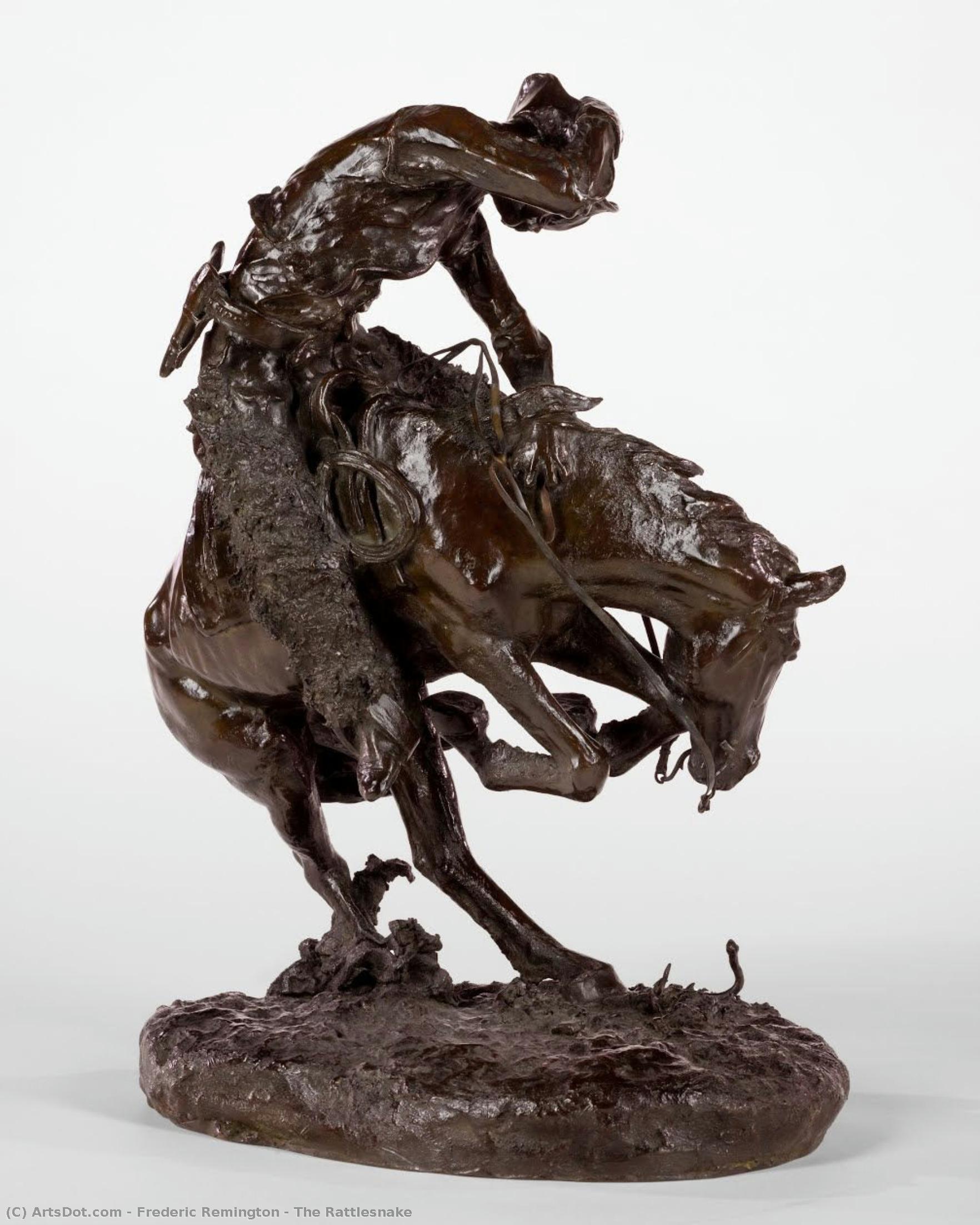
The Rattlesnake

Experience Frederic Remington's masterful bronze sculpture 'The Rattlesnake,' capturing the exhilarating dynamism of cowboy riders galloping across the American West in 1908 – a timeless testament to frontier spirit and artistic brilliance.


Frederic Remington (1861 - 1909)

Explore the captivating world of Frederic Remington (1861-1909), master of Western American art! Discover iconic paintings of cowboys, Native Americans & frontier life – a true American legend.

Amon Carter Museum of American Art (Fort Worth, United States of America)

Discover American art at the Amon Carter Museum of American Art! Explore masterpieces by Remington & Russell, plus photography & 19th/20th-century works. Free admission!

A Portrait of Grit and Motion: Frederic Remington’s “The Rattlesnake”

  • Subject Matter: Frederic Remington's "The Rattlesnake," completed in 1908, captures a quintessential scene from the American West – a cowboy astride a horse galloping across rugged terrain. The sculpture meticulously portrays the dynamism of this moment, embodying the spirit of exploration and resilience characteristic of the era.
  • Style: Remington’s style is firmly rooted in Romantic Realism. While grounded in observation of the natural world and accurate depiction of equine anatomy, he infused his work with expressive brushstrokes and dramatic lighting that elevate it beyond mere representation. This stylistic choice prioritizes conveying emotion and capturing the essence of the subject rather than striving for photographic precision.
  • Technique: Crafted from bronze, “The Rattlesnake” exemplifies Remington’s mastery of sculptural technique. The artist employed a lost wax casting method—a process favored during his time—resulting in a remarkably detailed and textured surface. Careful attention was paid to capturing the musculature of both the cowboy and horse, achieved through painstaking modeling and polishing. The bronze patina developed over time contributes to the sculpture’s rich aesthetic qualities.
  • Historical Context: Remington's work emerged during a period of significant transformation in the American West—the waning days of frontier expansion and the consolidation of civilization. He documented the lives of cowboys, Native Americans, and ranchers with unflinching honesty, reflecting both admiration for their courage and critique of societal injustices. “The Rattlesnake” stands as a testament to Remington’s role as a chronicler of this pivotal moment in American history.
  • Symbolism: The rattlesnake itself serves as a potent symbol—representing danger, vigilance, and the untamed wilderness. Coupled with the cowboy's posture of determination and forward movement, the sculpture communicates themes of perseverance against adversity and embodies the spirit of conquering challenges. Furthermore, the rifle symbolizes protection and preparedness, reflecting the realities of frontier life.
  • Emotional Impact: “The Rattlesnake” evokes a palpable sense of energy and excitement. The sculptor’s skillful rendering of movement inspires contemplation on themes of freedom, adventure, and the enduring connection between humanity and nature. It's a piece that resonates with viewers seeking inspiration from the grandeur of the American landscape and celebrating the bravery of those who inhabit it.