A Call to Valor: The Urgent Typography of Freedom
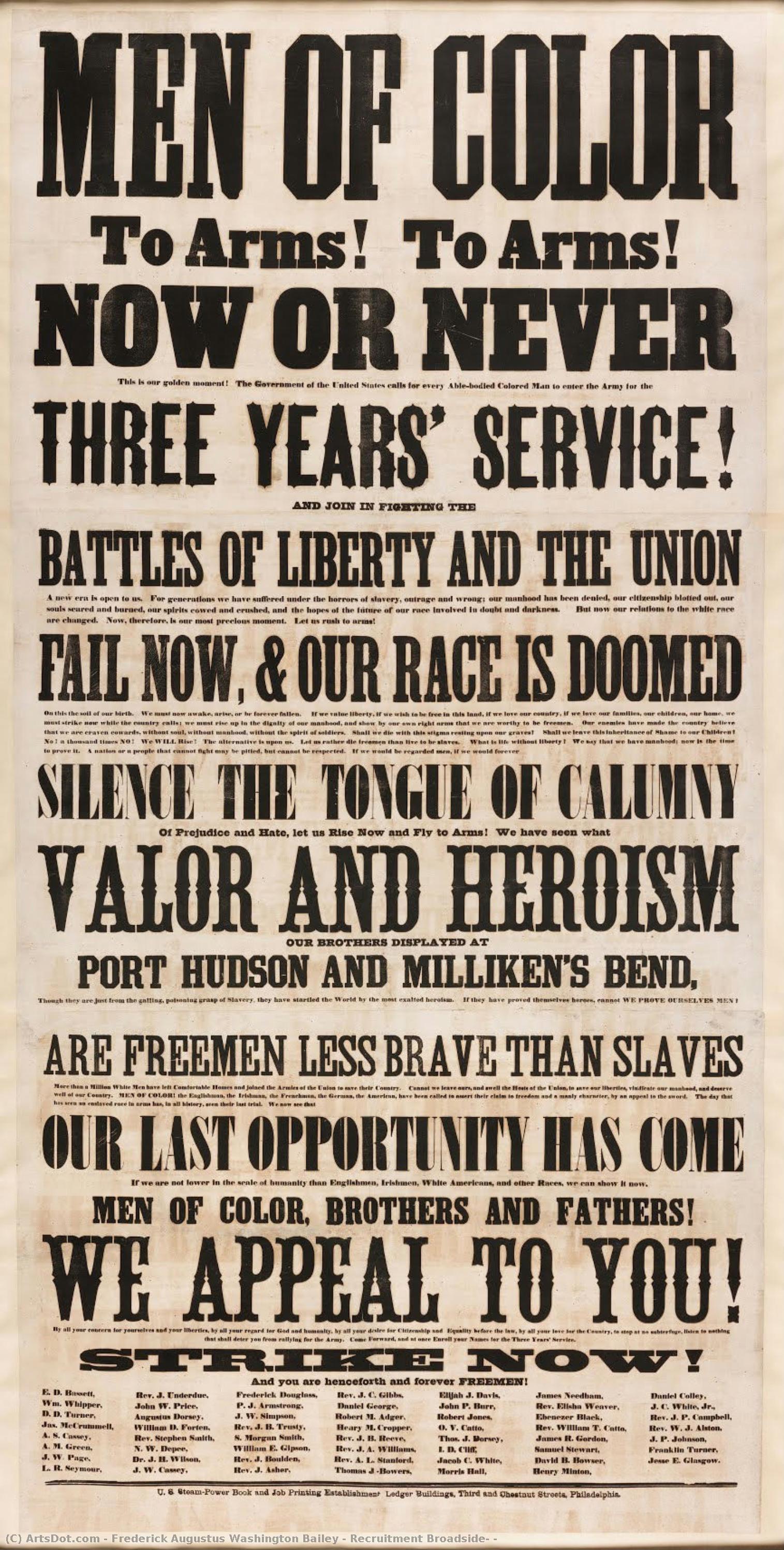
In the turbulent landscape of 1863, amidst the smoke and profound struggle of the American Civil War, certain artifacts emerged not merely as paper and ink, but as clarion calls for justice. The Recruitment Broadside, a powerful piece of historical propaganda associated with the era of Frederick Douglass, stands as a visceral testament to this period of transformation. This work is not a traditional painting of landscapes or portraits, but a masterclass in typographic urgency. It serves as a stark, dramatic visual command, designed to pierce through the chaos of war and rally African American men to the cause of the Union Army. The composition is vertically oriented, utilizing a dense, layered arrangement of text that creates a rhythmic, almost percussive reading experience. Every bold, sans-serif letter acts as a heartbeat of resistance, demanding attention through its sheer scale and unapologetic presence.
The aesthetic power of this broadside lies in its deliberate simplicity and the dramatic interplay between light and shadow. Set against a deep, somber background that borders on black, the lettering leaps forward with an almost luminous intensity. This high-contrast approach ensures that the message—"MEN OF COLOR To Arms! NOW OR NEVER!"—is impossible to ignore. The technique, reminiscent of woodblock printing or lithography, lends the piece a rugged, tactile quality. There is a beautiful imperfection in the slightly uneven texture and the limited color palette, which evokes the grit and raw emotion of the mid-19th century. For the collector, this piece offers more than just visual interest; it provides a window into the soul of an era defined by the fight for human dignity.
Symbolism and the Weight of History
Beyond its functional purpose as a recruitment tool, the broadside is rich with symbolic weight. The very structure of the text—the varying sizes and fonts—creates a hierarchy of importance that mirrors the escalating stakes of the conflict. The phrase "THREE YEARS’ SERVICE" is not merely a logistical detail; it represents a profound commitment to a future where liberty might finally be realized. The use of blocky, rectangular shapes and heavy lines conveys a sense of stability and strength, qualities essential for those being called to defend a nation in flux. It is an art of mobilization, where the typography itself becomes a weapon of persuasion.
To possess a reproduction of such a piece is to hold a fragment of the struggle for emancipation. For interior designers and curators, this work offers a profound way to introduce historical gravity into a space. It functions beautifully as a focal point in a gallery-style setting or as a sophisticated accent in a study dedicated to history and social justice. The piece does not merely decorate a wall; it commands the room, inviting contemplation on the themes of bravery, sacrifice, and the enduring pursuit of freedom. It is an evocative addition for anyone seeking art that possesses both historical depth and a timeless, commanding aesthetic.