A Moment of Vigilance: Exploring “On Outpost Duty” by Georg Friedrich Kersting
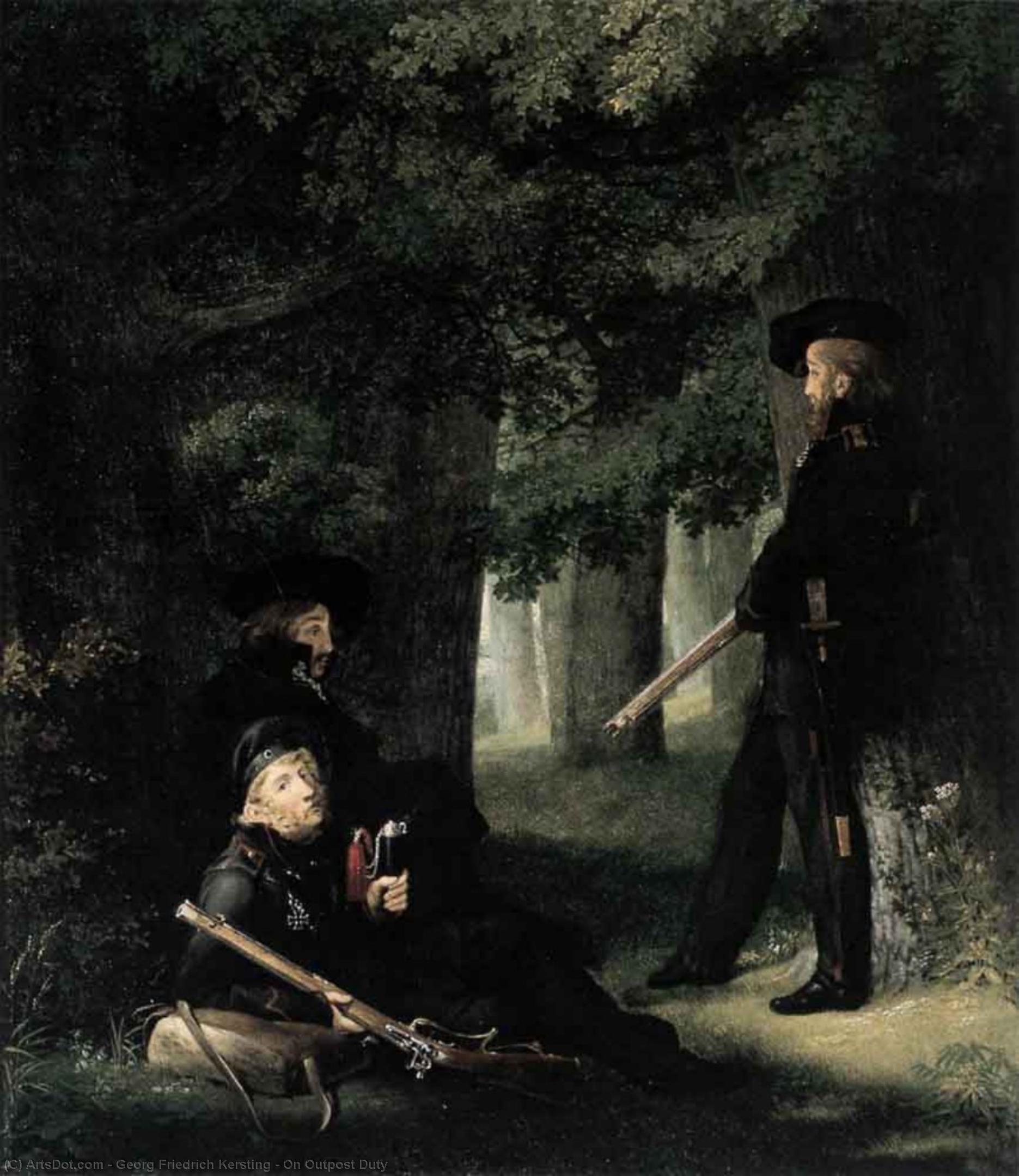
Georg Friedrich Kersting’s “On Outpost Duty,” painted in 1815, is more than a simple depiction of three Prussian rangers; it's a carefully constructed tableau of duty, contemplation, and the subtle anxieties inherent within military life. Rendered in the restrained elegance of the Biedermeier style – a movement characterized by its intimate realism and focus on everyday subjects – the painting immediately draws the viewer into a shadowed forest clearing, imbued with a palpable sense of quiet intensity.
The scene unfolds around a seated figure, identifiable as Kersting himself, holding a rifle and a small pouch. His posture is one of deliberate watchfulness, his gaze fixed on an unseen horizon. Beside him stand two other men, engaged in conversation, their faces etched with the weight of responsibility. The composition’s verticality – dominated by the imposing trees that frame the scene – creates a powerful sense of enclosure and reinforces the feeling of being trapped within this watchful vigil. The muted palette of browns, greens, and blacks contributes to an atmosphere of somber seriousness, suggesting both the harsh realities of military service and the inherent solitude of such duty.
The Biedermeier Aesthetic: Intimacy and Observation
Kersting’s work firmly resides within the Biedermeier tradition, a reaction against the grandiosity of Neoclassicism. Biedermeier art prioritized domestic scenes, landscapes, and portraits that reflected the lives of ordinary people – a deliberate shift away from overtly heroic or historical subjects. This emphasis on observation is strikingly evident in “On Outpost Duty.” Kersting doesn’t romanticize warfare; instead, he presents it with a quiet realism, focusing on the psychological state of his subjects rather than dramatic action. The painting's intimacy stems from its detailed portrayal of human interaction and the subtle nuances of facial expression – elements that were central to the Biedermeier aesthetic.
The artist’s meticulous attention to detail is further emphasized by the use of light and shadow. A directional light source casts deep shadows, highlighting the textures of the trees and the faces of the men, adding depth and a sense of realism to the scene. The careful blending of paint creates a slightly rough surface, mirroring the ruggedness of the landscape and reinforcing the painting’s overall atmosphere of quiet vigilance.
Symbolism and Historical Context
“On Outpost Duty” was created during a period of significant upheaval in Europe – the Napoleonic Wars and the subsequent efforts to restore the German monarchy. The Prussian rangers depicted in the painting were part of the forces that fought against Napoleon’s invasion, embodying themes of patriotism, duty, and sacrifice. The rifle held by Kersting himself is not merely a weapon; it represents the burden of responsibility and the potential for violence inherent within military service. The small pouch suggests provisions and perhaps even personal belongings – reminders of the lives left behind.
Furthermore, the painting’s setting—a dense forest—can be interpreted as a metaphor for the uncertainties and dangers that lie ahead. The trees, silent witnesses to countless battles, symbolize both protection and confinement. The act of watching, of being on outpost duty, becomes a symbol of vigilance against an unseen threat.
A Legacy of Quiet Realism
“On Outpost Duty” stands as a testament to Kersting’s skill as a painter and his ability to capture the complexities of human experience within a limited palette and restrained style. It's a poignant meditation on duty, solitude, and the subtle anxieties of military life—a work that continues to resonate with viewers today. Reproductions of this evocative painting offer a glimpse into a pivotal moment in European history, rendered with remarkable sensitivity and artistic integrity.